Why confidence is missing ingredient to pulses sector
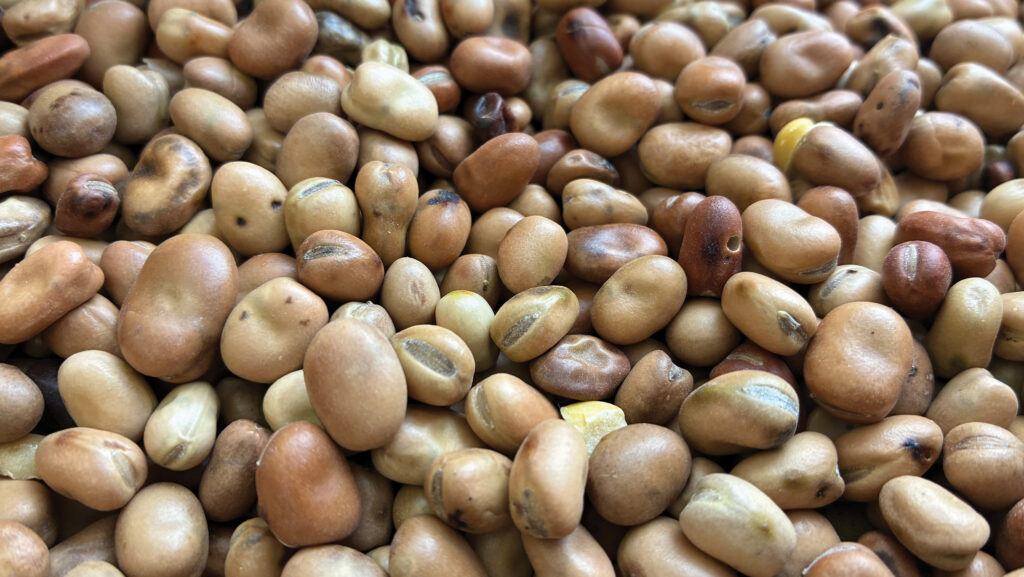 Unprocessed faba beans © BritPulse
What if pulses and grain legumes became the true foundation of UK arable rotations?
Historically, these crops were central to cropping, providing vital soil fertility long before the advent of synthetic fertiliser.
“If there is a single intervention to promote resilient cropping rotations, it is growing pulses, says John McArthur, chief executive of BritPulse, a UK feed ingredient business focused on reducing the livestock sectors dependence on imported soya bean meal with home-grown pulses.
“Pulses are adaptable and can be geared towards the feed or food system. In terms of resilience, they are an outstanding opportunity,” he adds.
See also: Why mixed farming could help future-proof arable farms
Gross margins worth having
In 2023 there was 4.3m hectares of cropping in the UK, of which 275,000ha was dedicated to pulses.
However, that area fell substantially driven by the introduction of the Sustainable Farming Incentive (SFI) legume fallow option (NUM3).
“If we were to dedicate 20% of the UK’s arable cropping to pulses, we are looking at an area of 875,000ha capable of producing 3m tonnes of pulses,” says John.
To make this transition viable, the industry needs a greater focus on production practise to improve yields and profitability.
Currently, the UK average yield for beans is about 3.4t/ha, but biophysical potential is up to 13.7t/ha.

John McArthur © BDC
Based on a yield of 3.4t/ha, this delivers a gross margin in the region of £450/ha, before considering the yield benefit to the following crop.
If we push that average yield to 5t/ha, the numbers change significantly, generating a £840/ha gross margin.
“Growers in the Adas Bean YEN already average around 5t/ha and the top quarter average 6.3t/ha.
“Factoring in a 0.9t/ha yield benefit for the following winter wheat, worth an additional £185/ha, we are now talking about a crop that meaningfully contributes to the arable enterprise,” says John.
Benefits of growing pulses and legumes across 20% of UK arable rotation
- 14% reduction in synthetic N used in British rotations
- 50% reduction in imported soya bean meal in livestock rations
- This will cut 3.3m tonnes CO2e a year
- +16% soil aggregation in diversified rotations, with 21% more microbial biomass
- More than two times higher bumblebee density after flowering in landscapes containing faba beans. In return, faba bean yield is 33% lower without insect pollination
But where is the market?
Kickstarting the movement to greater pulse production very much depends on demand.
We know processed pulses in livestock diets reduce dependence on imported soya bean meal and reduce feed emissions. The missing ingredient is confidence within the sector.
“Confidence will take time to build, but the industry is beginning to shift.
:For example, 2 Sisters Food Group has committed to removing soya bean meal from the feed of all chickens processed at its Coupar Angus site in Scotland by the end of 2027, with a focus on more home-grown protein,” says John.
A key element to agricultural resilience is adaptability – pulses can serve two distinct markets: feed or food. The development of both must go hand in hand.
“We advocate a ‘feed-first’ approach as this addresses immediate challenges in the livestock sector while providing a substantial market for British farmers.
“With more pulses in the rotation, food opportunities will follow, along with the investment in varieties, agronomy and infrastructure.
“A clear demand signal from the livestock sector will set us on the path to a more resilient food system.”
Businesses such as BritPulse are helping to scale-up British pulse production.
The firm’s pilot plant in north Lincolnshire is processing and supplying faba beans into the poultry feed sector and working with farmers to increase bean production and enhance yields.
From Soya to Sustainability 2027
The NCS Project, a four-year Defra-funded research project, will report on the opportunity for pulses in the UK food system at From Soya to Sustainability on Tuesday 26 January 2027, KingsGate Conference Centre, Peterborough.
Speakers include Baroness Minette Batters and guests from Defra, the NFU, AIC, The Andersons Centre and PGRO.

Farm advice and AI survey