

Advertiser content
Secondary growth in potatoes: Don’t let it steal your yield
Much has been written about the impact of dry, hot weather on spring cereals and oilseed rape, but potatoes are often overlooked when discussions turn to drought stress.
Yet potatoes can be particularly sensitive to fluctuations in moisture and temperature, with one of the most challenging consequences being the development of secondary growth.
In seasons such as this one, where prolonged periods of heat and drought place crops under significant stress, growers may find themselves facing a crop that begins producing a second generation of tubers while the first generation is still developing.
While this can appear to be a sign of continued growth and yield potential, the reality is often rather different.
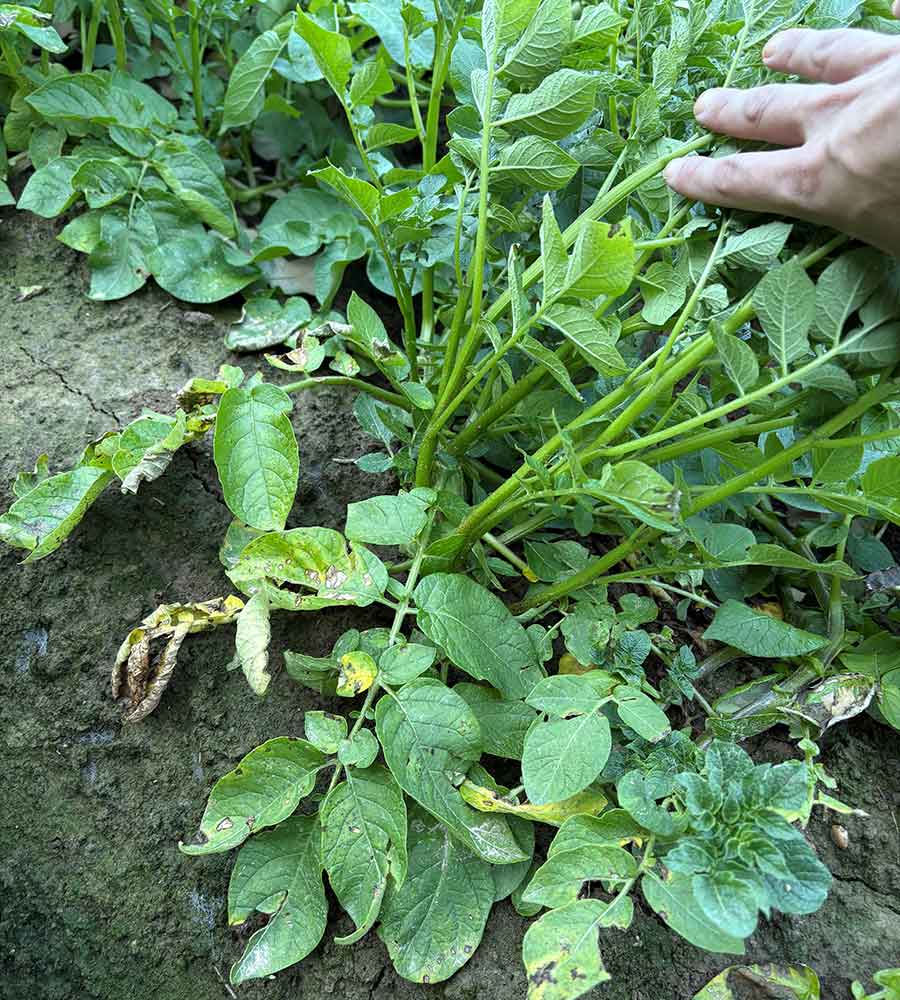
Regrowing potatoes from the leaf buds © Nichino
Why secondary growth occurs
Potatoes respond to environmental stress in much the same way as many other plant species. When conditions threaten the successful development of existing tubers, the plant attempts to maximise its chances of reproductive success by producing new ones.
This phenomenon, sometimes referred to as stress-induced reproductive allocation, is essentially a survival mechanism. A prolonged period of drought can temporarily halt tuber bulking, only for renewed moisture or improved growing conditions to stimulate fresh tuber initiation. The result is two generations of tubers competing for the same finite pool of resources.
From the plant’s perspective, this is a sensible insurance policy. From the grower’s perspective, however, it often creates more problems than opportunities.
Recognising the signs
Secondary growth is not always immediately obvious from the tramline. In many cases, identification requires careful inspection of plants and tubers beneath the soil surface.
However, several above-ground indicators can provide early warnings:
- An unusually dense or prolonged canopy.
- A second flush of vegetative growth following drought relief.
- Extended or repeated flowering.
- Uneven crop maturity across the field.
- Delayed natural senescence.
Where these symptoms are present, lifting a representative sample of plants can quickly reveal whether a second generation of tubers is developing.
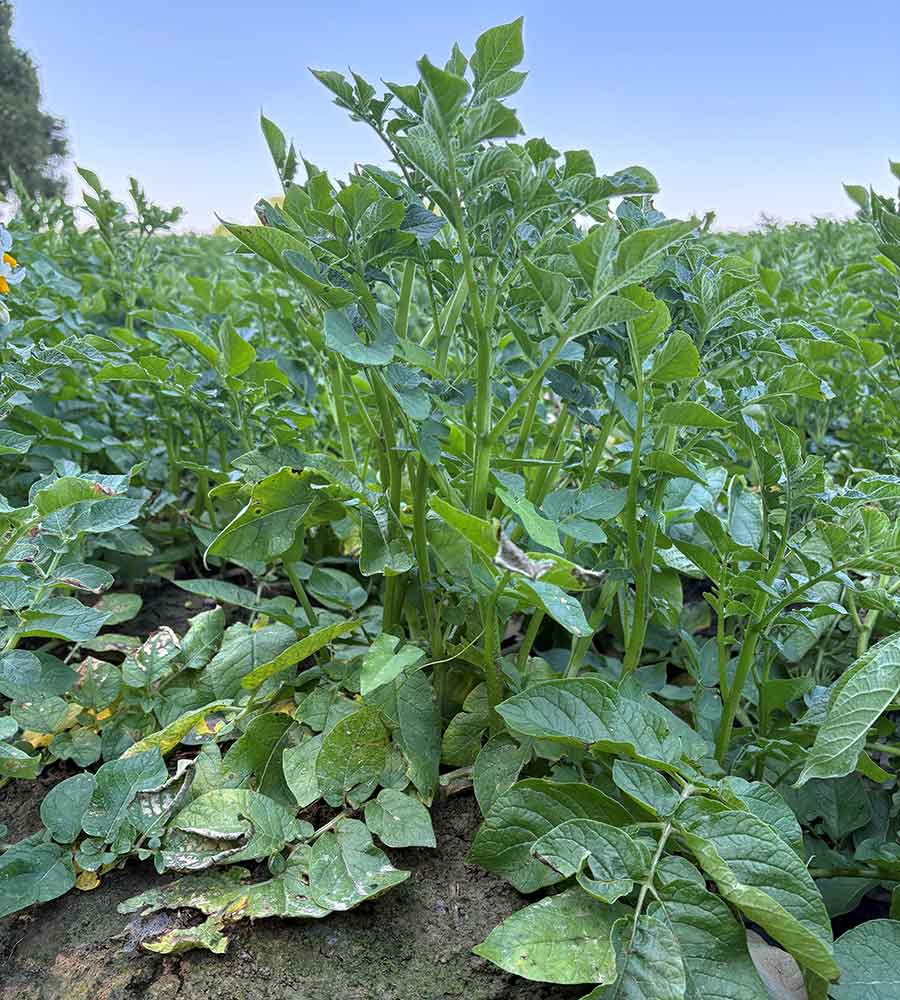
New potato shoots developing from leaf buds © Nichino
The hidden cost of extra tubers
It is tempting to view additional tubers as a potential yield benefit. Unfortunately, secondary growth rarely translates into additional marketable production.
The first generation of tubers has typically captured the majority of the season’s yield potential. More importantly, it has benefitted from the longest period of solar radiation, canopy development and starch accumulation.
The second generation starts at a considerable disadvantage. By the time these tubers are initiated, day length is already decreasing and the crop is moving closer to natural senescence. In most seasons, there is simply insufficient time for them to catch up.
Instead, these younger tubers become a competing sink for nutrients, water and, crucially, assimilated starch.
As the crop matures, resources that might otherwise contribute to maintaining the quality and dry matter of the primary tubers can be diverted towards the later generation.
The consequence is often a wider tuber size distribution, reduced uniformity and lower starch retention in the primary crop.
In short, the first generation is usually where the value lies. Management should be directed towards protecting that yield rather than chasing the unlikely prospect of bringing the secondary generation to marketable size.
Managing secondary growth
Once secondary growth has been identified, timely decision-making becomes increasingly important.
In some situations, Maleic Hydrazide may have a role in limiting further development of secondary tubers. However, timing is critical and applications should be made only with guidance from an experienced potato agronomist.
Poorly timed applications can compromise the very tubers growers are seeking to protect as well the additional cost of the product, which is itself quite expensive.
More broadly, crop management should focus on preserving the quality and starch content of the primary generation while preparing for a carefully managed burndown strategy.
Rethinking desiccation
One of the biggest mistakes in crops affected by secondary growth is to pursue an overly aggressive canopy destruction programme.
Rapid haulm destruction can create unintended consequences. When foliage is removed suddenly, secondary tubers may continue drawing resources from the primary tubers rather than from the gradually senescing canopy above ground.
This can accelerate movement of starch and nutrients away from the marketable crop.
For this reason, flailing can present a particular risk where significant secondary growth is present. While the temptation may be to tackle the substantial canopy with an initial mechanical pass, a gradual and controlled chemical desiccation programme is often the better approach.
The objective should be a managed reduction in green leaf area over time, allowing the crop to shut down progressively. Ideally, around 95% of green material should be removed before lifting, with any remaining vegetation dealt with by the harvester if necessary.
Every situation is different, but the principle remains the same: avoid unnecessarily shocking the crop.
Don’t forget about blight
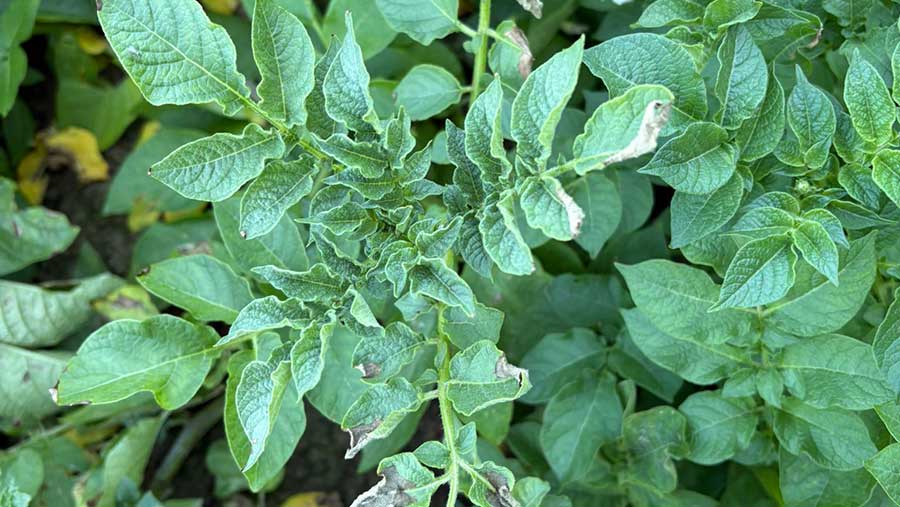
First symptoms of bacterial disease on leaves can be confused with blight © Nichino
Another consideration is disease management.
Where green growth remains active later into the season, particularly if rainfall returns, the risk of late blight can persist far longer than originally anticipated.
Dense canopies associated with secondary growth can create ideal microclimates for disease development, making continued monitoring essential.
In affected crops, previously planned blight programmes may need adjustment to reflect the prolonged period of active growth. Close consultation with your agronomist is advisable to ensure protection is maintained for as long as required.
Timing is everything
Above all else, avoid delaying lifting longer than necessary.
Every additional day between crop maturity and harvest creates an opportunity for resources to continue moving towards younger, less valuable tubers.
While the temptation may be to wait for secondary tubers to size up, this is often a false economy.
The reality is that many of these later-formed tubers will never achieve marketable size. Meanwhile, the primary generation which carries the bulk of the crop’s economic value risks losing starch and quality.
When secondary growth occurs, the most profitable strategy is usually not to maximise the second generation, but to preserve the first.
In a season characterised by heat and moisture stress, recognising secondary growth early and adapting management accordingly could make the difference between protecting yield and watching it gradually migrate into a crop of undersized, unmarketable tubers.

Oliver Johnson, Commercial Technical Manager, Nichino Europe Co., Ltd. © Nichino
For more potato-growing insights and seasonal agronomy updates, visit www.nichino.uk and follow us on Instagram and X @NichinoUK.
Provided by
Nichino UK specialises in the development and supply of high-quality crop protection, adjuvant and biostimulant products that are recognised not only for their targeted performance, but for their flexibility and ease of application – ideal for use with today’s environmentally conscious agricultural practices.