Soft rubber beats autumn erosion
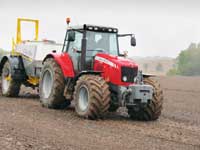
Tramlines can account for more than 80% of surface run-off, but this can be reduced by selecting the correct tyres for sprayers, as James Andrews found out
Low ground-pressure tyres could half the amount of surface run-off and soil erosion following autumn spray applications, a recent study has found.
Michelin Xeobib tyres used in the HGCA and DEFRA LINK-funded project were the most effective method of reducing soil compaction, erosion, and nutrient losses down tramline wheelings, said Martyn Silgram, senior researcher for ADAS.
Although tramlines only covered a small area of the field they were the greatest contributor to run-off, he told visitors to a Farming Futures event at Loddington, Northamptonshire, last week. “Previous ADAS research has shown they can account for over 80% of the surface run-off from cereal fields.”
This run-off was measured with a Massey Ferguson 7480 and 3500L trailed Chafer sprayer on both standard and low ground-pressure tyres.
Correctly-inflated Michelin Xeobib tyres on the sprayer unit gave the most significant reduction in compaction and surface run-off, he said. “This means there is less risk of nitrogen, phosphate, sediment and surface-applied products such as pesticides leaving the field and entering water courses.”
Traction was also improved, which reduced wheel slip, smearing of the soil surface and fuel costs.
The effect of unplanted tramlines was also addressed in the study, said Dr Silgram. “We wanted to find out if it was a lack of ground cover in tramlines or compaction that caused the run-off.”
Treatments compared the effect of autumn spray operations using conventional bare tramline wheelings, against drilling the whole field and leaving tramlines unmarked, or using low ground-pressure tyres in both situations. Soil sediment running off tramlines on 100m-long slopes was collect at three sites with clay, silty clay loam and loamy sand soils.
But drilling the whole field without tramlines and spraying using GPS had no consistent effect on surface losses, he noted. “The small amount of vegetation in the wheeling had no effect on compaction and run-off and, as you still have to traffic the field during autumn spraying, the conventional tyre configuration caused the same level of compaction.”
Drilling tramlines also meant paying for additional seed that would be killed by constant trafficking, he added.
The study continues this year with two additional techniques being tested. The first is a small Simba spiked harrow which attaches to a toolbar on the back of the sprayer. This scuffs the soil surface behind the rear tyres, says Dr Silgram. “It creates small, shallow holes that should help water to infiltrate while not affecting trafficability.”
The second is a tramline profiler that lifts the compaction in wheel marks, producing a concave mound which sheds water back into the crop area. “The downside is that, due to draft requirements, the profiler requires a separate operation after spraying.”
This meant there would have to be a significant incentive, such as points under the Environmental Stewardship scheme, for growers to adopt it, he said.
Other practical measures to mitigate the risk of run-off and losses down tramlines included increasing tramline spacing, and avoiding travelling in unsuitably wet soil conditions, he added.

Staying sharp shouldn't be a chore


Staying sharp shouldn't be a chore