Superabsorbant granules help potato crops cope with drought
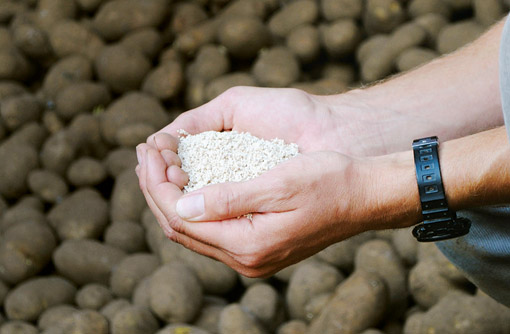
The Environment Agency’s latest drought update makes for heavy reading. The 12 months up to January was the eighth driest year since records began.
A combination of persistent dry weather and the continuing decline in groundwater levels and river flows prompted the EA to last month designate the south-east of England as officially in drought. Parts of the Midlands and central England are now at risk.
Growers are being encouraged to set up water abstractor groups and on-farm storage, to avert the need for irrigation restrictions later in the season.
That threat is prompting a dozen or so potato growers in East Anglia and the Midlands to try a novel approach to moisture conservation imported from America and trialled here in 2010 by an agricultural student.
Andrew Peal, then studying at the University of Reading, was encouraged to test Zeba – a starch-based granular product that absorbs up to 400 times its weight in water – under UK conditions. He used sites on different soil types across Norfolk on which to incorporate it alongside tubers at planting, and measured its effect on tuber yield and quality.
“I applied the US standard rate of 10kg/ha of Zeba through a Horstine granular applicator attached to the four-row Grimme planter, leaving some rows without it. I harvested the treated and control rows just after crop desiccation in mid-October,” he explains.
The results he obtained were comparable to those seen in the USA. Plots of maincrop chipping variety, Lady Olympia, yielded an average of 7.4% extra where Zeba was present. And 5% more tubers fell within the two largest grade bands – 50-70mm and 70mm+
While Mr Peal acknowledges one season is insufficient on which to make judgements, he believes the product offers great potential.
“Zeba has a recommended price of £20/kg. But the margin over cost was £258/ha, and if we’d held on to the tubers longer, we’d have got nearer £544/ha. The 2010 season actually had above average rainfall – I’d expect an even better response in drought years.”
The only drawback he can see is, ironically, moisture in the air. It’s not easy to apply when damp or humid because it turns from a sawdust-like granule to a gel in minutes. He overcame blockages in the trial by flushing graphite powder down the tubes of the applicator before adding the product.
“If you can modify the applicator’s tubing to minimise the bends, and have the time to clear blockages if they should occur, it’s worth a shot. I would use Zeba as an insurance policy where drought is predicted, despite its cost. At worst, it should improve tuber uniformity, giving a more marketable yield.”
Product profile
Like a sponge, Zeba holds available moisture that would otherwise evaporate or leach, creating an in-field water reservoir for later use, explains Paul Corfield of PP Products, UK agricultural distributor of Zeba.
That is particularly valuable on free-draining sandy soils, but on any soil it can reduce the need for irrigation, he says.
“One kg of Zeba can hold 400 litres of water. That’s not only useful in times of drought, but it prevents water-soluble nutrients such as nitrogen and phosphorus being leached out of the rooting zone of tubers. The University of Florida found leachate was reduced by a fifth where the product was used.”
In the USA and UK, it is used for golf courses, forestry and high-value crops such as onions and potatoes. It has a recommended retail price of £20/kg, which works out at £200/ha for potatoes.
Mr Corfield claims Zeba improves yield by 4-7%, depending on the season. Tuber values would have to be less than £50/t not to justify its use, he believes.
Manufactured from plant starch, Zeba offers a sustainable field management tool. The superabsorbent granular formulation, patented and made in the USA, is non-toxic, pH neutral and biodegradable. Within 12-18 months, Zeba is consumed by micro-organisms in the soil.
The product can be applied with all standard granular application equipment.
Other links