Tillage-Live 2011: Pesticide run-off solution
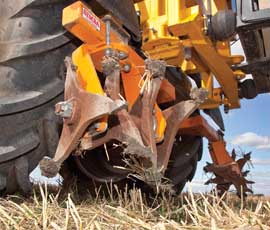
Intervention with innovative kit can significantly decrease the risk of surface run-off following autumn field operations, new results from a HGCA and DEFRA-funded LINK project suggested at Tillage Live.
Initial research found that tramlines could account for more than 80% of surface run-off from cereal fields, so the project has been investigating how to minimise run-off from arable fields.
Trials in 2010-11 found both a small Simba spiked harrow that attaches to a toolbar on the back of the sprayer and a surface profiler designed by Charles Creyke of Aqua Agronomy, significantly reduced surface run-off, said Martyn Silgram, a senior researcher at ADAS, who leads the project.
“Both are an alternative option that alleviates surface run-off following autumn operations,” he said.
Previous work in the project had shown that using correctly inflated low ground pressure tyres could also minimise the risk of run-off.
Both mechanical options had worked more effectively in trials on various soil types than using low ground pressure tyres with the surface profiler being especially effective.
That was a combination of two bent subsoiler legs, which worked to a depth of around 8in, and were adjustable to the width of the tramline, explained Mr Creyke. “They create a drainage channel that goes under the crop.”
Following behind were two rollers with “teeth”. “They create indents in the tramline above the entry to the drainage channel, so water enters the indent and drains down the channel.”
The rollers were unique, he said. “They have a concave shape, which leaves a convex impression to the centre of the tramline and are offset by 20°. That means they slip/slide which helps them self-clean.”
But, in addition, they were made from a hard-wearing plastic that was specially formulated to self-clean, he said.
In one of the trials, less than 100 litres of water, or just 2% of the rainfall, had run-off following its use after post-emergence spraying compared with around 5,000 litres, or 24% of rainfall, in the control treatment.
That compared with approximately 1,500 litres of water (6% of rainfall) when using the spiked harrow cultivator. The rotating tines, again off-set to help with cleaning and water infiltration, are placed behind the wheels of the sprayer and set to make pock marks in the tramline.
The advantage, said Dr Silgram, was the spiked harrow did not require a second operation and tests had shown it did not slow the sprayer down, require any extra horsepower or cause wheel slip during future operations.
Controlled traffic farming
Confining traffic to the least possible area on fields was another way of reducing the risk of run-off, Tim Chamen of Controlled Traffic Europe said.
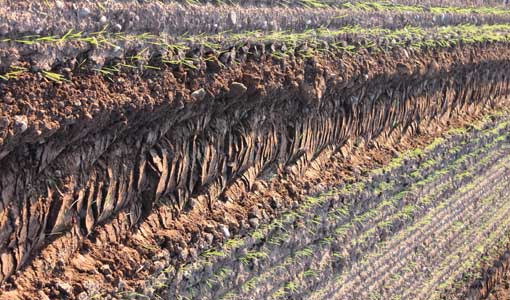
Badly damaged or compacted soils resulting from the use of heavier machinery had implications for not just seed-bed preparation but also for what happened to the water that fell on to it. Non-trafficked soils had four times the infiltration rate than trafficked land in trials, he said.
“Water is more likely to run-off or sit on the surface if the soil is compacted, and then your soil won’t function well. And if you’re not getting the full winter recharge [because water is not draining effectively] then you lose out, particularly in dry springs like the one we just had.”
Controlled traffic farming tried to address that issue by creating permanent tramlines and confining compaction to a known area. “Research has shown that crops can yield 10% more using the same amount of fertiliser when it is not trafficked.”