How sprinter wheats can extend drilling window to spring
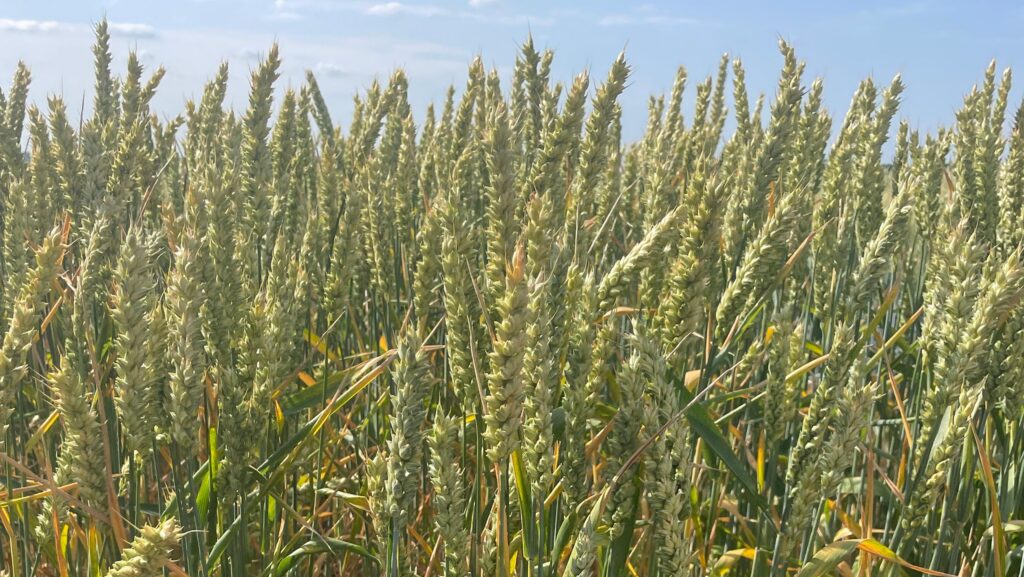 STR Pace sprinter wheat © MAG/Richard Allison
 Recent autumns have proven that delaying drilling much beyond the end of October increases risk as weather shuts down opportunities, especially on heavier soil types.
But there is always a late drilling window – it’s just knowing whether the variety in the seed bag is still suitable for drilling at that time, with many winter wheat varieties having a latest sowing date of the end of January and a corresponding drop off in performance.
See also: How trial is cracking calcite problem in high-calcium soils
Finding varieties that are as suitable for drilling from mid-October through as late as a traditional spring wheat variety was one of the key criterium in developing “sprinter” wheats, says Agrovista arable seed manager Ted Wiliams. The first will be widely available through the seed trade this autumn.
In particular, the search was for looking for varieties that could fit situations as diverse as delaying drilling for weed, disease or barley yellow dwarf virus management reasons to drilling after root crop harvests, as well as traditional spring wheat situations.
“No breeder in the UK had anything like that in their plans,” Ted says.
“So we looked outside of the UK and found that German breeder Strube, now part of RAGT, was working on a similar concept.”
What are sprinter wheats?
Sprinter wheats are winter varieties crossed with spring wheat, backcrossed with winter wheats to create individual lines that are genetically different to most other available winter wheats, Ted explains.
With no vernalisation requirement, while still being winter hardy, these wheats can be drilled across a wide window from mid-October to the spring, he says.
Candidate varieties from the Strube programme are trialled in the UK for suitability – for example, does resistance to yellow rust hold up against the different yellow rust races in the UK compared with Germany – before being entered into two years of Variety List trials.
With drilling of winter wheat AHDB Recommended List (RL) trials beginning before the earliest recommended drilling date for sprinter varieties, it didn’t make sense to put them into the winter wheat RL programme.
“They’d be far too vigorous and too quick out of the ground,” Ted says.
Instead, the varieties are entered into the spring wheat RL trials, in lieu of a specific alternative wheat category.
The first variety to emerge from the project is STR Pace, a Group 1 milling wheat, which was added to the spring wheat RL in 2025.
Seed available
After a small test market in the current season, commercial quantities of seed will be widely available this autumn.
“There are a multitude of companies with seed available including buyback contracts after a C1 seed launch last season,” Ted confirms.
STR Pace’s yields within the RL trialling system are 1% behind Harsum with higher protein content (13%) and a specific weight of 80.6kg/hl – the best of any spring wheat on the RL.
In Agrovista’s trials at its AgX sites, the firm compared STR Pace with Skyfall drilled in November at two sites.
At Lamport’s heavy clay soil in Northamptonshire, STR Pace yielded almost 1t/ha more than Skyfall, while on the high-yielding silt soils at Haddenham in Cambridgeshire, the advantage was nearly 0.6t/ha, with higher specific weights at both sites.
Three years of UK Flour Millers testing has shown good gluten quality and baking performance, with good water absorption, which is a positive indicator for flour usability.
Nitrogen strategy
Nitrogen management to reach protein levels doesn’t differ significantly from other varieties drilled at a similar time, particularly early drilled crops, Ted says.
“Clearly, the earlier you drill, the more nitrogen will be required by virtue that it will yield more, so we would typically advise a standard fertiliser programme as you would use with a comparator variety, like Skyfall, drilled at the same time.”
In the Agrovista “system” trials at Lamport, which tests how rotations, cover crops, cultivations and weed control interact under high blackgrass pressure, STR Pace yielded significantly more than a competitor spring wheat, reaching 9t/ha.
In that situation, the nitrogen required to meet those higher yields, while maintaining protein could be higher than a typical spring wheat, he notes.
“We’ve also seen that it roots well and scavenges a bit more nitrogen, so it is difficult to be too specific with general nitrogen requirements,” Ted notes.
Disease resistance is decent, with a 6 for septoria, 7 for brown rust and 8 for mildew on limited data. Like other spring wheat varieties, it can be infected with yellow rust.
“In trials, it seems to be susceptible early, so you might need an early fungicide to get on top of it. In reality, management of this variety is similar to any other spring wheat.”
While it is a tall variety, it stands well with a growth regulator programme, he adds.
Earlier harvest
A key attribute is its earliness. Later harvesting of spring wheat can put some growers off growing the crop, but STR Pace is particularly early, according to Ted.
“Some of the seed growers have told us it is way earlier than its RL score of -1 compared with Mulika.”
In Agrovista trials, both November and spring-drilled sprinter have been harvested around the same time as winter wheat sown in early October, a good 10-14 days ahead of traditional spring wheat varieties.
That brings several advantages apart from simply opening more following crop opportunities.
“You’re more likely to be able to harvest in better weather, reducing risk of sprouting and reductions in Hagberg Falling Number.
“You should also be able to harvest in drier conditions, meaning that drying costs should be lower than a true spring wheat.”
But while Ted thinks it is unquestionably the number-one option for spring wheat, its real benefit for UK growers is as a late drilled autumn-sown variety, he stresses.
Delayed autumn drilling
None of the agronomic challenges that first drew Agrovista to the sprinter wheat profile have diminished in the years since starting the search, he stresses.
Delayed drilling is still an important tactic to help manage grassweeds, while reducing pressure from barley yellow dwarf virus and key diseases, such as septoria.
“We’re finding more barley yellow dwarf virus pressure and had wheat dwarf virus this season, which has never been an issue. Drilling later is just about the only thing you can do culturally,” he says.
He points out that the potential UK-EU alignment with EU sanitary and phytosanitary (SPS) legislation means farmers could lose more active ingredients, particularly residual herbicides.
If that does happen, particularly without any transition period, growing early drilled autumn cereals will become even more challenging where there are grassweed issues.
“Even without that, there’s a case for growers to take a proportion of their area for this type of variety,” Ted says.
“While my advice would never be to put your entire farm down to STR Pace, if you’re a milling wheat grower, I would look to put the majority of your area into an early drilling variety, like Vibe, and then maybe 25% into the super-late-drilled slot.
“And if you can’t get it drilled in the winter for whatever reason, you know you can still drill it in the spring, eliminating the risk of having to purchase unplanned spring seed.”