Latest winter wheats deliver top yields and early maturity
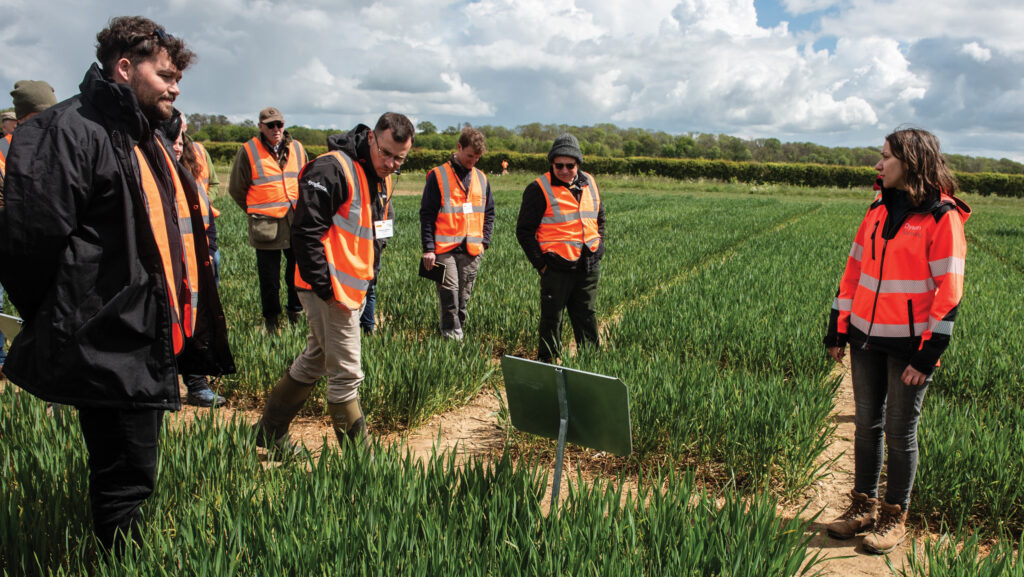 KWS at Arable Insights Live, hosted by Dysons Farming © Phil Weedon
 KWS is bringing a powerful line-up of hard Group 4 winter wheats to growers, with newly recommended KWS Aintree leading the charge, closely followed by early-maturing KWS Fowlmere.
They offer a blend of high output, agronomic strength and practical on-farm benefits, explains Matthew Bull, agroservice manager at KWS.
See also: Caithness farmer grows over 10t/ha spring oat crop
KWS Aintree – new yield leader
New to the 2026-27 AHDB Recommended List (RL), KWS Aintree is the highest-yielding variety on the list, delivering 110% of control yields.
Across three years of official trials, it achieved treated yields of 110%, 111% and 110%, providing the stability growers increasingly need when margins are tight.
“Alongside its yield potential, the variety combines a respectable specific weight of 78.7kg/hl with orange wheat blossom midge [OWBM] resistance,” he says.
As a relatively tall variety with a straw height of 93cm without PGR, KWS Aintree needs managing accordingly and is not suited to early drilling.
It offers a Septoria tritici score of 6.3, alongside mildew and brown rust ratings of 5.
The variety has a low score for yellow rust at 3, but it remains the highest yielding variety on the RL.
“For growers looking to maximise performance from a feed wheat slot, Aintree represents a significant step forward in yield potential,” says Matt.
KWS Fowlmere – earliest maturing
The variety’s standout feature is a maturity rating of -2, making it the earliest-maturing variety on the current RL.
“Its early maturity could mean a week earlier harvest for growers.
“This spreads workloads, eases pressure on combining capacity and creates earlier opportunities to establish following crops such as oilseed rape,” says Matt.
KWS Fowlmere delivers a treated yield of 106% of controls and an untreated yield of 88%.
Grain quality is another major attraction, with an excellent specific weight of 79.8kg/hl and a Hagberg falling number of 299, supporting both domestic and export market opportunities.
“It has the second highest specific weight, across all market segments,” he says.
Combined with OWBM resistance, a septoria score of 6.1 and strong fusarium resistance, KWS Fowlmere offers growers a well-rounded, reliable option.
Candidate varieties: Ones to watch
KWS Checkmate
Looking ahead, KWS Checkmate is generating excitement as a candidate variety.
Early results indicate a treated yield of around 107.7% of controls, but perhaps even more impressive is its untreated yield of 96%, highlighting its good disease resilience.
Checkmate delivers strong grain quality, with a specific weight of 79.7kg/hl.
While further trial results are still to come, the variety is showing the characteristics growers are increasingly seeking high output, strong agronomics and reduced reliance on inputs.
KWS Voyage
This potential Group 2 candidate offers a treated yield of 110% of controls.
Grain quality is good, featuring a robust specific weight of 78.6kg/hl and a 287 Hagberg falling number that exceeds premium commercial specs.
As the breeding company celebrates 170 years of seed breeding, their focus remains on combining long-term breeding progress with the practical performance growers need in the field.
Following publication, this article has been updated to address inaccuracies identified in the original copy. The corrections have now been incorporated in this online version, which supersedes the print edition.
KWS was presenting at Farmers Weekly’s recent Arable Insights Live event hosted at Dyson Farming, providing industry stakeholders with the latest agronomy advice and technology updates.