Precision breeding: Targeted traits or patented problems?
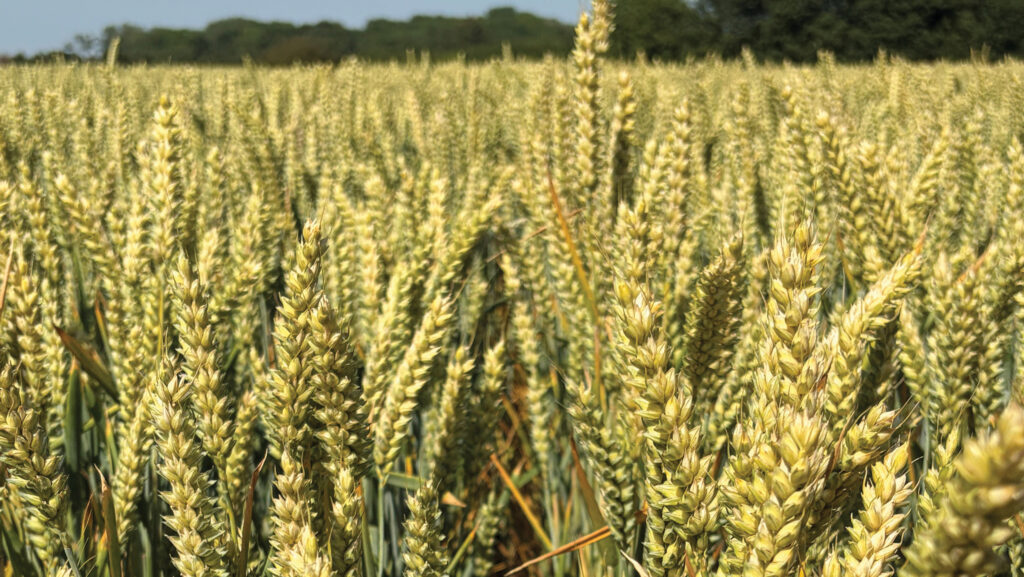 © MAG/Richard Allison
 Do farmers have the necessary information to make informed decisions about growing precision-bred gene-edited crops in the future?
That was the question – albeit one that was only partially answered – posed to a panel of two farmers, a researcher and a civil society advocate with differing perspectives at the Groundswell event this year.
Chairing the debate, Niab’s Dr Elizabeth Stockdale explained that gene-edited crops were a way of introducing a particular genetic mutation linked to a desired trait very precisely more quickly than using traditional selection techniques.
See also: Why gene editing could help growers practising regen ag
To qualify as a precision-bred crop under the Precision Breeding Act 2023 the change must be possible to also occur through natural selection, she stressed. “This isn’t about taking a fish gene and putting it into a tomato.”
Going deeper into the science, Prof Cristóbal Uauy, director of the John Innes Centre in Norwich, explained that there were already about 100 natural changes or mutations in DNA structure in every generation of a wheat plant. “If that didn’t happen there would not be the diversity we treasure so much.
“With precision breeding, we’re aiming to target specifically one location in the genome to make a precise edit with the seed produced having those 100 random mutations plus one extra, which is targeted for a particular trait and is indistinguishable from those that happen in nature,” he said.
He emphasised that gene editing was not a replacement or short cut for good agronomy, soil health or rotations, nor was it the silver bullet to solve the challenges we face. Instead, he said, it should be used to facilitate adoption of desired practices.
For example, by studying the 60% of genetic variability in heritage wheats or land races that has been lost during selections for modern breeding, his team was finding traits that could be used to help assist regenerative farming practices.
Wheat trait
One trait that the John Innes Centre was investigating was looking for wheat plants that associate with mycorrhizal fungi more effectively, which potentially increases the ability to scavenge for nutrients and water from soil, reducing fertiliser requirements.
“There’s a huge amount of variation to how different varieties of wheat respond to mycorrhizal fungi in these land races,” he noted.
“We could bring that in using marker assisted breeding, but it would take a long time and many breeding cycles.
“Or we can take the same natural mutation and put it into a particular line to accelerate that part of the process.”
Lincolnshire farmer Peter Lundgren said that while such technology had enormous potential, he could see worrying parallels with the GMO debate from two decades ago.
Patenting concerns
In particular, he was concerned by the issue of patenting, which is a widespread requirement for commercial GMO crops.
These prevent farmers from legally saving patented crops as seed, or other companies from using them in breeding programmes except under licence. It also left them at risk of being sued, as had happened to Canadian grower Percy Schmeiser, who was found guilty of infringing Monsanto’s patent.
“I don’t think any much has changed legally,” Peter said. “They are still being used to protect corporate interests. My understanding is that some precision-bred traits are already or due to be patented.”
He pointed out the contradiction of patents requiring products to be novel and innovative being used to protect rights while the developer was simultaneously claiming that the variety could be achieved by nature.
“They seem to want it both ways,” he said.
Instead, he wanted such traits to continue to be bred using traditional plant breeding, albeit enhanced using marker assisted selection and gene sequencing.
“Let’s use our expertise to develop novel traits and keep it in the existing royalty system where we are able to farm save our seed and improve on it, if we are inclined to do so.
“And if we as farmers or society desire a trait that cannot be achieved by traditional breeding, we should have a grown-up conversation about how that is achieved and how the developers are remunerated,” he said.
Same registration process
Responding to his concerns, Cristóbal pointed out that he was advocating that gene edited lines go through the same variety registration process as any other variety.
“Why do we need to create a new system if there is a system that already works for farmers, breeders and innovation? We should keep that system,” Cristóbal said.
Pat Thomas, director of Beyond GM, suggested the most critical requirement for farmers was access to accurate, complete and honest information.
“That seems like a ridiculously modest proposal,” she noted.
But she highlighted a recent High Court challenge brought by Beyond GM and others that found the then farming minister Daniel Zeichner was found to be repeatedly misadvised by his advisers who claimed he lacked the powers to implement transparency and labelling measures.
“If he had been properly advised, the court said he might have considered different options. He might have looked more deeply at costs, benefits and trade-offs, the impact on organic farmers, and the practicalities of how regulations that only apply in England, and not in Scotland, Wales or Northern Ireland will work.
“My question is if the farming minister can’t get accurate information, what chance do farmers have?” she said.
A survey conducted by Beyond GM found that eight out of every 10 agroecological farmers – the majority of which were techno-minimalists – felt that gene-edited crops were “not for them”.
“That figure is important as when the Food Standards Agency surveyed consumers, they found the same thing,” Pat said. “Consumers really want these things labelled so they have a choice.”
While Defra consulted last year on a proposed Precision Bred Plant Variety List for England that would potentially make it mandatory for the precision-bred status of a variety to appear on seed labels, it is not close to being enacted, she noted, in reply to a point made by Elizabeth about that type of information being made available to farmers.
On-farm testing
Oxfordshire farmer and British On Farm Innovation Network (Bofin) director Tom Allen-Stevens made the case for farmers to be directly involved in testing and trialling gene-edited crops, noting how in Bofin surveys of its members 80% wanted to grow such crops.
“We, as farmers, could say we don’t want this technology and block it out. It will then be developed by big corporations behind closed doors with IP agreements holding the industry to ransom,” he said.
“Or we could take the technology into the field now, understand how it performs, the benefits and what things are needed to be guarded against.
“That’s the choice we have. I want the second option so we will be in an informed position whether to grow the crops,” he said.
That was what Bofin, as part of two Defra-funded projects, was already doing, with the first precision-bred crops being trialled on commercial farms in England.
“We are trialling these innovations in different systems with different management strategies,” Tom said.
That was important as another Bofin project had identified that the level of mycorrhizal fungi associations, for example, differed hugely across a range of farms from 5 to 70%.
“It shows our soils do vary, which is exactly why we should trial in regenerative, organic and conventional systems to get a greater understanding.”
Peter noted on his farm that the condition of his soils changed with his farming system. “My soils are far more resilient [after implementing regenerative practices]. We’ve had a dry year and my crops are still feeding. There’s still moisture around the roots not many inches down.
“But part of the precision-breeding offer is a drought tolerance variety. I don’t know when I’m picking a variety whether we will have a drought or a flood or in between, so I’m not sure how the technology helps me.
“The way forward is getting the basics right, the soil in good condition, then we won’t need some of these traits because they’re irrelevant,” he concluded.