

Virus-resistant wheat variety finds favour in disease hotspot
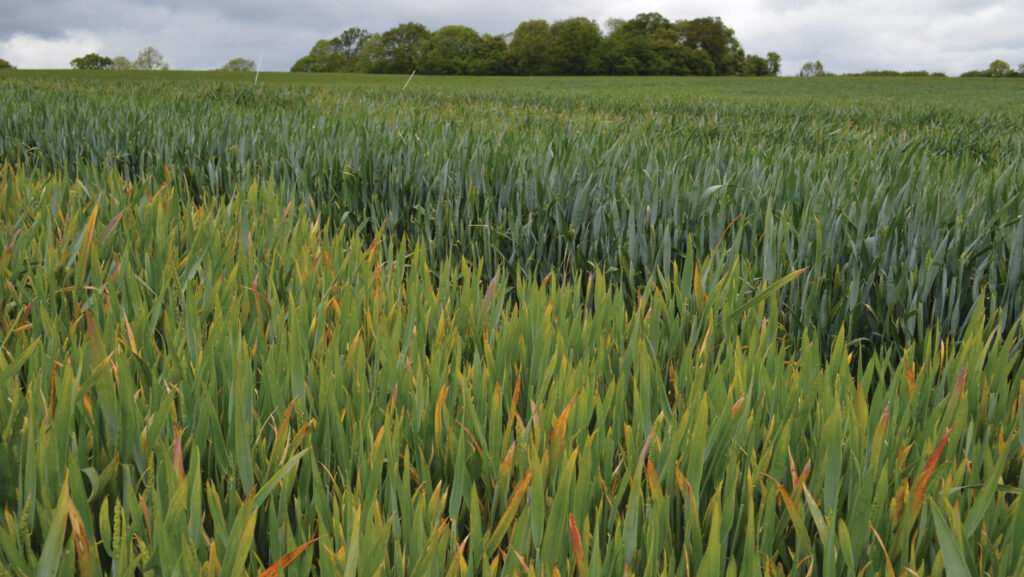 BYDV-susceptible winter wheat variety in the foreground and resistant variety Gorgon in the background © David Jones
 A virus-resistant winter wheat variety is showing promising results on the South Downs in Hampshire producing a good milling grain sample while cutting fungicide and insecticide costs.
The variety Goldfinch is being grown by a number of wheat growers on these chalky uplands, and they are aiming at 10t/ha-plus yields of a Group 2 milling wheat with fungicide costs well below £100/ha.
The variety is one of a line of varieties from breeder RAGT that are resistant to barley yellow dwarf virus (BYDV), and although the AHDB Recommended List (RL) shows it as low yielding with weak straw, it is performing well under good management.
See also: Cereals 2026: BYDV breeding efforts start to bring rewards
The area along the south coast of England is a “hot spot” for the aphid-spread BYDV due largely to increasingly mild autumns, while lots of valleys in the Downs with hedges and trees can support big aphid populations.
Andrew Stilwell, arable technical director of agricultural merchants Bartholomews Agri Food, sees increasing concern over this virus, especially as some growers are reluctant to use insecticides and an environmental payment is linked to non-insecticide use.
“Year-on-year, the problem of BYDV is becoming more noticeable, and this season is one of the worst we have seen,” says Andrew.
Goldfinch performance
He is seeing the variety match the yield of Group 2 mainstay Extase on some of his clients’ farms, while extra plant growth regulator costs for Goldfinch are more than offset by the reduction in fungicide use due to its good resistance to foliar diseases.
On one of his client’s farms in Chalton, south of Petersfield, Andrew is expecting a 10t/ha-plus crop with the aim of hitting 12.5% protein using 250kg/ha of nitrogen, and the short-strawed crop looked very good in mid-May.
He was first attracted to the BYDV-resistant Goldfinch as it could be drilled early – in the second half of September to the first week of October – and also its ability to produce a quality milling sample.
Last season, crops of Goldfinch were grown on a small scale in the area and produced good yields with low fungicide costs and no insecticide costs, with grain proteins of over 11.5%, and he is hopeful this season’s much bigger area will be even better.
BYDV is spread by the bird cherry-oat and the grain aphid and can cut winter wheat yield by up to 60%.
Since the banning of neonicotinoid seed treatments in 2018, chemical control has relied on pyrethroids insecticides.
However, these two aphid species are become more resistant to these insecticide sprays, while early drilling, long mild autumn with the lack of any early frosts is exacerbating the BYDV problem.
Therefore, Andrew was keen to try out the BYDV-resistant variety in an area that already focused largely on quality wheats, such as Group 1 milling varieties and Group 3 biscuit wheats.
Current season
In the current season, where the focus for winter wheat growers has been on yellow rust due to the resistance breakdown of many leading varieties, Goldfinch shows a very high level of resistance to the disease as well as to brown rust, and also good resistance to septoria.
“This year we have not been chasing septoria as the top three leaves are clean, while we have not seen any rust,” says Andrew.
This season, a crop of Goldfinch in Chalton had no T0 fungicide due to its high resistance score for yellow rust, a T1 focused on yellow rust prevention containing a SDHI-azole mix of benzovindiflupyr (Elatus Plus) and prothioconazole, with the strobilurin azoxystrobin added for extra yellow rust protection.
The T2 flag leaf treatment was a broad-spectrum SDHI-azole mix of fluxapyroxad and mefentrifluconazole (similar to Revystar) and the strobilurin pyraclostrobin was added for extra brown rust protection, while a T3 ear spray is set to be prothioconazole.
Andrew’s plant growth regulator (PGR) programme is a touch more intensive than for other winter wheat varieties.
Most of his wheat crops are treated with chlormequat plus trinexapac-ethyl (Moddus) at T0 and also T1, while his Goldfinch crops have had an extra treatment of mepiquat chloride and prohexadione-calcium (Canopy) at T2.
He says the extra £10/ha cost of the Canopy is more than offset by the big reduction in fungicides costs and the absence of any insecticides.
Christian Maltby, seed manager at Bartholomews, adds that many cereal growers in the south of England are not wanting to use insecticides for environmental reasons, and also because non-insecticide use, under the Sustainable Farming Incentive 2026, could earn them £45/ha.
RL disadvantage
Edward Stanford, arable product manager for Goldfinch’s breeder RAGT, says the BYDV-resistant varieties are disadvantaged in the RL scheme as all trial plots receive insecticides, thus negating the advantage of BYDV-resistant varieties.
“We are not saying no to using insecticides as they can be used as an insurance policy, but we see more and more farms not wanting to use insecticides,” he says.
Despite Goldfinch’s low yield and weak straw, it was given a special recommendation in the 2025-26 RL due to its BYDV resistance and good disease resistance ratings for the three main wheat foliar diseases, and it is also resistant to orange wheat blossom midge.
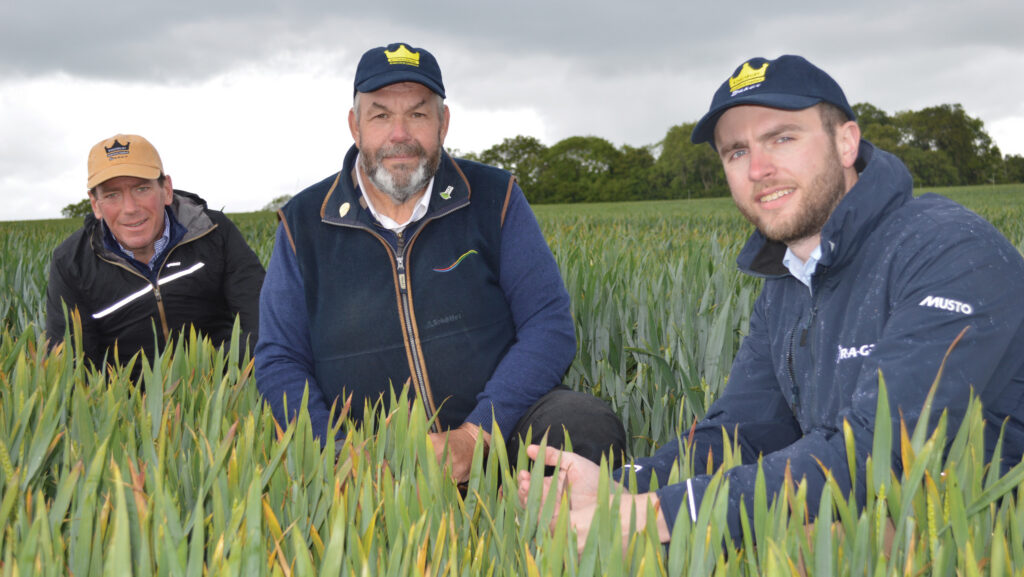
Christian Maltby, Andrew Stilwell and Edward Stanford © David Jones
Goldfinch scores a maximum 9 for resistance to yellow rust in a 1-9 rating system where 1 is very susceptible and 9 shows good resistance.
This is of particular interest as some mainstream varieties with the YR15 gene have seen their resistance scores fall sharply after a mutation of an existing yellow rust race was seen to have overcome the YR15 resistance gene in the spring of 2025.
The yellow rust resistance rating of Champion was reduced to a 4 from a previous 8, while other popular feed wheat varieties with the YR15 gene were also downgraded.
Dawsum and Typhoon were both cut to 5s from 9s and Beowulf to a 4 from a 9.
Meanwhile for some varieties, like Goldfinch without the YR15 gene, their resistance scores were unchanged.
In addition, Goldfinch has a 9 score for brown rust and a 7 for septoria, showing that the variety has perhaps the best all-round disease package on the RL for these three foliar diseases.
Goldfinch has a low fungicide-treated yield of 88% compared with top-yielding Group 2 variety Arnie on 104% and the still popular Extase on 102%, while Goldfinch’s untreated yield is 83% against Arnie on 87% and Extase’s 90%.
Edward says the small gap between the fungicide and non-fungicide yield for Goldfinch of just 5 points is a good metric that emphasises the stability and reliability of the variety.
Goldfinch’s lodging score in the RL is a lowly 2 when grown without a PGR, and a more reasonable 6 when using a PGR, while Arnie has two 8s and Extase two 7s for lodging with and without a PGR, so a good PGR programme for Goldfinch is essential.
The performance of the breeder’s first BYDV-resistant wheats Wolverine and Grouse has now been overtaken by Goldfinch, and also the new entry to the RL, the hard-milling feed wheat Guardsman.
This latter variety has BYDV resistance and a fungicide treated yield of 103%, but not midge resistance. Its straw, like Goldfinch, is on the weak side, with a non-PGR score of 3 and a PGR score of 5.
All future RAGT varieties will have yields over 100%, with BYDV and midge resistance, adds Edward.
This is the case with two feed wheat varieties coming up for recommendation at the end of this year, which he describes as second generation BYDV-resistant wheat varieties.
These are Gorgon and Griffin with yields in line with the popular wheat variety Dawsum and straw stronger than Guardsman, says Edward.
Some key Group 2 winter wheat varieties |
|||
|
|
Goldfinch |
Arnie |
Extase |
|
Fungicide-treaded yield (%) |
88 |
104 |
102 |
|
Non-treated yield (%) |
83 |
87 |
90 |
|
Yellow rust resistance |
9 |
7 |
7 |
|
Septoria |
7.0 |
6.8 |
6.5 |
|
Brown rust |
9 |
6 |
7 |
|
Resistance to lodging, no PGR |
2 |
8 |
7 |
|
Resistance to lodging, with PGR |
6 |
8 |
7 |
|
OWBM resistance |
R |
– |
– |
