Winter malting barley impresses growers and maltsters
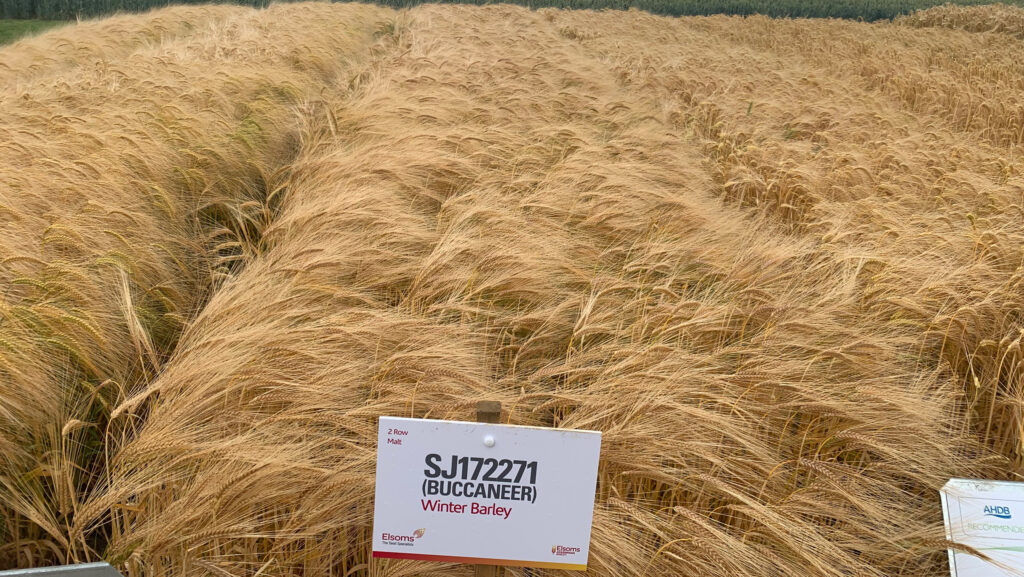 © Elsoms
 Winter malting barley variety Buccaneer is continuing to impress growers and maltsters since joining the AHDB Recommended List (RL) in 2023.
According to David Griggs, technical director at Crisp Malt, the variety came along at the right time with the right attributes, following years of a noticeable lack of new winter malting barley varieties on the RL.
See also: 3 winter barleys join slimmed-down AHDB Recommended List
“Offering a big uplift in yield, particularly untreated, Buccaneer gained industry support following its malting barley committee [MBC] approval for brewing. It continues to attract dedicated winter malting barley growers who have moved away from older varieties,” says David.
“Maltsters like it, the brewing industry likes it, and, with a 5% yield advantage over Craft, I can only see more growers moving towards it as long as it continues to perform,” he concludes.
Case study: Andrew Ross, WJF Ross, Norfolk
Norfolk farmer Andrew Ross has included winter malting barley in his rotation for over 40 years.
Andrew introduced Buccaneer for the first time in the 2024-25 season, replacing Flagon. He is now in his second season with the variety, and sees winter malting barley as a highly commercial second cereal crop and an excellent entry for oilseed rape.
Farming at Houghton St Giles, near Walsingham, Andrew is part of the ABC grower group, a long-standing 20-year partnership of just over 200 growers supplying Crisp Malt’s two Norfolk malting sites. The group’s key goals are to secure a sustainable, traceable and reliable supply of premium-quality grain to the brewing and distilling industries.
“Beyond its yield uplift, Buccaneer seems to offer a stronger disease resistance package and produces a bigger, bolder grain with lower nitrogen content than other winter malting barleys we’ve grown,” says Andrew.
“Although 2025 was a tricky year with exceptionally dry weather, we still achieved average yields of 7.5t/ha. Importantly, all the Buccaneer we grew made malting spec.”
He says it establishes and competes well and has been relatively straightforward to manage.
For this year’s crop, nitrogen rates have been increased from 130kg/ha to 140kg/ha on the basis that it can take more N because it yields more.
“As of early summer, our current crop has produced a lot of tillers and is looking very clean. I’m confident we’ll achieve the higher yield by upping the nitrogen.”
To combat the effects of the dry weather experienced in the past few seasons, Andrew added the seed dressing Vibrance Duo (fludioxonil + sedaxane), which enables crop roots to extend more deeply into the soil.
“The strategy seems to have worked well so far, particularly on some of our lighter land that struggles to hold moisture.”
Andrew normally grows about 80ha of winter malting barley each year.
“It’s a superb early entry for oilseed rape and, given we often achieve up to 5t/ha with our OSR crops, I’d be reluctant to move away from it, providing there are sensible malting contracts out there.”
© GNP
Grain quality consistency
Rebecca Gee, director of procurement and Logistics at Crisp, has also been impressed with Buccaneer’s rapid progress since gaining full MBC approval in November 2024.
She adds that in the three years since they began working with the variety, the overall consistency of grain quality across three variable seasons has been excellent.
With a high untreated yield of 88%, it’s significantly ahead of other two-row winter malting barleys. It competes favourably on untreated yield with most of the mainstream two-row and six-row feed varieties.
For maltsters, on grain quality, it also offers lower screenings than its competitors.
“Ultimately, growers need strong varieties supported by contracts to incentivise them, and in Buccaneer they have an exceptional winter malting barley offering high yields, a solid disease resistance profile and consistently high grain quality,” she concludes.
Optimising nitrogen content for brewing
Kurtis Scarboro, crop manager for cereals and oilseeds at Elsoms Seeds, highlights that Buccaneer has been a game-changer and has been working on nitrogen programmes.
A set of trials were carried out by Elsoms Seeds last year to identify the optimum nitrogen rates that enable Buccaneer to reach its target nitrogen content for brewing.
The aim of the trial was to achieve 1.65-1.7% of nitrogen in the grain while simultaneously also maintaining its high yield using lower application rates of N than other two-row winter malting barleys.
“Due to the extremely dry growing conditions during 2025, carrying out nutrition trials was particularly challenging, with much of the nitrogen applied during the spring simply sat on top of the soil,” says Kurtis.
However, once the rain arrived, it was interesting to observe that, across a range of nitrogen inputs, Buccaneer delivered consistently lower grain N content in combination with higher yields than the two established control varieties.
Kurtis explains that Buccaneer’s higher yield means its grain N is diluted somewhat in comparison to the controls.
“This is important to growers because it shows that it can be relied on to deliver high yields while achieving target grain N content across a range of different growing regimes, and in the face of challenging weather conditions season to season,” he says.