

Advertiser content
Why farmers should look to broad-spectrum Ascra this season
Favourable conditions in autumn 2025 meant crops enjoyed an excellent start, but the mild weather through to the start of the new year means crops are likely to be harbouring a range of pathogens, notably Septoria leaf spot, yellow rust, powdery mildew and, in some cases, eyespot.
Ensuring crops are suitably protected will require the all-round performance of a broad-spectrum fungicide such as Ascra®Xpro® (bixafen + fluopyram + prothioconazole), or in more testing situations, an Iblon®-based fungicide such as Plaxium® (isoflucypram + fluopyram + prothioconazole), says Greg Hanna, Bayer Technical Specialist.
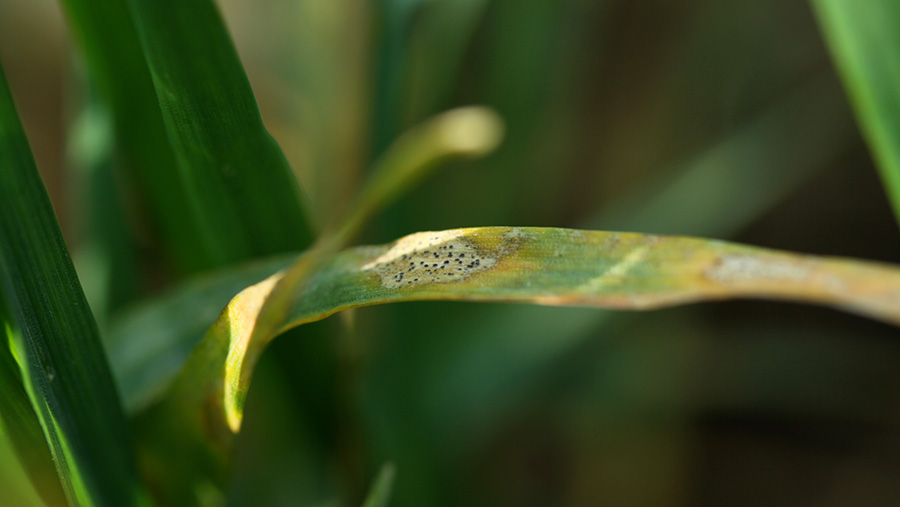
Forward crops and favourable conditions mean foliar diseases such as Septoria leaf blotch, seen here at the T0 timing, are likely to be significant threat to crops in 2026. © Bayer
For Greg, the concern is a repeat of 2024 when crops came under intense disease pressure in the spring as conditions favoured sporulation while limiting the number of available spraying days.
“It’s worth noting how quickly the situation evolved and what this meant for fungicide programmes.
“Disease pressure was intense from the outset with little to no opportunity to recover the situation if application timings slipped, rates proved to be inadequate or where programmes lacked effective broad-spectrum activity,” Greg says.

Greg Hanna highlights the value of an all-rounder such as Ascra®Xpro® in protecting against disease at both the T1 and T2 timings. © Bayer
The 2024 season was another year characterised by the harsh economics of poor market prices, but it also served as a valuable reminder of the protection afforded by broad-spectrum fungicides once the weather deteriorated.
“Put simply, crops that received a robust fungicide at both T1 and T2 went on to do better and be more profitable than those that received a reduced programme because they were nurtured and endured less disease-related stress,” he says.
The use of carboxamide-containing fungicides such as those contained in Ascra®Xpro® (bixafen + fluopyram + prothioconazole), improve on this by enhancing nutrient use efficiency, so even when disease pressure is lower crops are often more productive. It’s just one reason why Ascra®Xpro® is seen as great all-rounder in both wheat and barley,” he adds.
If evidence were needed of the extent of the disease pressure in 2024, the yield response seen in Bayer’s fungicide trials (displayed in Fig. 1 below) proves compelling, Greg believes, but the crop’s potential should be used as a measure of just how much ‘protection’ is warranted (see Fig. 2).
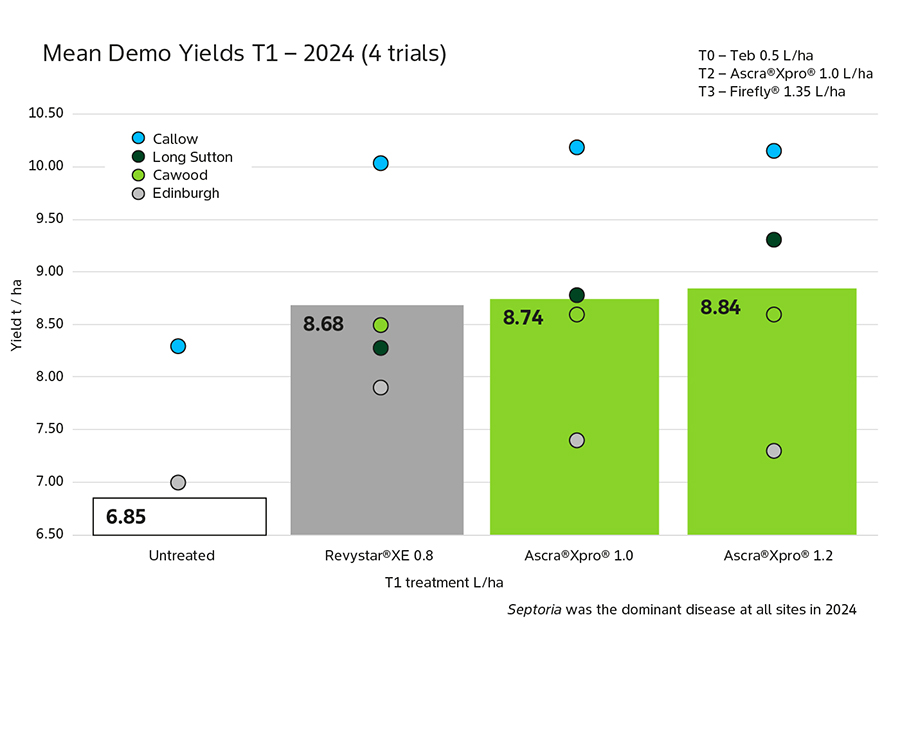
Fig. 1: The yield protection delivered by Ascra®Xpro® applied at 1.0 L/ha at T1 was more than 2 t/ha over the untreated. Reference: Bayer demo sites, 2024 © Bayer
“The yield response in our Septoria trials was close to 2 t/ha (over untreated) for varieties with poor resistance and in our yellow rust trials, was closer to 6t/ha in varieties such as KWS Zyatt or Skyfall,” he says.
A new development that will distinguish 2026 from the 2024 season, however, is the emergence of a new strain of yellow rust capable of overcoming the Yr15 gene and the large area of varieties with this susceptibility.
This will serve to raise the importance of fungicides showing good broad-spectrum activity if yield potential is to be protected for maximum performance, he believes.
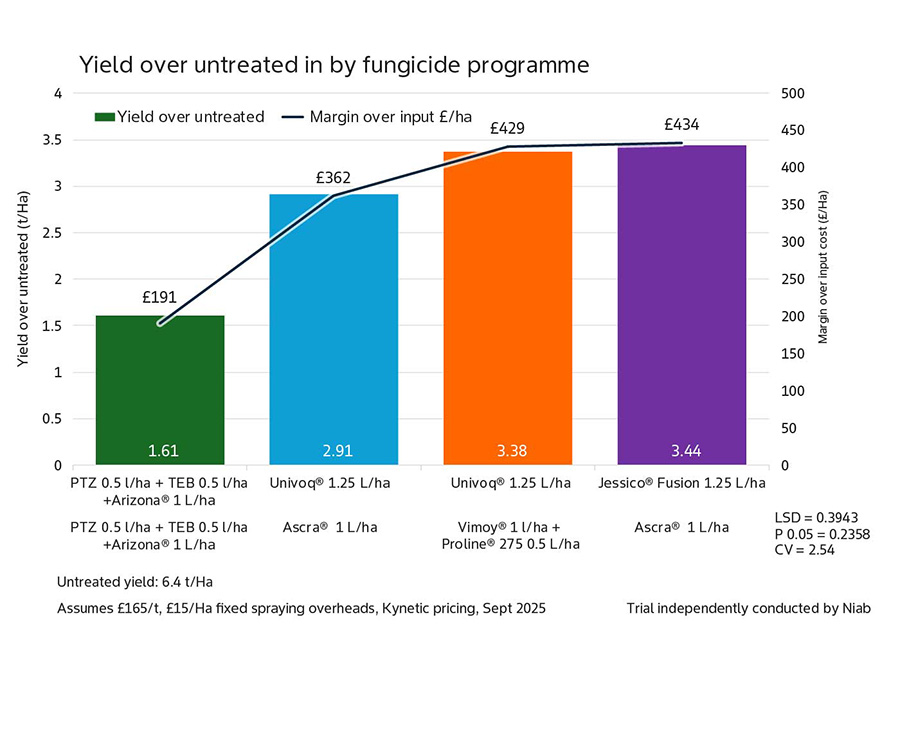
Fig. 2: Modern active substances tend to give better yield protection than previous generations, but it is for the grower to decide what protection the crop justifies. Reference: Bayer fungicide trial performed by Niab, Dorset, 2024. Cv. Saki. Untreated yield: 6.4 t/Ha. Financials assume wheat £165/t; £15/ha spraying overheads. Kynetic pricing data, Sept 2025. LSD: 0.3943; P 0.05: 0.2358; CV: 2.54. © Bayer
Another observation worth noting is the role of active substances featuring multisite activity. They are primarily a means of supporting effective resistance management and can be useful in raising the performance of more established, but less efficacious substances.
“They tend to give sufficient return to cover the cost but fail to match the payback of modern fungicides,” Greg says.
Prothioconazole is another important active substance that tends to feature heavily in most programmes. Fortunately, it continues to perform reliably.
“Bayer’s resistance monitoring has found no significant shifts in the sensitivity of prothioconazole in recent years.
“Given its role as both a protectant and its importance for resistance management when used as part of a balanced programme, it is reassuring that its performance remains stable against today’s pathogen populations,” Greg says.
Provided by
At Bayer Crop Science, we are committed to transforming the future of UK crop production by becoming the preferred partner for agronomists, distributors, and growers. Our focus is on world-leading innovation, dedicated in-field expertise, and a tailored customer experience that consistently delivers value, trust, and results sustainably.