Advice on borrowing for farm building projects
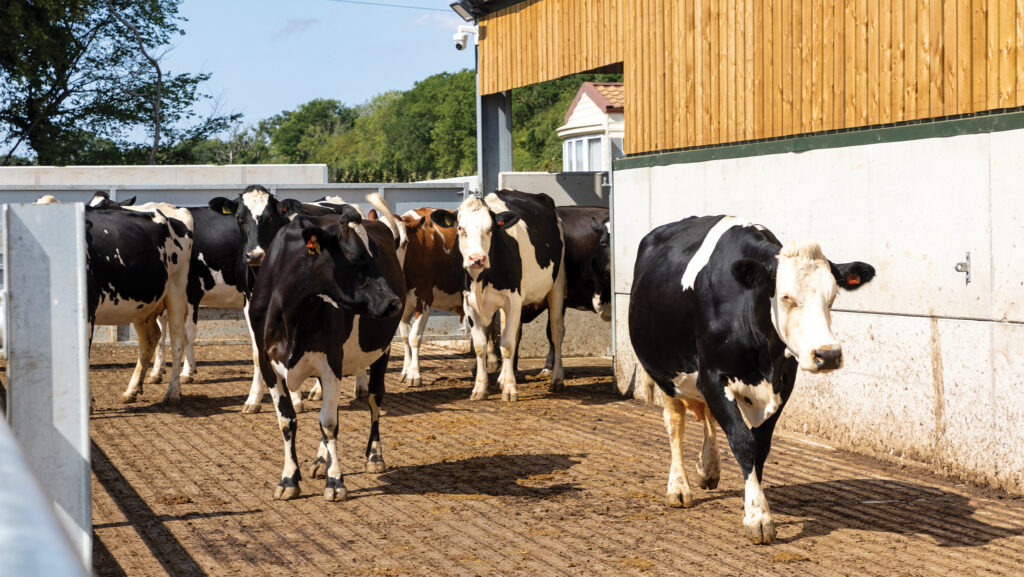 Dairy cows on new-build dairy © GNP
 Borrowing to fund farm buildings can be done through high street banks or specialist funders and can be though a straightforward loan, hire purchase (HP) or what is commonly termed asset finance.
There’s plenty of appetite to lend to farming across a wide range of funders, says Lee Hayes, corporate finance partner at north-east accountant Armstrong Watson.
“High street banks all have agriculture specialists but can be more cautious than the secondary lenders, especially in times of general economic uncertainty.
See also: Farm building projects: health and safety obligations
“It’s all about risk versus reward and each lending request will need a different approach depending on timescales and the quality of the proposal.
“This can narrow the options, but it’s all about loan to value and debt serviceability.
“Typically, a lender will lend around 70% of the value of the project, although it’s possible they might go to 80% in some cases and down to 60% in others.”
So lenders will want to see farmers putting in some of their own cash.
It’s not unusual for some farm labour to be used on a project to keep the cost down, and the value of that could count towards what the borrower is putting in on a project, suggests Lee.
High street bank loans typically take longer to organise than those from secondary lenders, says Lee, albeit the latter are usually more expensive.
Show benefit of investment
“The affordability or ability to service the loan needs to be demonstrated and sometimes that can’t be done on current profitability.”
However, if a well thought through proposal shows how the business will benefit as a result of having that new building, that can get it across the line to approval, says Lee.
“As a minimum you need a plan or forecast showing how you will be able to meet the serviceability requirements.
“This will include the lender wanting to see your accounts for the last three years and they will take into account drawings and other personal expenses.”
Banks use earnings before interest, taxes, depreciation, and amortisation (EBITDA) as measurement to judge a business’ performance and in particular its ability to generate cashflow.
A business needs to demonstrate how its EBITDA will rise as result of the proposed project, says Lee.
“Banks will also often ask for the last three years’ accounts, and because these are potentially already 18 months out of date, up-to-date management accounts showing what’s happening since the end of the last accounting year can really help.”
Secured loans will generally be offered for up to 30 years, while unsecured facilities are more likely to be for up to six years, says Lee.
Payments to contractors can be released as the stages of the build progress, so that interest is due only on the actual portion of the facility used, rather than on the whole sum.
In cases where a business is not as strong as a lender would like, banks are able to draw support from the British Business Bank, which is government backed and can guarantee 70% of the facility offered by the lender.
In Lee’s experience, more borrowers are opting for variable rates at present, which means that if there is any spare cash to go towards paying off the loan, this can be done with no penalty.
Using a broker
Different lenders have different appetites for what they will cover, so getting the help of a finance broker can save time and cost in finding the right deal.
Gavin Dixon Finance Solutions (GDFS) is an independent broker based in Bridport, Dorset, which specialises in organising finance for farming.
The firm is Financial Conduct Authority regulated and draws from a panel of 30-plus specialist lenders, which includes many names familiar in agricultural lending, both secured and unsecured.
Brokers are paid a commission by the lender when a deal successfully completes and this should always be set out during the process of finding and agreeing what borrowing product to take, says director and owner Gavin Dixon.
Documentation fees should also be set out clearly in finance illustrations.
Brokers generally handle the paperwork, and Gavin says that an agreement can be reached with some non-high street lenders in 24-72 hours in some cases but larger loans can take longer to be approved.
Lenders will want to see a quote or an invoice for the project for which the funding is being applied, also basic information about the borrower and the business – names, addresses and dates of birth of all those with any interest in the business, and whether it is a partnership, company or sole trade.
Bank details are also needed, along with several months’ bank statements and the latest set of business accounts.
Unsecured loans and asset re-finance are generally available for farm buildings, typically over a term of up to six years for sums of up to £200,000, says Gavin, possibly higher depending on the strength of the business and the size of the farm.
Traditionally, funders would have used HP finance for farm buildings as that could give the funder the option to remove the barn if the customer was to default.
“Farming business are generally seen as a low-risk to funders, due to being very well-established, generational businesses which are not going anywhere, this makes unsecured loans a safe option for the funders.
“If a customer is perceived as a higher risk by the funder and an unsecured lend is not an option, we can look to release equity from unencumbered assets and use re-finance to raise the funds.
“GDFS recently re-financed a tractor to raise £30,000 for a customer looking to re-roof an existing barn.”
Advice – and questions to ask
- Look beyond the headline interest rate as it won’t always tell the whole story – fees may not be included – there is almost always an arrangement fee. Also, banks may require a valuation and will usually pass this and any legal fees to the customer
- Have a business plan or forecast to show how the payments schedule can be met – most agricultural specialist lenders will offer payments suited to the type of farm and its cash flow
- Include how the proposed building can increase sales or improve margins and therefore profitability
- What are the penalties for a missed or late payment?
- Can overpayments be made or can the loan be repaid early and what are the implications of doing so?
- Seek accountancy or specialist debt adviser advice before approaching the bank
Buildings tax advice
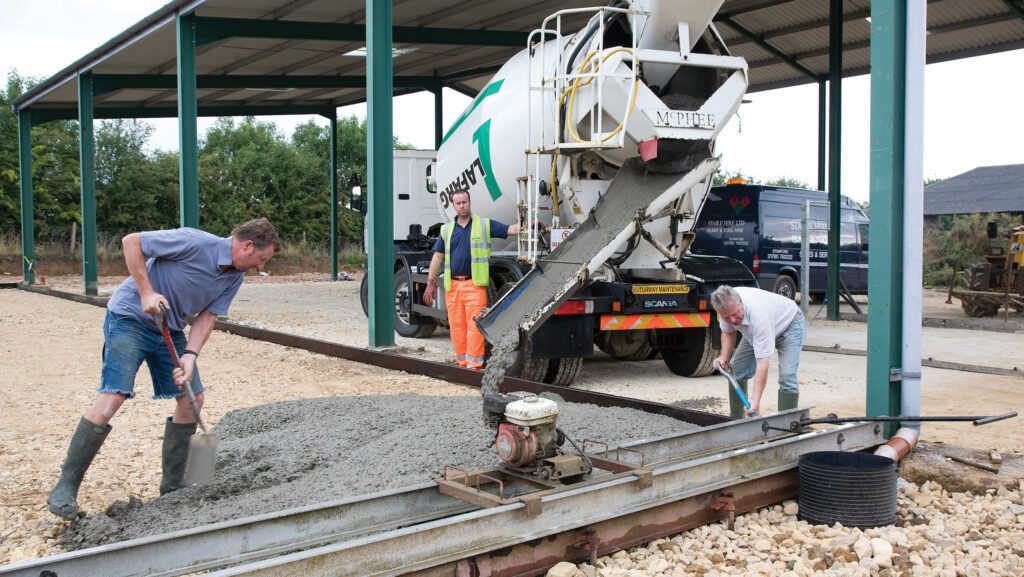
© Tim Scrivener
Farms could be paying more tax than necessary by overlooking or wrongly applying the structures and buildings allowance (SBA), say advisers.
This is a capital allowance (CA) of 3% a year on a straight-line basis and charged against business income for expenditure on the fabric of most farm buildings and other commercial construction projects.
It was introduced in October 2018 and, despite the name, the 3% allowance is available on some items that are neither a structure nor a building, points out Peter Griffiths, tax director with accountant Hazlewoods.
This can include farm buildings, offices, commercial buildings to let out, new-build diversification projects such as a farm shop or play barn, reservoirs, new roads, fencing, walls, bridges and tunnels.
SBA also applies to expenditure on new conversions or renovations, as long as they are non-residential.
Buildings must be in use for SBA to be claimed and, at 3%, it takes just over 33 years to get the full tax relief.
Detailed quotes and invoices
Getting detailed quotes and invoices for any project is important, because much of the expenditure that makes up the remainder of the building qualifies as plant and machinery, attracting the far more favourable 100% CA available in the year of expenditure through the £1m annual investment allowance (AIA).
The list of eligible items – fixtures, fittings and integral features – is a long one, but the most common items are electrical, lighting, ventilation, heating and hot water systems.
Moveable dairy equipment, such as a bulk tank, or movable cattle pens/troughs and so on within a big beef or dairy shed, would qualify for plant and machinery CAs and could be covered by the AIA.
Once the full AIA has been used by a company, sole trader or partnership business for such items, then any further qualifying expenditure will usually be eligible for a writing down allowance (on a reducing balance basis) in what is known as the special pool for fixtures/integral features.
Companies can also claim what is known as “full expensing”, which – in addition to the AIA – gives a 100% CA on qualifying expenditure and a 50% first-year allowance for certain special rate assets, such as integral features of a building and long-life assets (new assets only).
Tax efficiency of repairs
If expenditure on a building can be regarded as a repair, this is likely to be the most tax beneficial position, says Peter, as repairs are wholly allowable as a business expense in the year the expenditure is incurred.