

Advertiser content
Experts advise on wheat disease control decisions this spring
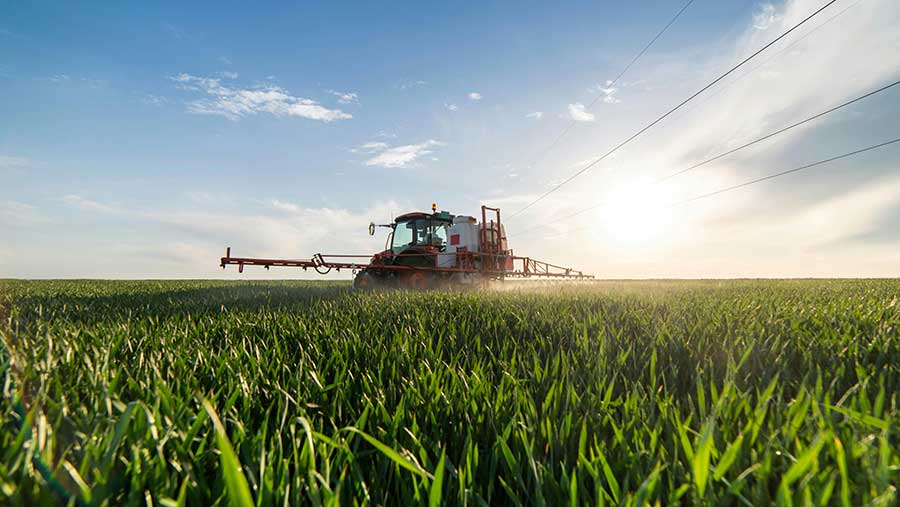 © UPL Europe
 Experts from Niab, Adas, and Scotland’s Rural College (SRUC) joined UPL for their Do Disease Differently webinar, which is available to watch on YouTube.
We have summarised the key points from the discussion.
Crop health set to be the crucial factor this spring
“It is a question of above and below-ground biomass,” says Dr O’Driscoll. “Plants are under a lot of stress at the moment. Poor rooting caused by waterlogging increases the risk of soil-borne diseases.”
“Reduced above-ground biomass will mean they are less able to escape early infections of yellow rust or powdery mildew.
“Whatever disease is in the air and the ground, the crop will have much more difficulty getting away from it this year than in previous years.”
Rebecca Joynt, senior consultant in crop pathology at Adas, agrees and highlights eyespot and take-all as diseases favoured by the conditions this season.
“A lot can happen with foliar disease pressure through the spring, but farmers should be aware of the different risks to later-drilled crops,” says Rebecca.
“Later-drilled crops are generally more susceptible to yellow rust and powdery mildew, but septoria is less of an issue because crops are exposed to spores for a shorter duration.”
New plant health elicitors demonstrate benefits in trials
SRUC, Adas and Niab all trialled Iodus (laminarin) last season.
Whereas conventional fungicides act on fungal diseases directly, Iodus mimics the degraded cellular material released from a fungal attack, stimulating the plant to defend itself.
“We find it works best in combination with conventional fungicides,” says Prof Havis.
“It is a product that induces the plant’s own natural defence mechanism, so it is something you want to be using earlier in the programme, around the T0 timing.
“Elicitors should not be seen as alternatives to fungicides. They induce the natural defence mechanisms within the variety, making the most of the available varietal resistance.
“By starting the plant’s defence mechanisms early, you can tailor the fungicide programme accordingly.
“We have had some very promising trial results, in which using Iodus has helped to cut back on fungicides later on.
“Margin is all-important, so if you are looking at your fungicide spend, products like Iodus might help you.
“They also give you more options later in the programme and help to reduce the total fungicide bill.”
Rebecca has seen similar results in 2023 Adas trials in Herefordshire, which have looked at different dose rates of T1 products with and without Iodus at T0.
“You can see the same level of disease control and yield response from including Iodus at T0 followed by a reduced application rate of the T1 fungicide instead of just applying a higher rate of the T1 fungicide without the Iodus.
“Building it into fungicide programmes has been where we have seen some benefits of Iodus come through,” says Rebecca.
The unique mode of action of elicitors in stopping disease has led to some debate among agronomists about its effectiveness depending on the plant’s genetic disease resistance. The Adas trials went some way to answer this.
“In 2023, we used some September-sown Elation and October-sown Graham.
“The Elation was a tough, high-pressure test, and the Graham was more of a realistic commercial situation.
“We saw improvements to septoria control in Elation and Graham, so it [Iodus] was adding to control both where the pressure was very high and more moderate,” explains Rebecca.
Advice for the key T1 and T2 timings
Application timing with variable leaf emergence and considering the fungicide actives used are highlighted by Dr O’Driscoll as the two most important considerations for fungicide programmes this season.
“Leaf layer emergence will probably be all over the place this year,” advises Dr O’Driscoll.
“We know from work Niab has done looking at leaf layer emergence in different varieties that leaf two and flag leaf emergence can last two weeks in some susceptible varieties.
“Trying to time your sprays according to that won’t be easy.
“For some more resistant varieties, it can take three to five days for them to come out.”
With a range of fungicide chemistry available to farmers, Dr O’Driscoll recommends moving from a product to an active based approach when building fungicide programmes.
“There are two good azoles in Revysol (mefentrifluconazole) and prothioconazole, several good SDHIs and a QII.
“These are available in many different co-packs and co-forms, which makes it quite confusing.
“Paying attention to ensuring programmes have different azoles, an SDHI, a QII and multisites spread across the programme is important. Don’t rely solely on one type of chemistry,” cautions Dr O’Driscoll.
The spread of drill dates for wheat crops will cause a spread of timings and yield potential.
Rebecca expects conversations to take place about how to maximise each crop’s yield potential and tailor fungicide spending to this potential yield.
Adas run a fungicide challenge annually, and the ‘blockbuster’ fungicide programme rarely comes out on top when margins are calculated, says Rebecca.
Analysis of disease isolates gathered last season does not point to any significant changes in fungicide resistance to influence decisions this spring.
However, the experts argue against complacency.
“The best way to combat resistance is alternating products,” argues Prof Havis. “All the scientific studies show that repetition of the same products has the biggest effect [on resistance].
“There are always concerns about how to protect the newer products in the market. If it is not in a co-form with an equally strong partner, it can be under increased selection pressure.
“That might be a situation in which including a multisite is important.”
The multisite landscape has changed since the loss of chlorothalonil three years ago.
The activity of folpet is well-known, having been in the market for a long time. Joining it as an option is a range of products based on sulphur as the active ingredient.
SRUC and Adas trialled one such product, Thiopron (sulphur), last year.
In SRUC trials, Thiopron has looked quite good, says Prof Havis. He sees a position for it in tank mixes at T1 and T2 but cautions that the dose rate needs to be higher than folpet for similar control.
The higher dose rate is compensated for with a lower price per litre for Thiopron, which benefits the cost per hectare equation.
Key points to consider for disease control in wheat this spring |
|
Early in the season, focus on improving plant health and building biomass to enhance the plant’s resilience to disease |
|
Variable sowing dates and patchy emergence will add to the challenge of correctly timing fungicide applications |
|
Plant health elicitors like Iodus showed a benefit to disease control in trials in 2023 |
|
Use the full range of fungicide actives (including multisites like folpet and Thiopron) in alternation in a programme for the best disease control and anti-resistance strategy |
|
Focus on margin by balancing crop yield potential, fungicide cost, and the likely benefit to disease control when making fungicide decisions |
Provided by
UPL is a global provider of sustainable agriculture products and solutions. We are a purpose-led company. As one of the largest agriculture solutions companies worldwide, our robust portfolio consists of biologicals and traditional crop protection solutions.