

How a soil focus returned Northumberland farm to profit
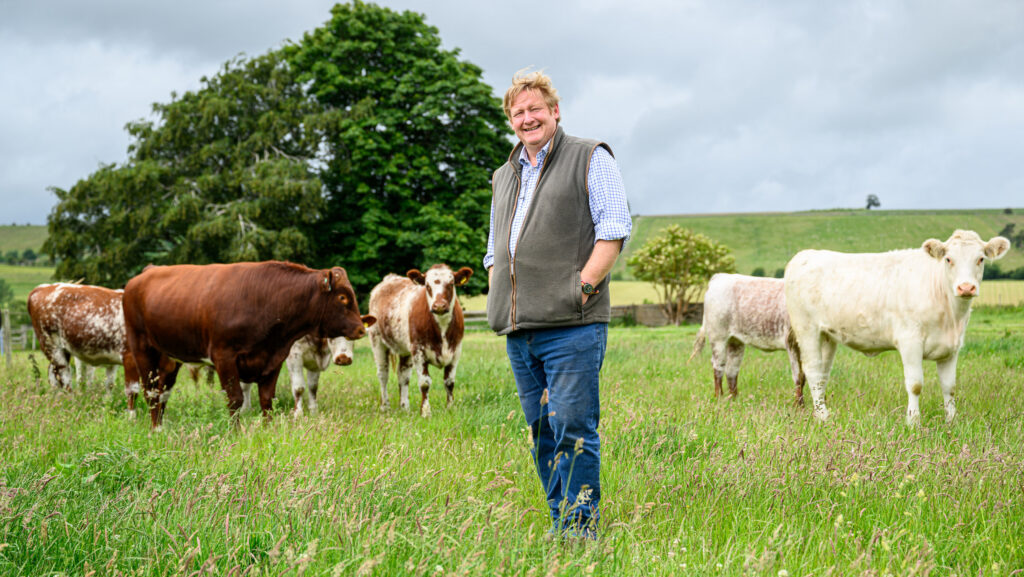 Tom Fairfax © Richard Lee Photography
 Tom Fairfax and wife Miki farm the 473ha Mindrum Estate in the foothills of the Cheviot Hills, close to the Scottish border.
The farm runs a 100-head suckler herd of Aberdeen Angus Shorthorn crosses and a closed flock of about 1,000 Texel cross Suffolk mules.
Exlana genetics are being introduced as Tom considers switching to low-input, outdoor lambing.
See also: Why two returning farmers pressed for regenerative change
Farm facts
Mindrum Farm, Cornhill-on-Tweed, Northumberland
- 476ha – one-third each of permanent pasture, rotational grass leys and arable cropping, plus woodland
- Winter and spring wheat
- Short-term leys,
- 90 Shorthorn and Aberdeen Angus suckler cows
- 930 Suffolk cross Mule ewes put to Texel ram; now introducing Exlana genetics
- Agroforestry
- Annual rainfall 750mm
- Light, sandy loam soils with some wet ground
The farm also has 48ha of woodland shelterbelt and 120ha of mixed arable on mainly sandy loams.
The Transition from a conventionally run mixed farm to a regenerative, organic system, began about six years ago.
Cereal yields had stalled; we were applying more artificial fertiliser each year just to maintain output, says Tom.
The biodiversity was declining, the soil was getting thin and we were spending more on inputs so margins on the arable side were falling, he adds.
Decades of using artificial inputs had taken a toll on the whole farm system and the business needed a rethink.
Nutrient management
Tom took part in training including a Soil Food Web Foundation course which aims to help farmers improve soil microbiology and move away from artificial inputs.
From there Tom learned to look at nutrient efficiency and soil biology as an enabler for nutrient management across the farming system.
This allowed him to look at the impact balance of inputs at a systemic level and to harness the power of the natural systems in a nutrient cycling model.
It became clear that functional biology was the key to a massive soil nutrient reserve which was previously locked up.
A former reconnaissance officer, Tom has used his detailed observation and analysis skills on the farm and widened his approach to incorporate the use of a microscope, reading weeds and traditional lab-based methods.
The microscope is used alongside a spade to regularly examine the structure, organic matter content and the soil health systems.
The key is the systems approach rather than a reliance on discrete structural or chemical metrics, he insists.
Organic matter
The long-term incorporation of organic matter creates a soil system that retains water, stabilising plant nutrients and enabling beneficial microbial activity.
The spectrum of processes within a functional soil system create conditions to bring together plants, micro-organisms and soil in a resilient, responsive and flexible system.
“This drives productivity and buffers shocks. In short, this healthy system does many of the expensive tasks that we previously resourced,” he says.
“As a result we no longer need any artificial fertilisers or pesticides so inputs are down, our margins are up and we are in profit for the first time in years.
“Significantly, our livestock growth rates and quality are rising, while our vet bills are down.”
The soil structure has improved and better supports traffic, widening work windows.
Fieldwork for crops reflects the individual field conditions with min-till and direct-drilling a green canvas.
Perennial ryegrass is a challenge and shallow ploughing (5in depth) is used every three to four years.
The impact is monitored under the microscope and it has become clear that establishing an “A-horizon” – a biologically active topsoil layer to 12in – allows the system to heal itself when only the top few inches are disturbed.
“We also monitor total nutrient composition, giving us access to a nutrient reserve which can be converted by our carefully managed biology.
”Findings from the soil tests then guide which fields will take a crop and ambient conditions like temperature are used to advantage.
“Cereals will grow from approximately 4C whereas the clover needs about 8C,” Tom explains.
“So drilling takes place at the lower temperatures giving the cereals a head start while the whole system produces sugary exudates, feeding the soil microbes, and nutrients for the plants and introducing liquid carbon into the soil system.”
A clover/forb mix is spread from a quadbike-mounted spinner if a companion layer is required to support the crop. Once the cereal is harvested, the clover flourishes with light.
A variety of grazing systems are used as required including set-stocking, rotational, multi-paddock and mob grazing, according to individual field needs.
The underlying principle, though, is to move livestock on quickly, to rest swards. At times we are moving livestock every two to three days, Tom says.
Woodland and agroforestry
One of the Transition goals is to enhance woodland and agroforestry by careful addition to existing tree plots to create shelterbelts for cattle and crops.
Mindrum has historically planted shelterbelts on about 15% of the land.
Further trees, funded by various sources have been planted on about 14ha at 40-60 trees/ha and 3ha at 20/ha to create silvopasture.
This provides shelter for cattle from sun, wind and rain reducing stress and improving production.
A further agroforestry aim is food production. Apple trees for juicing and nut varieties are being considered to supply food.
If successful, these will help support the third Transition goal of creating a food hub.
As a nation the UK is out of the habit of eating local food. But there are huge benefits, with lower transport miles and reduced waste, says Tom.
To this end Mindrum has started to produce meat boxes and a local feed system from its own stock and is considering introducing a vending machine system.
Transition goals
- Rebuilding the soil’s productive power
- Whole-farm approach to enhancing agroforestry
- Creating a local food hub
Explore more / Transition
During the series we follow our group of 16 Transition Farmers through the challenges and opportunities as they seek to improve their farm businesses.
Transition is an independent editorial initiative supported by our UK-wide network of partners, who have made it possible to bring you this series.
Visit the Transition content hub to find out more.
