

Transition Farmer: Fodder beet test lifts liveweight gain
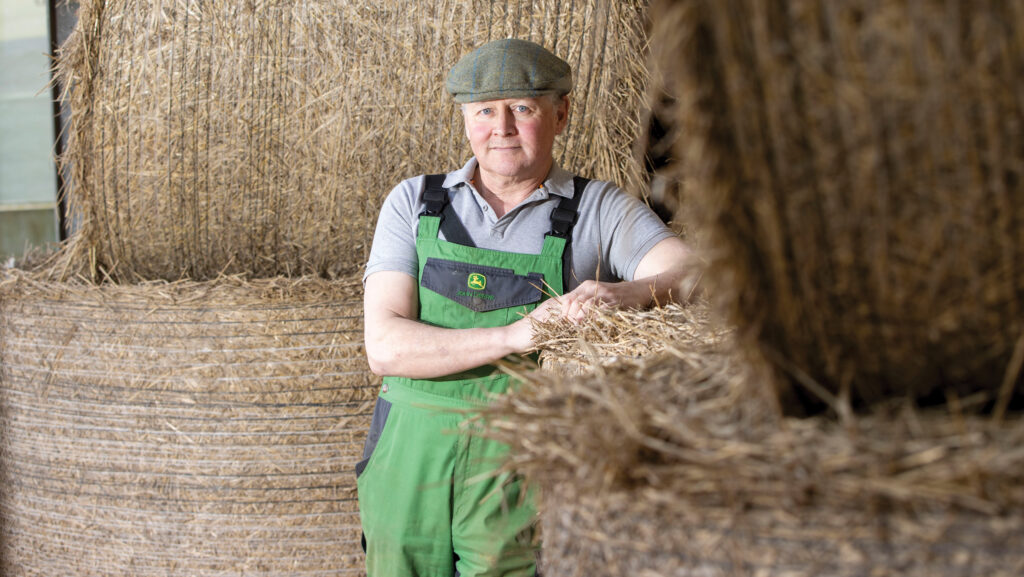 © Jeff Holmes
 Farmers Weekly Transition Farmer Andrew McFadzean has been focusing on expanding fodder beet grazing, improving cattle performance, upgrading grazing infrastructure, and harvesting earlier, higher-quality silage.
We catch up with him in Ayrshire to find out how the farm’s Transition goals have progressed so far in 2026.
See also: All updates from Andrew McFadzean
Farm facts
Dalchomie Farm, Maybole, Ayrshire
- Farm size: 285ha split across three units
- Annual rainfall: 1,016mm
- Soil type: Upland 100-280m
Andrew McFadzean
The resilience of fodder beet as a grazing crop has been tested in tough conditions on Andrew McFadzean’s Dalchomie Farm.
But with high utilisation and beef cattle achieving an average daily liveweight gain (dlwg) of 0.8-0.9kg the crop has proved itself.
Andrew had allocated half the 12ha he grows annually to a grazing variety, the remainder to lift and include in the growing and finishing rations – historically 3ha had been grazed.
Sixty Shorthorn-cross, Charolais-cross, Limousin-cross and Aberdeen Angus-cross cattle from suckler herds, purchased as stores from livestock markets, were transitioned onto the crop at 360 – 370kg in early October 2025.
What followed was a winter of exceptional rainfall but, as Andrew reports: “The cattle did tremendously well on the fodder beet, growing 0.8-0.9kg a day with no supplementary feeding.”
Good utilisation was down to allocating only two or three rows daily, he reckons.
“Utilisation was fine but the mess was horrendous, I was a miserable farmer having to move that fence every day. The cattle did well though and that is what matters.”
So much so that Andrew has increased his grazing acreage further, planting four hectares with Robbos in the first week of May.
“Robbos has a high dry matter so it can stay in the ground for a bit longer with less risk of frost damage,” he explains. The crop was planted in the same fields for a second year.
“That practice is commonplace up here and farmers in New Zealand have been doing it for many years with great success,” says Andrew. An improvement in the weather as the season transitioned into spring saw first cut silage taken on 1 May – the earliest harvest ever achieved at Dalchomie Farm.
“In my father’s day it would have been the end of May or the beginning of June and for the past four or five years we’ve cut on the 12-14 May but this year it was 1 May with very high quality grass, it was lovely stuff,” says Andrew.
He has an ongoing programme of replacing temporary paddock fences with permanent infrastructure, altering paddock size too to improve grazing efficiency and for ease of cattle movement and access.
Paddocks vary between 1.5ha and 3ha and are further divided with temporary fences according to cattle numbers, although more than 60 are never grazed in one group.
Transition goals
- Increase cattle numbers and slash finishing time
- Reduce dependence on inputs
- Improve grassland and access
Explore more / Transition
During the series we follow our group of 16 Transition Farmers through the challenges and opportunities as they seek to improve their farm businesses.
Transition is an independent editorial initiative supported by our UK-wide network of partners, who have made it possible to bring you this series.
Visit the Transition content hub to find out more.
