

Transition Farmer: Grain price rise offsets yield drop
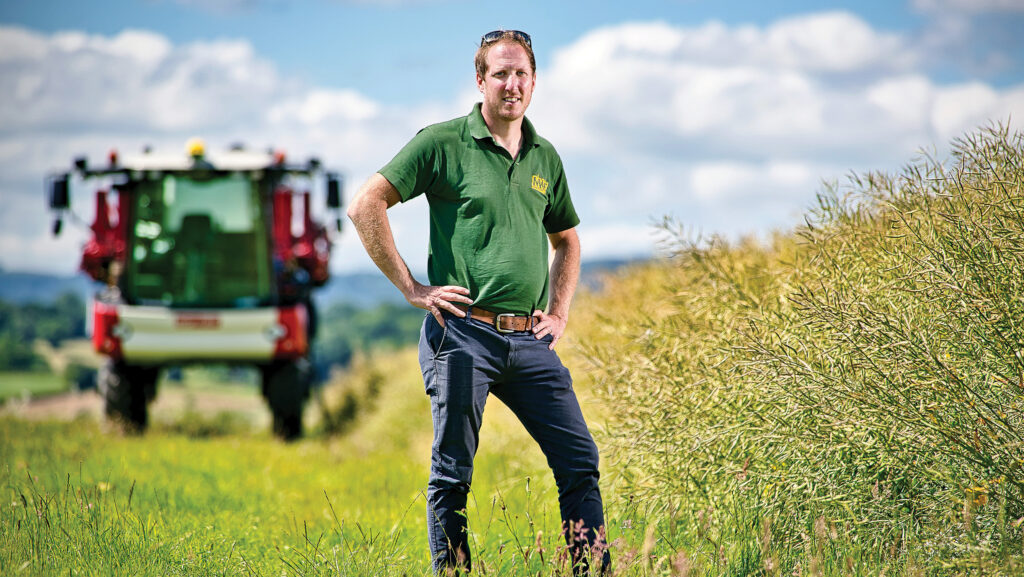 Matthew Williams © Richard Stanton
Farmers Weekly Transition Farmer Matthew Williams is using a grain marketing consultancy to aid his grain sales decision, which has paid off this year with yields down after the hot and dry summer.
See also: All updates from Matthew Williams
Farm facts
Criddon Hall Farm, Shropshire
- Size 1,100ha
- Rainfall 724mm
- Soil Sand to medium, loamy clay
An early autumn uptick in grain prices will allow Matthew Williams to hit his cropping budget even though his wheat yield was down by 20%.
Weeks of searing temperatures and no rain took its toll on Matthew’s combinable crops, but since he only forward-sold 15% of grain, he could capture an enhanced price of up to £30/t with later sales.
See also: BYDV: Lessons from 2026 on how to reduce risk
“We played the market and sat on our hands with the balance of our tonnage and that has worked in our favour,” he says. His decision-making on sales is informed in part by analysis by an independent grain marketing consultancy he subscribes to.
Matthew started using that service two years after he first established his arable farming enterprise and, by acting on the advice, he calculates that his business was £60,000 better off, making a note in his dairy of when he sold grain and when he would otherwise have. Gut instinct plays a part too, but that independent advice means he can keep track of markets.
“It’s a big driver behind grain sales for me,” he says.
The cropping plan will see all but 100ha of the 971ha farmed sown to winter crops, even though it will mean a higher spend on herbicides. However, as Matthew points out: “It is a risk worth taking to get a crop in the ground and fill the sheds with grain next year.
“We will be quite robust with pre-emergence treatments to get on top of grassweeds so we are not chasing a weed burden in the spring, because when you do that, you are on a hiding to nothing, you might as well be burning £50 notes.”
A Vaderstad Rapid drill is being used to establish the crops and, when conditions dictate, they bring in a Claydon drill that Matthew has used more widely in other years.
He has some reservations about losing potential yield from the inter-row gaps left by the Claydon, concerned that he could be missing out on potential yield.
“If there was another row of wheat between the rows we would have more wheat in the field and less risk of losing moisture,” he says.
To maintain soil structure, Matthew is not running a deep-leg cultivator through the majority of the land, discing it instead to scratch the top three inches with a Vaderstad carrier in front of the rapid drill.
Transition goals
- Improve profitability and margins
- Continue to improve soil health
- Control and optimise input use
Explore more / Transition
Follow the experiences of our 16 Transition Farmers and access in-depth supplements, expert webinars, live events and practical content covering the challenges and opportunities facing farm businesses.
Transition is an independent editorial initiative supported by our UK-wide network of partners.
Explore the Transition hub for the latest insights, resources and events.
