

Advertiser content
UK trials seek to unlock chickpea break crop potential
Farmer-led trials are putting chickpeas through their paces to find out whether an alternative break crop can deliver both agronomic and market opportunities for UK growers.
For farmers looking to build more resilient and diverse rotations, the challenge is not a shortage of ideas. It is knowing which ideas are worth taking further.
Chickpeas are a good example. The crop has potential as a UK-grown source of a high-value, nutritious food ingredient, while offering some attractive agronomic characteristics.
It fixes atmospheric nitrogen, has relatively few pest and disease issues and could fit well within lower-input and regenerative cropping systems.
But potential does not necessarily translate into a commercially viable crop.
For chickpeas, one of the biggest questions is whether growers can consistently get the crop to ripen evenly enough to harvest successfully, particularly in the cooler and wetter conditions that may occur towards the end of the UK growing season.
A farmer-led project supported through the Accelerating Development of Practices and Technologies (ADOPT) programme is now testing whether growing chickpeas alongside cereals could provide part of the answer.
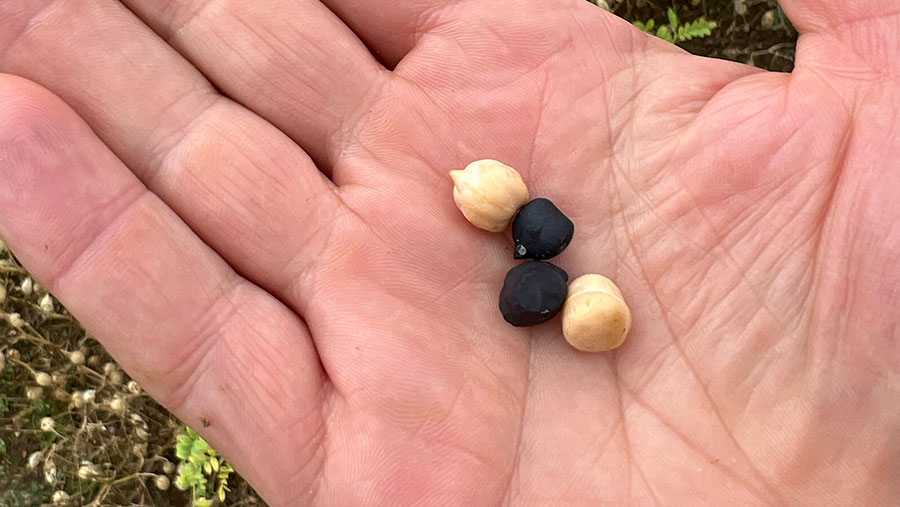
Chickpeas of two types: Kabuli (K), pale coloured, and Desi (D) with dark testa © Niab
Putting the idea to the test
The project brings together farmers, specialist pulse processor and retailer Hodmedods and the crop research organisation Niab, combining practical farming experience with scientific monitoring and evaluation.
David White of Hawkmill Farm, Little Wilbraham, Cambridgeshire, is leading the project. Having farmed conventionally for 40 years, David is now in his tenth year of regenerative agriculture, using no-till direct drilling into catch and cover crops.
He has a particular interest in specialist supply chains and niche crops, as well as experience of growing pulse/cereal bi-crops using minimum-tillage approaches.
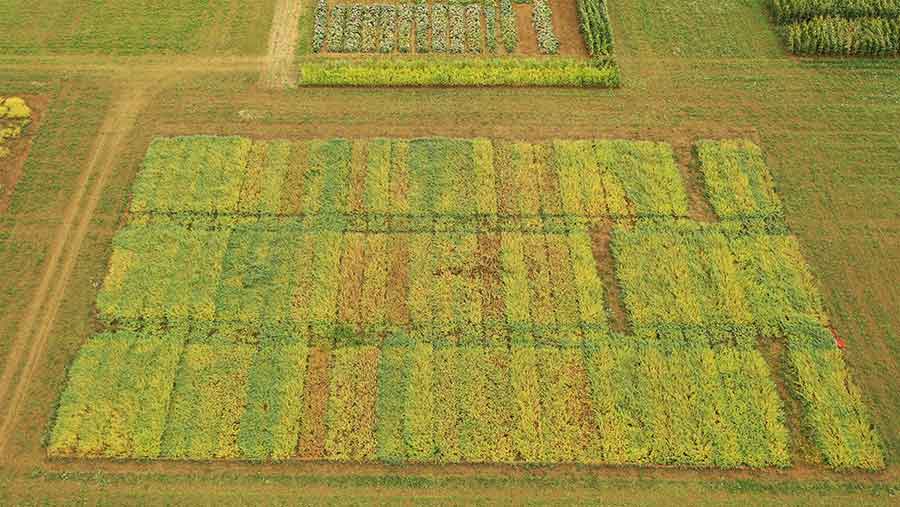
Chickpea seed rate (left), variety (centre) and herbicide trials (right), at Niab Cambridge in September 2024 © Niab
“Chickpeas are an interesting crop because there is clearly a market opportunity, but we need to understand how to make them work reliably in a UK farming system,” says David.
“The attraction of a project like this is that we can test the practical questions on farm, rather than simply assuming that something which looks promising in theory will work commercially.”
Trials are also being carried out at Shimpling Park Farms in Suffolk, an organic farm run by John Pawsey, who has extensive experience of bi-cropping and farmer-led research.
The different farms provide an opportunity to see how the crop performs under contrasting soil and farming conditions.
Can a cereal companion improve harvestability?
Chickpeas are semi-indeterminate, meaning they can continue producing flowers unless conditions become sufficiently hot and dry. That can lead to an uneven crop which presents challenges at harvest.
The project is testing whether growing chickpeas alongside cereals as a bi-crop can encourage more even crop development and senescence.
Two early-senescing chickpea varieties, Flamenco and Rondo, are being grown with different component ratios within bicrops.
The idea is relatively simple: the cereal companion could provide competition that changes the way the chickpea crop develops, potentially helping it ripen more evenly.
But the important question is whether that translates into a better crop in practice.
“This is exactly the sort of question where on-farm experimentation is valuable,” says Colin Peters, Niab’s break-crop specialist and project facilitator.
“We can measure what is happening in the crop, but the farmers bring an essential understanding of how those results fit within a real rotation, with real machinery, soils, weather and commercial pressures.”
The trials will also compare mechanical swathing with direct combining.
Swathing is expected to hasten chickpea senescence and potentially make the crop easier to harvest, but it could also reduce yield.
The project will therefore assess whether any improvement in harvestability justifies the potential trade-off.
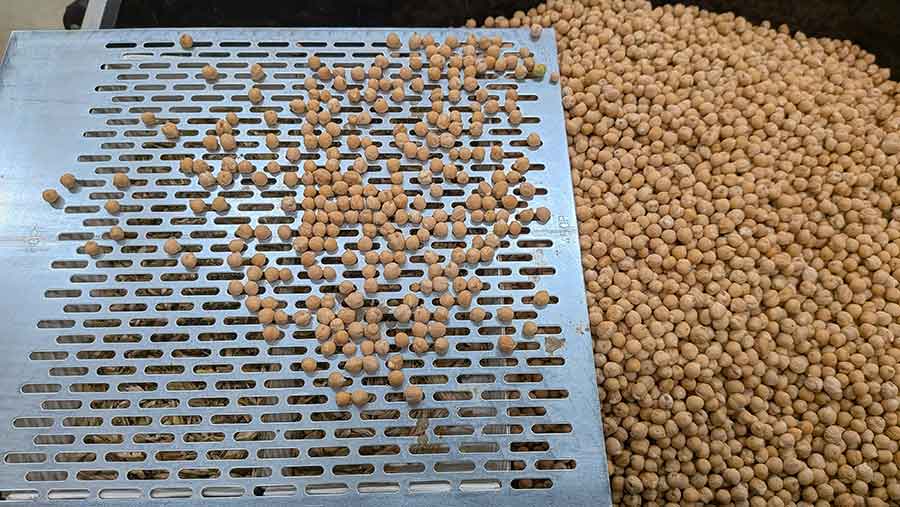
Cleaning high quality chickpea samples from Niab’s 2025 trials © Niab
Looking beyond yield
The project is not simply asking whether chickpeas can produce a crop.
For an alternative break crop to earn a place in a commercial rotation, growers need to understand the wider picture – including crop quality, marketability, effects on the following crop and the overall contribution to the farming system.
The main plots are being grown with Kabuli types, which have the larger seeds commonly used in Mediterranean and Middle Eastern foods.
Smaller plots of Desi types, with their smaller and typically darker seeds, are also being assessed. Yield and crop quality will be measured, with Hodmedods assessing the harvested crop for processing and market requirements.
The project will also look at what happens after the chickpea crop. Soil and tissue nitrogen levels, together with other measures of crop and soil health, will be assessed in the following cereal crop in 2027.
That broader approach is important. A new crop does not exist in isolation; its value comes from how it performs as part of a whole farming system.
Why farmer-led innovation matters
For growers considering an unfamiliar crop or technology, the risks are often greater than simply asking whether it works.
Will it work on my soil? Can I establish it reliably? Does it fit my machinery and labour requirements?
What happens when the weather turns against it? Is there a market? And does it improve the economics of my rotation?
Those questions can be difficult to answer through conventional research alone.
This is where programmes such as ADOPT provide an important bridge between research and commercial farming.
ADOPT projects are farmer-led and collaborative, bringing farmers together with industry and research partners to test innovative practices and technologies under real farm conditions.
Projects include significant measurement and recording, with results and learning shared with the wider industry.
Niab is supporting a number of ADOPT projects, working alongside farmers, growers and industry partners to help turn promising ideas into robust evidence that can inform future decisions.
For Niab, this builds on a long history of working at the interface between science and commercial agriculture – designing and evaluating trials, providing independent technical expertise and, importantly, helping ensure that research findings are translated into information that farmers can use.
“The strength of ADOPT is that it starts with a real farming question,” says Colin.
“Our role is to help make sure that question is tested rigorously enough to produce useful evidence, while keeping the farmer at the heart of the process.”
From trial to knowledge
The value of an on-farm trial does not end when the combine leaves the field. The farmers involved in the chickpea project will lead peer-to-peer dissemination through farm visits and open days.
Demonstration plots and presentations at Niab technical events will provide further opportunities for growers, advisers and the wider industry to see the results.
Hodmedods will also share information through its newsletters, blogs and consumer activities.
For Niab, this combination of research, on-farm testing and knowledge exchange is an important part of helping innovation move beyond the trial plot.
“Farmers don’t need more innovation for innovation’s sake,” says David. “They need good evidence about what works, where it works and what the implications are for the rest of the farming system.”
That is ultimately what the chickpea project is trying to provide.
If the trials identify combinations of varieties, cereal companions and harvesting approaches that make chickpeas more reliable and commercially attractive, they could give more growers the confidence to consider the crop.
And if they show that the challenges outweigh the benefits, that is useful evidence too. Either way, the result is a step towards better-informed decisions.
Niab and ADOPT: Turning ideas into evidence
ADOPT – the Accelerating Development of Practices and Technologies programme – supports farmer-led projects testing innovative technologies and practices against real on-farm challenges.
Niab is involved in a number of ADOPT projects, working with farmers, growers, researchers and industry partners across a range of agricultural challenges.
The projects complement Niab’s wider work to help bridge the gap between research and practical application, combining scientific expertise with on-farm experience and robust measurement.
For farmers, that means creating opportunities to test new ideas in the conditions that matter most: real farms, real rotations and real commercial decisions.
To find out more
Call: 01223 342200
Email: info@niab.com
Visit: www.niab.com and ADOPT Support Hub
Provided by
Niab is a leading UK crop science organisation delivering research, innovation and practical solutions to support productive, sustainable agriculture and horticulture.