Business Clinic: Advice on approach by mineral company
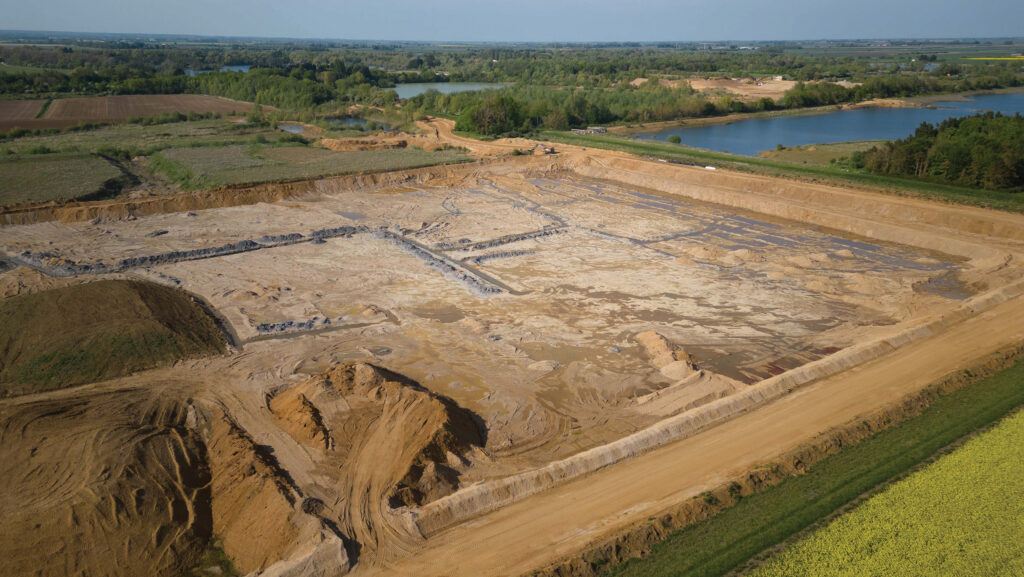 Gravel extraction © Gravel Workings
Whether it’s a legal, tax, finance or management question, Farmers Weekly’s expert panel can help. Here, Carter Jonas partner Paul Clarke advises on what to consider if approached for mineral exploration.
See also: Business Clinic: should we sell solar lease income for lump sum?
About the author
 Paul Clarke is a partner in the minerals and waste team at Carter Jonas.
He almost 25 years’ experience, mainly advising landowners on the promotion, delivery and management of mineral prospects across the UK and Ireland.
He also values mineral and waste management assets for taxation, compensation and loan security purposes.
Paul has a BSc (Hons) in Minerals Surveying and Resource Management, is a chartered minerals surveyor, member of the Institute of Quarrying and is a Royal Institution of Chartered Surveyors valuer.
Q: I have been approached by a quarry operator company that would like to investigate potential sand and gravel deposits beneath part of my land. They’ve asked about carrying out some initial investigations to see if extraction might be possible.
I’m interested in finding out if this could provide another income source but I don’t understand what would be involved in the process or what it might mean for the land in the long term. What should I consider before agreeing to the investigation?
A: Many landowners are receiving approaches like yours, and the timing is no coincidence. Sand, gravel and crushed rock are the raw ingredients of concrete, mortar and other building products.
House-building ambitions and major infrastructure projects depend on a steady supply of materials, yet sales are outpacing the rate at which reserves are replenished through new planning permissions. Consequently, mineral landbanks are shrinking in many areas of the UK.
Mineral planning permissions are also becoming harder and more expensive to secure, putting operators under pressure to find good resources in the right locations.
Only intrusive investigations, such as sinking boreholes and taking samples, will confirm the true nature of any resource beneath your land. Never agree to this on a handshake.
Instead, agree an exploration licence, ideally on your terms rather than the company’s.
It should include commercial terms, indemnities covering surface damage and buried services, compensation and, crucially, access to the data generated.
If the operator decides not to proceed, the borehole results and geological analysis are a valuable commodity you can take ownership of.
Exploration payments are usually modest, but it is normal for the company to cover your professional fees, making this a virtually risk-free exercise if handled correctly.
Proven mineral volumes
The key outcome for a landowner is the proven volume of viable mineral.
Setting up a quarry involves heavy upfront costs, so for sand and gravel, operators typically want at least 1-2m tonnes – enough for a 15 to 20-year project.
For greenfield sites, closer to 4m tonnes may be a more realistic requirement.
If the resource stacks up in scale and specification, the usual route is an option to take a lease of the land and minerals.
Options typically run for two to three years and are conditional on achieving planning permission, which can take 12 months or longer to determine.
The lease is likely to run for 15-20 years, or a period reflecting the scale of the opportunity.
Planning applications require an Environmental Impact Assessment addressing issues such as noise, dust, traffic, ecology, heritage, landscape and water.
In my experience, effective mitigation and a well-managed site can help to address local concerns where they arise.
I generally favour a lease agreement for extraction. Royalties are paid on every tonne sold, so income rises if the site outperforms expectations or more mineral is recovered than predicted.
Royalties on 200,000-300,000t a year soon add up, and ensuring you are paid fairly for every tonne is key.
Make lease work for you
Remember that once minerals are extracted and sold, they are gone for good, so you have one chance to get the deal right.
A strong mineral lease does more than secure the best price. It should protect you from liability if the operator defaults and leaves you with a costly restoration bill.
It should also give you the right to monitor what happens on your land and engage with your tenant on operational decisions.
Many farmers worry a quarry will wipe out their business, but extraction and farming can usually coexist, albeit at adjusted scales. Sites are worked in phases.
On a 70ha scheme, the first phase might take 12ha while you farm the balance, with the operator giving notice each year of the next area required. Worked land is restored and handed back progressively.
Potential diversification opportunity
Restoration can return land to agriculture, or to water, which some owners have used as a springboard into leisure and tourism.
Given the complexity and the one-off opportunity to capture best value, I recommend appointing a chartered mineral surveyor rather than a general land agent.
This is a specialist field where the difference between good and poor advice can run to hundreds of thousands of pounds over a project’s lifespan.
Do you have a question for the panel?
Outline your legal, tax, finance, insurance or farm management question in no more than 350 words and Farmers Weekly will put it to a member of the panel. Please give as much information as possible.
Email your question to FW-Businessclinic@markallengroup.com using the subject line “Business Clinic”.