Farmers Weekly Question Time: Farm profitability heads discussion
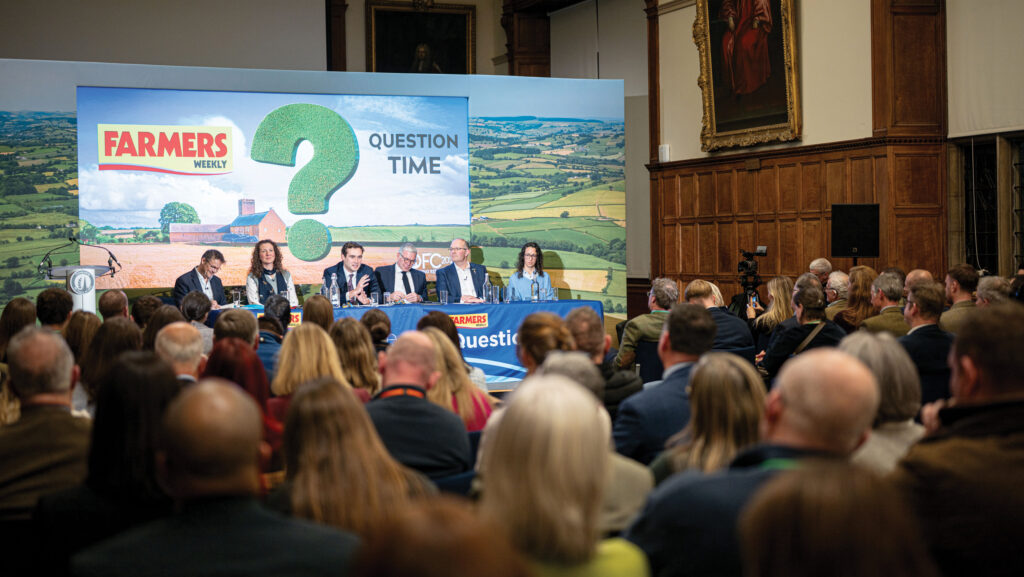 Question Time panel and audience at Oxford Farming Conference © Telling Photography
 Profitability in farming was top of the agenda at the first Farmers Weekly Question Time of the year, held at the Oxford Farming Conference.
A panel of food and farming experts, chaired by Farmers Weekly’s Johann Tasker, took questions from the audience on a wide range of topics, giving attendees the opportunity to air their most pressing concerns and hear industry leaders’ responses.
In a discussion reflecting the challenges faced by the sector, the subjects aired included the Batters profitability review, food prices, IHT campaigning, farm recruitment issues and the future for sharing farm data.
See also: Farmers Weekly Podcast Ep 287: Should we continue campaign against inheritance tax?
On the panel
Tom Bradshaw, NFU president and Essex farmer
Tom farms in partnership with his wife, Emily, and his parents in north Essex. Alongside a small owned farm, they run a larger contract farming business growing a range of combinable crops across 950ha in north-east Essex.
He was elected to the position of NFU president in February 2024.
Peter Craven, head of agriculture at Natural England
In his role with Natural England, Peter collaborates with farmer organisations, industry groups, eNGO’s and policymakers to integrate sustainable practices, ensuring resilient and productive agriculture that supports nature recovery.
Kelly Hewson-Fisher, director and head of rural research at Savills
Kelly joined Savills in 2023 as a director and head of rural research leading a team of 10 researchers.
She is a conscientious, professional leader with more than 20 years of environment, food and water sector experience, and a practical farming background.
Henry Tuffnell, Labour MP for Mid and South Pembrokeshire
Henry lives just outside St David’s but grew up in a farming family, where he spent Easters lambing and summers doing the harvest.
The rural economy is vital to Pembrokeshire and Henry is committed to representing all communities across Pembrokeshire and the country when it comes to farming.
Emma White, produce commercial manager, The Felix Project
The Felix Project is a charity that fights hunger and food waste by taking surplus food from supermarkets, wholesalers and farms, and delivering it free to those in need across London.
What your verdict on the Batters profitability review and what should the priority recommendations be?
NFU president Tom Bradshaw welcomed the report and acknowledged the impact it could have on the farming sector, providing it became the catalyst for delivering substantial change.
“The danger is that only some of the recommendations will be taken up in a piecemeal fashion and we will only see incremental change.
“We need it to do more than that.”
Food production targets were his priority. “We know that a food strategy is being developed and that a Farming and Food Partnership Board is being set up, both of which are important.
“We need some numbers attached to these.”
Labour MP Henry Tufnell revealed that the report had landed well in Westminster and had set out the reality for MPs.
“These are tough times for farming and that message came through loud and clear.”
He saw the report as the chance to move forward, following the IHT revisions announced in December.
“It’s drawn a line in the sand. We now have to focus on the profitability challenge and work on getting a better deal for farmers.”
Savill’s Kelly Hewson-Fisher’s main priority was to establish some timescales for the recommendations set out in the report.
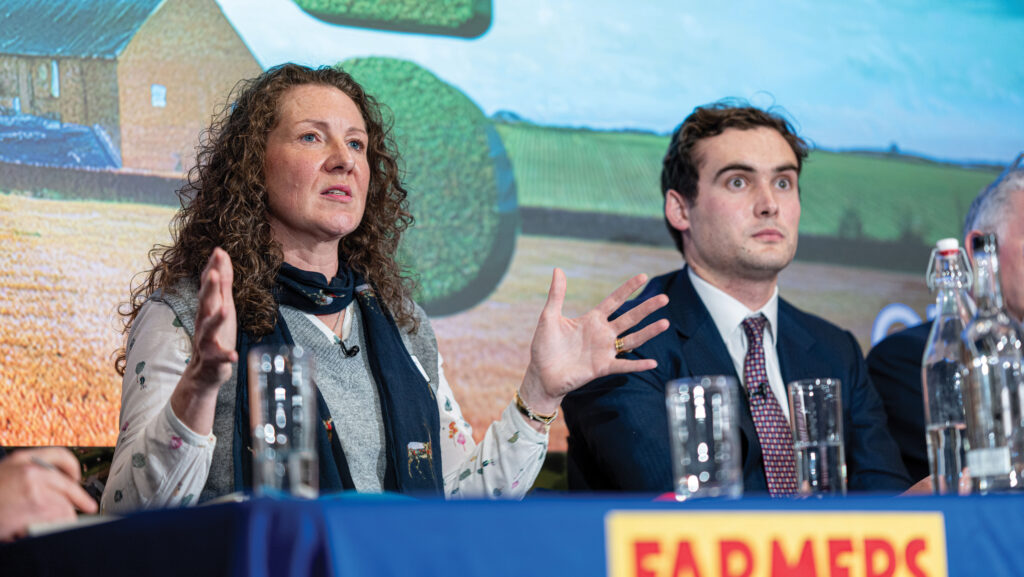
Kelly Hewson-Fisher and Henry Tufnell © Telling Photography
Dividing them up into short-, medium- and long-term goals, which tied in with other strategies, was her wish.
“There is a commitment required from policymakers and stakeholders,” she said.
“We don’t want to see this review just put on a shelf.”
Peter Craven of Natural England agreed and highlighted that farmers need certainty, which is why his priority was also for delivery.
“The report is good. Now we need to see it support food production and give the industry a proper direction.”
Should consumers pay more for food?
The overall aim is to get good food onto people’s plates, said Emma White of the Felix Project, who recognised that farmers as well as consumers were facing rising costs.
“Affordability is a difficult question,” she stressed.
“Our focus is on looking at how we can integrate food redistribution into the farming plan, to prevent waste.”
Mr Bradshaw pointed out that social policy had to work with farming policy where food affordability was concerned.
“We need is a fair marketplace that gives fair returns.
“The cost-of-living crisis is rightly occupying government minds and rebuilding our capacity for food production would help with that.”
Ms Hewson-Fisher pointed out that food accessibility could be just as important as its affordability – a point that Ms White agreed with.
“Transport costs have a bearing, too. We need to connect people with food as well as make sure they can pay for it.”
© Telling Photography
Should the farming industry continue its campaigning on inheritance tax or be grateful that revisions have been made?
Accept that the industry is now in a better place and use this new position to move forwards and start to address some of the other issues faced by farming, said Mr Tufnell.
“I’m pleased that we’ve been able to make changes and raise the thresholds.
“Now, we need farmers and the government to work together constructively.”
Mr Bradshaw added that there was no opportunity to create further change, so further protesting would not achieve anything.
“You must have political will to bring about change. The pressure created meant they recognised that the policy was faulty.
“However, the NFU is a lobbying organisation, not a protest group.
“We need to work with the government on other issues now.”
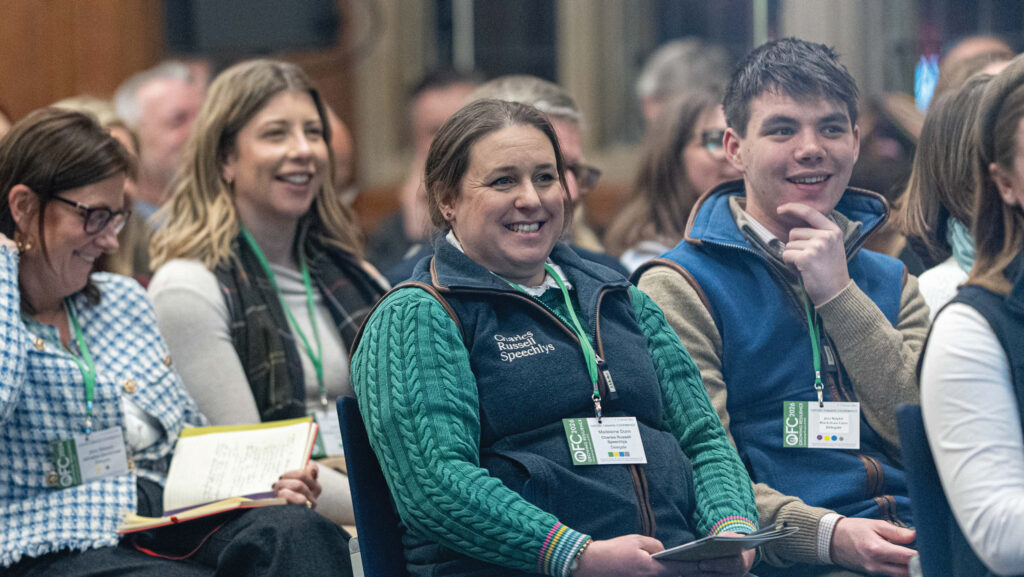
Does farming need to be careful about the language it uses so that new entrants aren’t discouraged from entering the industry?
There’s no shortage of passion and energy among the young people that Ms White has encountered this year, so she believed they are seeing opportunity in the sector.
Paul Craven pointed out that having hard conversations is part of the farming industry now, especially where succession is concerned, so no-one should shy away from the truth.
“Of course, we do have to break any doom loops. Celebrate when we’re doing well and highlight the good wages and flexible working patterns that are on offer.”
© Telling Photography
Should farmers put more trust in data sharing?
Farmers must be at the table when decisions are made about their data, believed Ms Hewson Fisher, so that the conflict between ownership and control was solved.
There is a role for government in facilitating good practice, said Mr Tuffnell, who saw that as being a trusted middleman.
“Moving fast enough for the supply chain is the unknown.”
Mr Craven stressed that data should be used to drive efficiency on farms.
He questioned why some farmers don’t want to share data.
“Is it because they don’t like what it is showing? We have to be honest and truthful where data is concerned.”
What is your one wish for farming in 2026?
- Tom Bradshaw – progress on the trade agenda and in public procurement.
- Kelly Hewson Fisher – for all the strategic and operational planning to come to fruition.
- Peter Craven – to see farming businesses develop the resilience they need for the future.
- Henry Tufnell – a reset in the relationship between government and farming along with a rebuilding of trust.
- Emma White – for farming to continue seeing the benefit of food redistribution.
Question Time sponsor

Whether you’re managing a multi-generational change, looking for support in navigating the new grant funding options, wanting valuations for your property and assets, or needing some practical guidance on balancing farming with the developing environmental opportunities, we’re here to help.
Whatever the rural property advice needed, we can provide support and guidance across a spectrum of services.
Visit our Savills Rural Knowledge Portal where you can find an array of information on the rural sector.