Growing number of farm kit sales shows scale of restructuring
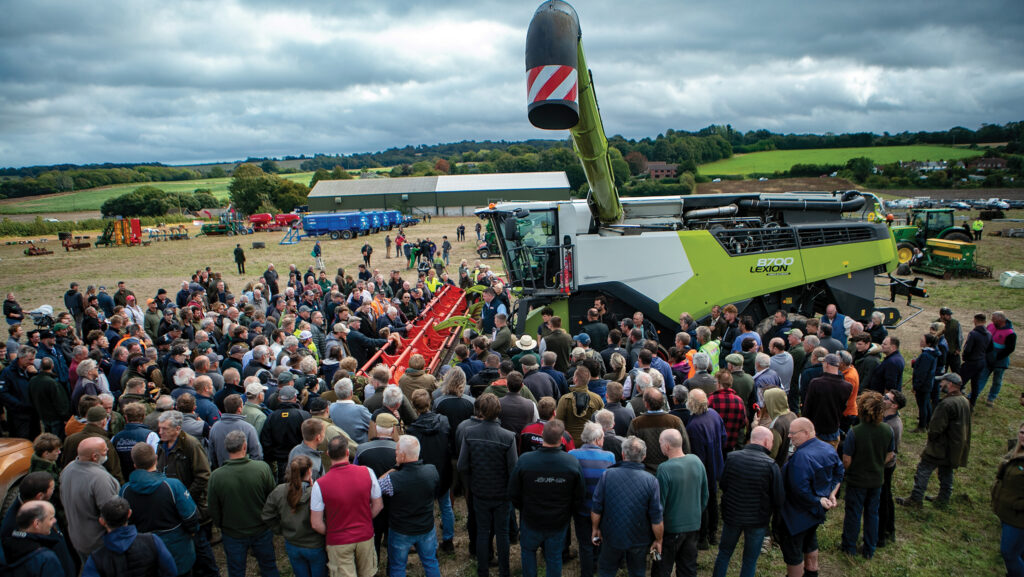 A large Kent dispersal by Hobbs Parker Auctioneers saw good prices for the well-maintained kit © CombatMoosePhotography
 Farm dispersal sale numbers are up significantly this autumn.
In the three weeks to 11 September 25 sales were advertised in Farmers Weekly compared with 17 in the same period last year. These have been mainly arable sales on the eastern side of England.
While September is traditionally a busy month for farm machinery auctions, this year Cheffins is running the busiest September in its 200-year history, says chairman Bill King.
See also: How do I plan for tax on retirement farm sale?
The firm has 12 sales booked across seven counties in Nottinghamshire, Suffolk, Hampshire, Hertfordshire, Norfolk, Cambridgeshire and Essex as well as its monthly Cambridge Machinery Auctions, at Sutton.
Some of these would have occurred naturally, but the degree of farm business restructuring is driving the increase, with retirement accounting for a growing proportion.
After several challenging arable years, some retirement decisions are being made earlier than expected, quite often because there are no successors wanting to take on the business.
Some sales are bank led, others because a significant change in land use is planned.
Contractor businesses are also seeing a higher number of retirements and restructures.
“A large proportion of the sales, in fact 80%, are on behalf of farmers who are retiring, changing their farming policy, or, in one case, selling the family farm altogether,” says Bill.
This trend is also happening among the largest agricultural businesses and estates in the business, he says. Examples include sales as a result of Velcourt’s restructuring, and the auction for the 4,250ha Euston Estate, where a decision has been made to use a local contractor with whom there is already a long-standing relationship.
Whether for retirement, putting land to alternative uses, taking up environmental schemes or entering contracting farming agreements, an auction releases cash quickly, paying in just a few days.
However, for some in contract farming agreements things are challenging, with some contactors walking away from land or not renewing agreements because the financials don’t stack up.
Machinery values holding up
Conversely, some businesses are scaling up, both farmers and contractors.
The UK second-hand market is still very strong because of the high cost of new kit, says Bill.
“Demand is still there for good-quality machinery, particularly if it has come straight from farm.”
The low level of new machinery investment has meant a slight drop in lot numbers at the firm’s monthly collective auctions, but a rise in average lot value.
There is a trend to some of the kit at sales having done more hours than one would expect for, say, a 400ha operation, says Bill, again reflecting the challenging cost of new replacements.
UK farmers are currently stronger in the market than the dealers, he says, and are also outbidding the export buyers in many cases.
“A few years ago, for every 10 tractors we sold on farm, seven or eight would be bought for export and two or three by farmers – now it’s the other way round.”
Demand is changing
However, some who might have been wanting a second-hand 250hp tractor in the past are now going for a 150hp model if they can make that do, says Bill.
Also, while 5,000 hours was a threshold above which many buyers would not be looking in the past, they are now interested in those that have done 6,000 or 7,000 hours.
The tractor brands most in demand are John Deere, New Holland, Claas and Massey Ferguson.
South and South East
John Rossiter is managing director of Kent-based Hobbs Parker Auctioneers and held a large mainly arable farm dispersal in Hampshire this week.
There are more sales to come in the South and South East, he says, but some slow land and farm sales in the firm’s region have held up dispersal date bookings.
“Purchasers are wanting to see what happens – it’s a difficult time to make a big move,” says John.
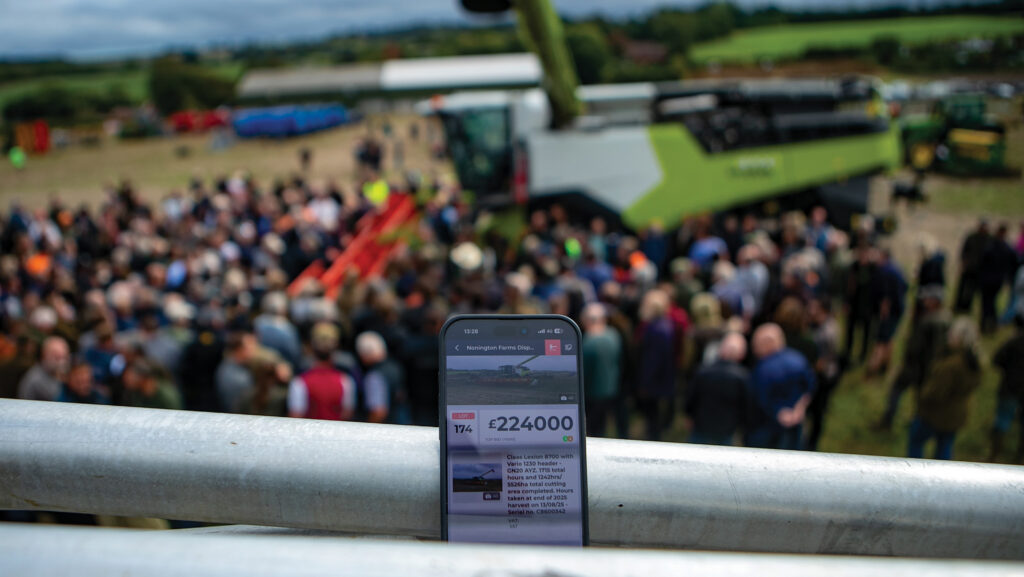
© CombatMoosePhotography
The high cost of new machinery – at £1,000/hp, plus a 7% or 8% finance cost in many cases – is killing the arable job, he says, and he is seeing contract farming agreements ending as they no longer stack up financially.
“The loss of BPS [Basic payment Scheme] has hit hard across both arable and livestock businesses. That hole will need a lot of filling.”
Well-presented kit will always sell well but machinery should ideally be marketed at a relatively quiet time in advance of the season of use and there are sometimes particular seasonal opportunities.
For example, combines available to buy at the end of harvest in south-east England can sell well for movement to Scotland while harvest there is still under way.
John prefers in-person auctions, which now almost always have online bidding running alongside the live event.
“You can see what you’re getting and tell the quality, which isn’t always so clear with online-only sales,” he says.
Yorkshire sales
York Auction Centre, which incorporates Boulton & Cooper and Stephensons Rural, has regular monthly sales.
Machinery sale manager and auctioneer Will Amos says these are growing, as is the number of dispersal sale bookings.
He sold a large machinery fleet on behalf of two retiring neighbouring tenant farmers this week.
Another sale is booked for October and already there are five dispersals in the diary for spring 2027.
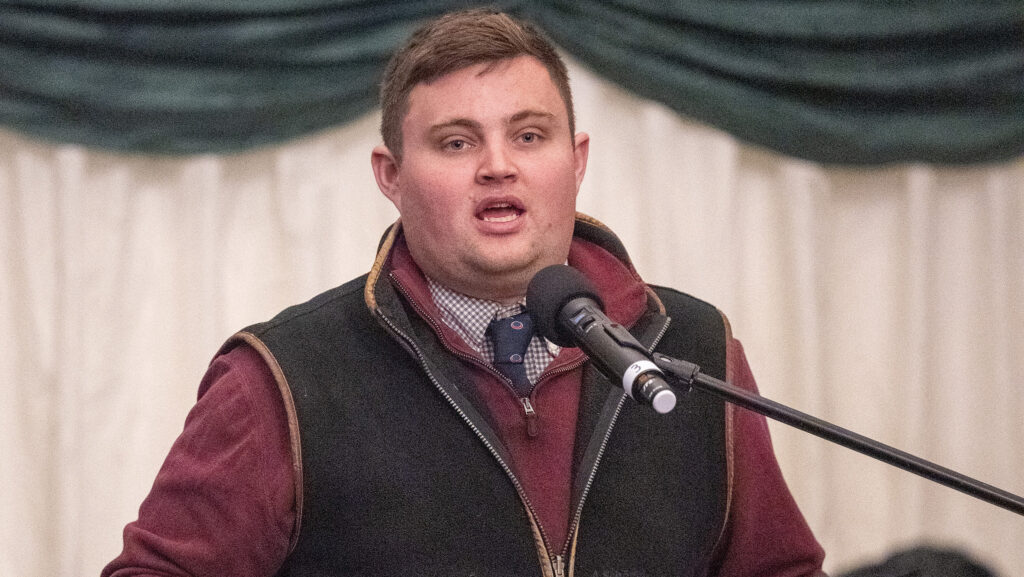
Will Amos © Wayne Hutchinson
“We’re also seeing a lot more partial reductions coming through the monthly machinery sale,” he says.
“The pig sector is struggling at the moment and we are seeing more arable farmers re-evaluating their machinery needs. Values are holding up as the quality second-hand kit isn’t filtering through, due to the decline in new sales.”
The collective sale regularly sees 5,000 lots entered, with more than 1,000 of these tractors and machinery.
Will reckons that for the right kit, a new year sale can be better than an autumn event, with perhaps a little more optimism around at the start of a year.
He has found that many older farmers are choosing an online-only sale, because this offers a degree of privacy and avoids having a big crowd on farm.
While the background to a sale can sometimes make for a somewhat solemn event, the buzz and energy of an in-person auction at the right site and with the right kit can be very positive, he says.
Export markets
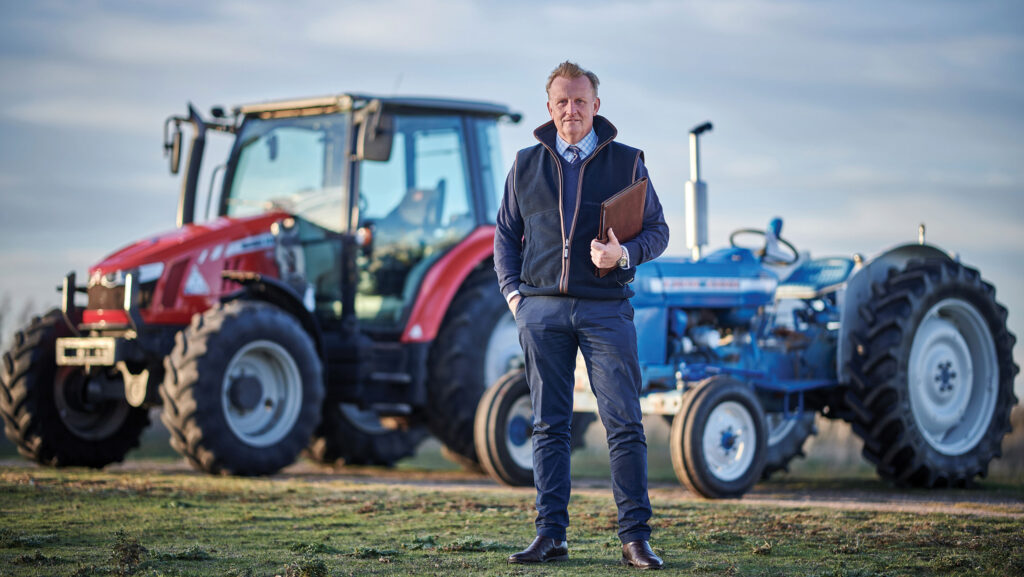
Cheffins’ Bill King says well over 50% of second-hand kit offered by the firm is sold online © Cheffins
Most sales see keen export buyer interest. Cheffins reckons about 50% of tractors from its Cambridge Machinery sales are bought for export, generally the higher hours machines.
The main EU destinations are Spain, Poland and Ireland. For export to any part of the EU, kit must be scrupulously clean and certified by the Animal and Plant Health Agency for England and Wales, the Scottish Agriculture Science Agency for Scotland and the Department of Agriculture, Environment and Rural Affairs for Northern Ireland.
This is organised after the sale by the auction company. Other common destinations are New Zealand, Australia, the US, Canada and Africa.
Continental buyers are generally looking for wider kit, so 6m and 8m drills and cultivators, says chairman Bill King, with EU buyers cashing in on sterling’s weakness since Brexit.
Advice – sale considerations
- Lead time for organising a sale – ideally a minimum of six to eight weeks, but can be done in four to five weeks, at least that long is needed to get a good run at marketing the sale
- Best prices – usually be achieved when sales are held in a relatively quiet farming time just in advance of the seasonal use of the kit offered
- In person, online or both – the choice is down to the personal preference of the seller, often guided by the reason for sale or the logistics such as car parking and access, as it’s not unusual for there to be 200 cars at a sale with only 200 lots on offer. Security and privacy are also considerations
- Benefits of an on-farm sale include buyers liking to see the farm kit has worked on, and to also get an overall impression of how well it has been looked after – the state of the workshop can say a lot.