How care with contractor instructions protects both sides
 © Tim Scrivener
 The costs of failure to properly organise those providing services to the business but not directly on the payroll can be a combination of personal, financial and reputational impacts.
See also: Why farmers should have a health and safety emergency plan
There is a duty of care in both directions when contractors are employed, whether this is for an agricultural or other operation, such as building or repair work.
Farms and estates are legally responsible for the safety of everyone on site, including contractors, delivery drivers and visitors, points out Robert Gazely, partner responsible for health and safety at adviser Ceres Rural.
Root of misunderstandings
“Contractor accidents often stem from misunderstandings about who controls what, how work should be done and what site rules apply,” says Robert.
“Farms and estates should assess contractors’ competence, safety and suitability for the work to be undertaken. They should be appointed formally, which means confirming expectations, responsibilities and reporting lines.”
While this can sound onerous, especially where long-standing arrangements have worked on a verbal basis and there may be concern about risking a relationship, the other risks outweigh this, says Robert.
“The farming industry often functions on a good deal of informality and trust – these are wonderful qualities, but there is still very much room to professionalise the approach on both sides.”
Verbal agreements are legally binding, but are much more difficult to evidence than those in writing.
The information those using contractors need to gather includes:
- Health and safety statement of intent and policy
- Training certificates and records, qualifications and trade registrations
- Risk assessments and method statements for the work
- Certificates of public and, where applicable, employers’ liability insurance
- Equipment and machinery maintenance and inspection records
- Control of Substances Hazardous to Health data for chemicals or other hazardous substances to be used
- Work at height, in confined spaces or machinery safety procedures where relevant
- Accident, incident, near miss and enforcement history to help judge reliability
- Instruction and supervision arrangements, especially for temporary or seasonal staff
- Previous experience and references for similar work undertaken
This helps not only to assure that the contractor is suitable for the work, but also protects the business in that it is able to show that it has carried out and documented the checks.
On the other hand, farm business owners and managers have a duty to provide a safe working environment for anyone on their premises.
So, in addition to any instructions about the actual work to be carried out, such as field maps and locations, they need to provide clear information about site rules, including biosecurity, procedures and traffic routes – and these should be enforced consistently for staff and contractors alike, says Robert.
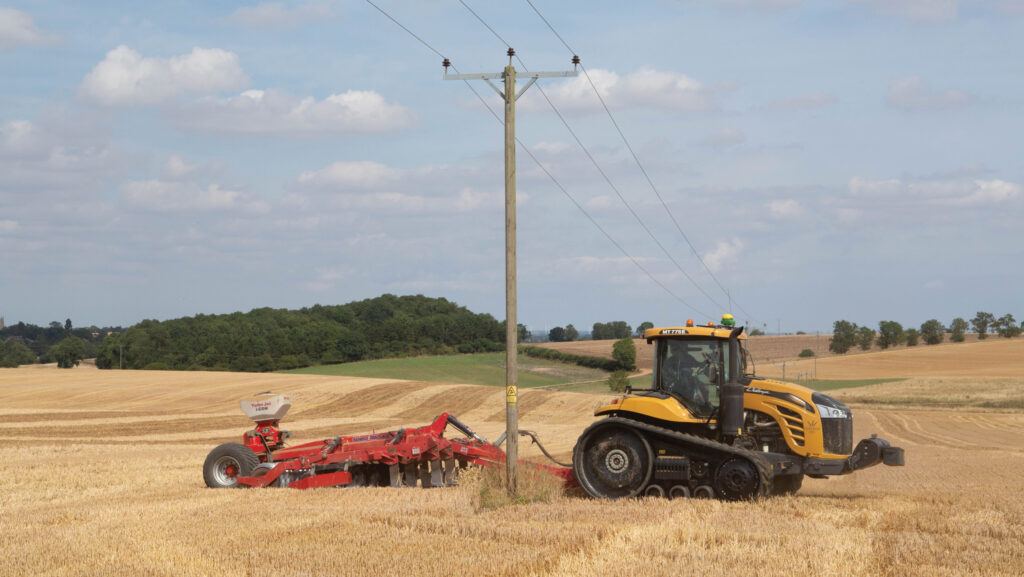
Other essential information includes any known hazards such as overhead powerlines or underground cables relevant to the work, what to do in an emergency, what other activities are happening on the day, any public rights of way in the working area, points of field access and exit.
Changes to work
Jobs frequently evolve from the original instruction – it is important that any changes are communicated clearly, recorded and with risk assessments and method statements updated where necessary, says Robert.
National Association of Agricultural Contractors (NAAC) chief executive Jill Hewitt reinforces the need for good information to be given on both sides and highlights the increased danger presented by some types of seasonal work: “If someone is beet harvesting at night and they don’t know about overhead power lines that’s a massive risk.”
Jill reiterates the public footpath warning and adds that if there are any sensitive residents close to where the work will be carried out, the contractor should be informed of this, as well as any shared access arrangements.
“And if there is any risk of children being around, which there shouldn’t be, then this must be flagged too,” she says.
Dealing with waste is an area where there can be issues, so if any waste is created as a result of the job, such as spent sheep dip, empty containers or plastic waste, it needs to be agreed and clear who will dispose of it and how, ideally in writing, says Jill.
Payment issues
The NAAC has a set of terms and conditions for members’ use and while the practical working and health and safety aspects of using contractors are the main areas covered here, late payment by customers is frequently an issue for contractors.
If there is a problem, or there is likely to be a problem with payments, she urges farmers to contact their contractor.
“Payment plans can be put in place if things are tight. Both sides need to flourish and make money.”
Contractor assurance scheme
For 15 years the NAAC has had an Assured Land Based Contractor scheme, audited by Supply Chain In-Sites. To become assured, contractors have to meet criteria in one or more of several sectors, currently covering mobile feed processing, agricultural operations, mobile seed processing and potato fogging.
The iceberg effect – costs
For every £1 in the immediate direct and insured costs of accidents and incidents, there is an estimated £10 of indirect and uninsured costs, says Ceres Rural’s Robert Gazely.
These add up in reduced productivity, staff replacement and reduced morale, clean-up costs, increased insurance premiums and reputational damage.
What can go wrong when correct practice is not followed
Case study – poor spraying practice
A spraying contractor is booked to apply herbicide to a block bordering public footpaths and neighbouring gardens.
The farm has seasonal staff working nearby and livestock in adjacent paddocks.
The contractor receives verbal instruction from the landowner and begins spraying mid-afternoon.
The wind increases and becomes gusty. Spray drift affects an adjoining garden boundary and a public footpath.
A member of the public walks through the edge of the treated area and later complains of skin irritation and odour.
Separately, a farmworker in a nearby area reports eye/throat irritation.
Immediate impacts include potential formal complaints and ill-health claims, reputational harm, operational delay, and regulatory scrutiny if allegations suggest unsafe use, inadequate control of exposure, or poor planning.
Management failures include no pre-qualification of contractor’s competence and documentation (health and safety policy, public liability insurance, PA1 PA2 National Register of Sprayer Operators, National Sprayer Testing Scheme, recommendation from Basis-qualified agronomist), no co-ordination with other site activities, no notification to the contractor of public rights of way, no consideration of livestock locations and restrictions, emergency arrangements or incident reporting expectations.
Case study – welding fire
A contractor is hired to repair and reinforce steelwork in an old machinery shed.
The job involves welding and cutting near stored machinery, fuel containers, hay/straw, and a mezzanine with miscellaneous storage.
While cutting, sparks fall through gaps in the steelwork onto dusty straw and debris in a corner.
The contractor finishes the cut and moves to the next bay. A smoulder develops unnoticed.
About 30-45 minutes later, flames take hold and fire spreads into stored materials.
The contractor runs round the farmyard until he finds the owner and tells him what is happening.
The owner rings two other members of staff who are elsewhere in the yard and tells them to meet him at the workshop.
In their confusion, nobody agrees who will ring the fire brigade and it isn’t until they meet that they realise this hasn’t been done and call 999.
Management failures include no review of risk assessments or method statements, no site rules communicated, inadequate housekeeping (work area not cleared and combustible materials remained nearby), no supervision of the contractor, no emergency procedures, contractor not briefed on locations and access routes for fire extinguishers, no system for raising the alarm in the event of fire, no formal fire assembly point, and water supply not known to the contractor.
Immediate impacts include fire damage to buildings and equipment, smoke damage to machinery, and operational disruption during a critical seasonal period.
Case study – plastering accident
A plastering contractor is booked to carry out plastering work on the refurbishment of a farm office.
The farmer tells the contractor there is a tower scaffold on site that the contractor can use.
The contractor arrives and the farmer verbally asks if they are happy using the tower scaffold – the contractor confirms they are.
The contractor builds the tower scaffold to a height of 2m with no edge protection.
As the contractor can’t quite reach the work area he puts a 1.8m stepladder on top of the tower scaffold.
While plastering, the contractor reaches off the ladder, which causes it to become dislodged and the contractor falls to the ground, sustaining several bone fractures, but fortunately no critical injuries.
Management failures include no pre-qualification questionnaire of the contractor’s experience, insurance, health and safety policy, risk assessments, method statements or training records, and no supervision of the contractor.
Being Riddor reportable (the Reporting of Injuries, Diseases and Dangerous Occurrences Regulations 2013), the Health and Safety Executive is notified and, despite eventually understanding that the casualty was a contractor rather than an employee, still charge the farm business with failing to adequately plan, manage, monitor and co-ordinate the contractor who should have been under their supervision.
While the HSE accepts that the farm business has, since the incident, implemented a procedure for verifying and recording competence of contractors, its fee for intervention is still invoiced to the farm business and comes to just under £3,000.
Source: Ceres Rural