Insurance mistakes that could leave farmers out of pocket
 © Tim Scrivener
 Insurance is a big farm cost and premiums are rising by 5-10% a year, according to latest figures.
However, there are multiple reasons why that investment could be worthless at the point of claim.
Claims can fail, and that is often because policyholders haven’t fully understood the cover and its exclusions, limitations and terms and conditions.
See also: Stacking income: What is it and how to do it on farm
“No one likes paying for it but if we want it to work when we need it to, it is worth taking time to get it right,” says independent broker Nigel Wellings.
“Farmers will ask for an insurance quote but warn me that if I’m going to ask lots of questions, they’d rather not bother.
“But it’s not just a pricing exercise – this stuff really matters if they want that insurance to kick in, in their hour of need.”
Disclosure of information
The principal reason why companies reject a payout is the policyholder failing to disclose information.
“If there is a disagreement over a claim it can often be because the farmer hasn’t disclosed a ‘material fact’ – anything that might have changed the underwriter’s view of a risk when the policy was taken out,” says Nigel.
Often it is not because the farmer has deliberately withheld information, but they simply didn’t understand how that fact could have any bearing on insurance – the farm’s location next to a power station perhaps, or the site of special scientific interest (SSSI) on their land.
In the case of an SSSI, if the farmer is seeking a payout for a vehicle stolen from the farm, the insurer could rightfully argue that the designation draws people to the farm and those visitors would have been identified as a risk in the policy.
Insurance is a legal contract and farmers should treat it seriously, advises Nigel, who is chairman of Acres Insurance Brokers.
“If they don’t give the correct information at the time they are taking out insurance, when it comes to making a claim they might find it is not worth the paper it is written on. Do it and do it properly, or don’t bother.”
Independent brokers have a professional duty to tease as much from the client as possible to ensure all the correct information is provided to the underwriter.
“We work on behalf of a client to hopefully avoid disputes occurring at point of claim, but we also rely on clients disclosing as much as possible,” says Nigel.
“Clients should rack their brain about what could be considered a material fact.”
Claims history
The policyholder’s past five years of claims history must be provided, including an accurate list of claims and sums paid out.
It is not enough to state that they think that about three years ago there was a claim for a fire on the farm and the payout was about £10,000 – the figure needs to be the exact sum paid and the date it was paid.
The farmer has a right to request that information in writing from their insurer at that time.
The purpose is to avoid dispute at the point of claim, says Nigel.
“It is much better to submit material facts at the time the policy is taken out or when the risk changes.
“It is more convenient for everyone to deal with a potential problem there and then so that it doesn’t become a problem at the point of claim.”
Non-disclosure of facts
During the course of a policy the client is under a legal obligation to notify the insurer of any material change to risk.
The insurer should be notified about changes at the time they become effective – the policyholder shouldn’t wait until renewal date.
Material facts that are commonly not disclosed include:
- Penalty points on a driving licence
- County court judgments
- Bankruptcy or insolvency involving a partner or director of a farm business
- Modification of a vehicle – fitting tyres that are wider than standard to a farm vehicle, for example, or having the engine “chipped” to improve its fuel consumption.
Vehicle use
Most farm fleet policies will cover drivers for using vehicles in connection with the farming business and for social, domestic and pleasure purposes.
However, if a spouse has a business or job that is not connected to the farm and uses the vehicle for work without informing the insurer, the chances are they won’t be covered by that insurance.
Farmers might not disclose this because they are concerned it will bump up the premium, but this is shortsighted, Nigel warns.
© birdsonline/iStockphoto
“If they don’t disclose these things, they run the risk of having no cover at all, whereas if they did so in the first place we could negotiate something with the insurer.
“Yes it might increase the premium by 5%, or the insurer might stipulate a higher claims excess, but that could be done in good faith at the start.”
The farmer is immediately on the back foot if at the point of a claim the insurer finds out something they feel they should have been told about at the outset.
However, the 2015 Insurance Act states that insurers shouldn’t throw out a claim unreasonably if the non-disclosed material fact isn’t relevant to the claim.
Electrical certificates
In the case of a farm policy, if one of the conditions is that all buildings must have a valid electrical certificate and a straw stack catches fire outside a building that doesn’t have one, in Nigel’s opinion it would be unreasonable to turn down a claim for the fire damage.
“The non-disclosure of the lack of an electrical certificate has no effect on this claim,” he says.
The type of insulation in a farm building would be regarded as a material fact to insurance risk.
© Paul Burton/iStockphoto
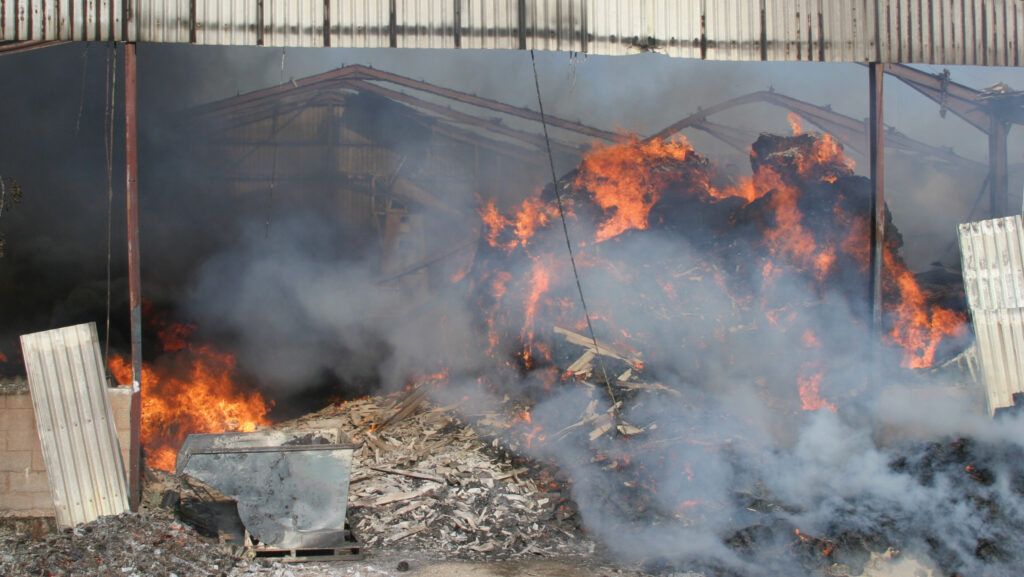
Insulated buildings carry a far greater fire risk than a conventional farm shed built from steel, concrete panels and a fibre cement roof. If a building has spray foam insulation or insulated panels, the insurer should be told.
Another source of conflict is use of a building. If a shed has always been used for agricultural purposes but it now houses a storage facility operated by a third party, the insurer should be notified.
If they are not and there is a fire in the building, the insurer would be entitled to throw out a claim.
Legal compliance
In the terms and conditions of every insurance policy is a clause that states the policyholder must comply with all relevant and current legislation.
This includes observing the maximum gross train weight of a trailer towed by a tractor.
“If there is an accident and the trailer is overladen, an insurer is quite within their rights to chuck out the claim,” says Nigel.
That is also true if a commercial vehicle doesn’t have an MOT certificate, or if equipment hasn’t been maintained in good order.
In one accident, which involved a runaway tractor, Nigel says the insurer wouldn’t pay out because the handbrake was faulty and the brakes poor. Therefore, the vehicle was deemed to be not properly maintained.
Bald tyres could be regarded as non-maintenance too.
The insurer could also challenge a claim if keys had been left in a vehicle when it was stolen, and there are means of proving this even if the claimant fails to disclose it.
“One of the first things the insurer will ask for is the set of spare keys,” says Nigel.
“We have known of cases where those keys have been forensically examined and the insurer has established that they have had very little usage and requested the other set, which were of course in the vehicle.’’