Why tax planning is still crucial despite IHT concessions
 © Adobe Stock
 There is little doubt that the increases to inheritance tax (IHT) thresholds announced by the government just before Christmas 2025 will take a huge number of farmers out of the firing line.
Speaking at last month’s NFU Conference in Birmingham, Defra secretary Emma Reynolds said the changes mean “85% of those claiming agricultural property relief will not now pay inheritance tax”.
And new figures from land agent Strutt & Parker suggest that Ms Reynolds is probably not far off the mark – so long as farmers take some key actions.
See also: Advice on minimising IHT impact on pensions
“The government’s decision to increase the IHT reliefs threshold reduces the tax burden facing many farm businesses substantially,” says the firm’s head of private clients Nick Watson.
“But it does not remove the need for careful tax and succession planning, and there are circumstances where options are limited,” he adds.
Inheritance tax allowances and tax rates
- APR and business property relief (BPR) for each spouse is available at £2.5m each
- The couple can also claim normal “nil-rate” bands (worth £325,000 each) and one spouse’s “residential nil-rate band” (worth £175,000)
- Combined assets of £5.825m may be excluded from inheritance tax (IHT)
- Above that, farm assets will be charged at 20% IHT, and other assets at 40% IHT
The analysis
The Strutt & Parker analysis is based on Defra’s Farm Business Survey (FBS) data for 2024-25 – “the same data set used by the Treasury for its own impact assessments”, says Mr Watson.
While it is clear that every farm in the country will be different, the modelling makes various assumptions – the first being that the farm in question is run by a married couple and that each spouse avails of all the reliefs available to them.
These reliefs are applied to a variety of farm sizes, plus an assumed value of £1m for the farmhouse and £700,000 in additional “non-relievable” assets (such as shares or other property).
For example, a 160ha “medium-sized” farm is assumed to have a net worth of about £2.5m, rising to £4.2m once the farmhouse and other savings are added.
A “very large” farm with 385ha is ascribed a net worth of £8.2m, including the farmhouse and other savings.
“If these farm asset values appear lower than expected, this is because the FBS data also includes tenanted land, which typically accounts for 25-35% of a holding’s area,” says the firm’s rural research director Jason Beedell.
Strutt & Parker modelling assumptions
- There are two £2.5m agricultural property relief allowances (APR) available – one each for the farmer and their spouse
- As well as the value of farm assets, the farmhouse is valued at £1m
- There is a further £700,000 of “non-farm assets” available, such as shares or property
- There is time available to gift some assets
Tax planning

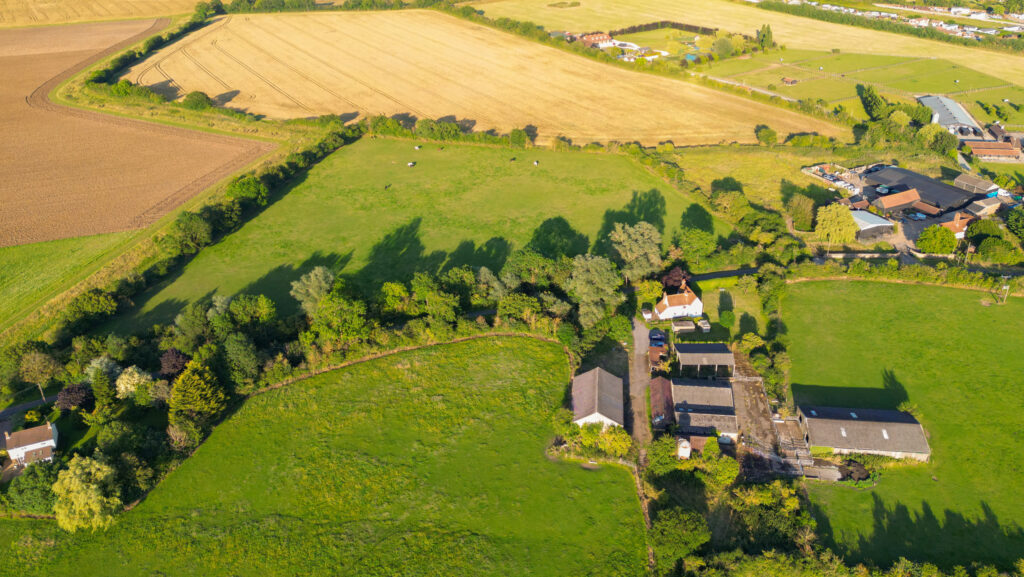
Careful tax planning can significantly reduce IHT exposure for many farms © Adobe Stock
In order to limit exposure to IHT, the Strutt & Parker analysis assumes two different levels of tax planning.
The first is “basic” tax planning, which effectively means dividing the assets between the two spouses to make full use of the reliefs available (though Dr Beedell is quick to explain that this may not mean a 50:50 split, to maximise the “residential nil rate” element of the allowances).
Even with just “basic” tax planning, some smaller farms will avoid IHT. But for many, some level of “additional tax planning” will be required, carried out by spouse two, following the demise of spouse one.
Measures incorporated into the Strutt & Parker analysis include:
- Lifetime gifts to the next generation, equivalent to 25% of the value of the land and buildings
- Livestock and deadstock (machinery, grain stocks etc) transferred to the next generation
- The remaining farmland is “rented” to the next generation on a long lease, so reducing asset value.
“When making lifetime gifts, there is a requirement for the donor to live at least seven years to secure full IHT relief,” says Dr Beedell. “This cannot be guaranteed, so spouse two is likely to need to take out some life insurance as protection.
“This will incur a cost which will vary hugely depending on the age and medical history of the donor.”
Mr Watson adds that, while many farmers can reduce their IHT exposure by taking such measures, the elderly with less than seven years to live – and farmers who are single – will have far less opportunity.
Impact on farms
The impact of these measures is calculated for a range of different farm sizes.
Taking the “medium-sized” farm of 160ha, the data suggests a total net worth of about to £4.2m (see table below).
While some of this will be covered by the various IHT reliefs, not all of it will be – for example, some of the value of the farmhouse and the other non-relievable assets.
As such, the couple would be left with a tax bill of £98,000 if all they did was maximise the use of their combined reliefs.
However, by taking those additional tax planning measures – making lifetime gifts to the next generation (worth £75,000 in inheritance tax savings), transferring livestock and deadstock (worth £91,000), and reducing asset values by long-term leasing (worth £23,000) – the farm will be able to eliminate its IHT exposure.
Assumed asset values for a medium-sized farm 160ha |
|
| Land and buildings | £2,250,000 |
| Live and dead stock | £450,000 |
| Other fixed assets | £3,000 |
| Liquid assets | £115,000 |
| External liabilities | -£300,000 |
| Net worth | £2,518,000 |
| Farmhouse | £1,000,000 |
| Other assets | £700,000 |
| Total net worth | £4,218,000 |
|
Notes: Without tax planning, this farm would face an IHT bill of £98,000, but by making gifts and transferring some assets, it can reduce this to zero. |
|
The Strutt & Parker analysis also shows that, based on similar assumptions, a larger 230ha farm should also be able to reduce the potential IHT to zero.
A large farm of 385ha could reduce its exposure from over £500,000 with basic tax planning to less than £25,000 by adopting the measures outlined above.
“The position for ‘very, very large’ farms of more than 800ha – which are not uncommon in the ‘breadbasket’ parts of the country – is more challenging,” says Mr Watson.
Even with full tax planning, such a farm might have a net asset value of £15.2m and an IHT bill of £925,000 – “unless more than 25% can be gifted while maintaining lifestyle and business efficiency”.
Other considerations
Mr Watson is quick to point out that, while all this is achievable on paper, real-world situations will be much more complex.
“Every family will be different and tax should not be the only consideration when succession planning,” he says.
“As advisers, we work with solicitors and accountants to focus on the practical and lifestyle implications of any tax planning recommendations.
“For example, if gifting more to reduce the IHT burden, the benefits may be offset by the insurance costs, and leave the gifter with significantly reduced income.”
Affordability is still an issue for the very largest farms
As well as reducing the IHT exposure by careful tax planning, the new rules coming into effect from 6 April 2026 also allow for most tax dues to be spread over 10 years.
Using Farm Business Survey data again, Strutt & Parker has estimated the affordability of meeting these dues, based on a farm’s average profitability.
It illustrates that, while many farms will fall out of tax altogether, the very largest will still face a considerable burden.
“With the largest farms still having to pay an estimated 64% of annual profit in inheritance tax, that does not leave a lot for capital investment,” says Strutt & Parker’s Nick Watson.
”However, if the farm is performing in the top 25% band, the percentage of annual profits required to pay IHT installments falls to 18%.”
Inheritance tax burden on farms |
||||
| Medium farm (160ha) | Large farm (230ha) | Very large farm (385ha) | Very, very large farm (810ha) | |
| Net worth | £4.2m | £5.5m | £8.2m | £15.2m |
| IHT liability (basic planning) | £98,000 | £98,000 | £515,200 | £2m |
| IHT liability (additional tax planning) | £0 | £0 | £22,800 | £925,100 |
| Annual IHT liability (over 10 years) | £0 | £0 | £2,280 | £92,500 |
| Annual farm profits (five-year average) | £29,600 | £41,100 | £69,600 | £145,600 |
| IHT liability as a % of profits | 0% | 0% | 3% | 64% |
| Source: Strutt & Parker (Farm Business Survey) | ||||
How could the new Finance Bill be further improved?
While the Treasury decision to raise the agricultural property relief (APR) threshold to £2.5m and for this to be transferable between spouses has been well received by the farming industry, there is still considerable room for improvement.
NFU president Tom Bradshaw says he remains “fundamentally opposed” to the whole concept of inheritance tax being levied on farm assets, (albeit at a reduced rate of 20% rather than 40%).
“It does nothing to disincentivise outside wealth investing in land, risks the opportunity for longer-term tenancies, and jeopardises some of our more productive farming businesses,” he says.
Country Land and Business Association president Gavin Lane says the IHT changes remain flawed and would continue to harm many family-owned businesses.
“In the immediate term, ministers can help by extending the period before which inheritance tax must be paid from six to 12 months, and increase the relief for woodland areas to ensure tree planting isn’t hit by the changes.”
Tenant Farmers Association chief executive George Dunn says he wants to see full APR being made available to those landlords who are letting farms, including farm business tenancies, for 10 years or more.
“Secondly, the inherited value of joint tenancies should not be assessed for inheritance tax,” he said.
“The beneficiaries of such inheritances are generally unable to capitalise on the theoretical value they have acquired. It is unfair that they should be liable to tax on that basis.”