

Water capture and storage: What farmers need to consider
 © kodachrome25/iStockphoto
The UK climate has already changed. Weather patterns are now characterised by heatwaves and extended dry periods, interspersed with downpours and followed by weeks of rain.
This summer was the hottest since records began and for large parts of the country, the driest too.
But earlier in the year, some regions endured relentless rain, recording more than 50 days of consecutive precipitation.
These more extreme weather patterns are becoming common and water can be scarce when crops and livestock need it most, but in excess when soils are already saturated or too hard to absorb it.
And yet, despite the flood, drought and record-breaking heat of 2026, still very few farmers and growers take a strategic approach to control water flowing on and off the farm.
See also: How a passion for nature turned into a thriving bird food business
Water sector experts want to see that change and are urging all farmers to adopt a strategy to manage flows and see water as a vital resource.
One element of that wider strategy is to even out the peaks and troughs by being prepared to capture water in times of plenty so that it is available when demand rises.
Here, we ask Catchment Sensitive Farming land management adviser Charles Chantler, Water Resources East stakeholder lead Teresa Meadows, Anglian Water catchment adviser Chris Hewis, and Adas principal consultant John Gadsby for their tips and advice on how to capture and store water.
Why managing water is important
In the past, water was an occasional operational challenge, but it has fast-become a key resilience factor, says Teresa.
However, while nutrient and soil health management plans are already established on a farm business’s agenda, there is still no equivalent for water, she points out.
“If you think about water as a resource in its own right, it quickly becomes more apparent that water, climate and business resilience are all closely linked,” says Charles.
Cost
Water is a paid-for resource, just like feed and fuel, says Chris.
Treated, mains-supply water costs farm businesses each year so it makes sense to reduce bills by harvesting and retaining rainwater for cleaning, irrigating, using in the sprayer and watering livestock.
Legislation
As water has become a scarcer resource, legislators have tightened the rules on who can have what.
With drier weather forecast to become the norm, there are suggestions that abstraction rights may be halved within the next 25 years.
In the future, arable and vegetable growers may face tough constraints when abstraction demand is at its highest, says Charles.
Retaining water on-farm would reduce the pressure on abstraction.
Pollution and nutrient retention
Downpours and flash-flooding carry away costly nutrients and pesticides, soil and run-off from livestock yards and buildings, potentially causing pollution incidents and legal issues.
Having the infrastructure to withhold water and reduce peak overland flows would help retain more inputs nutrients in the field, improve soil health and crop performance, reduce slurry volumes and cut the risk of penalties, but more importantly, reduce losses from the farm, suggests Chris.
Flooding risks
Controlling flows by building and installing structures that will divert and retain water at key areas on the farm can reduce the impact on flood-prone fields and access points.
It may also reduce flood risks to on-farm infrastructure and downstream settlements.
Together, or even singly, these factors make the case for investment in capture and storage extremely strong, says John.
Assessing needs
Before investing in infrastructure, the first step should be to assess the farm’s needs and aims for capturing water.
The capital costs, planning pitfalls and licensing requirements can be considerable especially with reservoir construction, says Teresa.
It’s vital then to seek advice at an early stage and plan carefully, she suggests.
Think about the problems you are trying to solve with water capture. For example, are you trying to reduce flooding or retain sufficient quantities of water to help alleviate pressure on abstraction or be more self-sufficient, says John.
It is important not to underestimate the amount of water that will be required, not just today but in the future.
A reservoir could still be operating effectively 50 years from now, so use Met Office forecasts for potential climate change in the long-tern, advises Charles.
Options to capture water
There is a wide range of options that can be taken to capture water, from tanks on drainpipes to scalping rivers for reservoirs, says Charles.
Roof rainwater capture
Rain is soft water and so prevents mineral deposit build-ups in sprayer tanks and allows active ingredients to work more freely.
Livestock watering is a possibility, but run-off can contain particles from the roof and guttering material, while plant deposits and bird droppings act as contaminants.
That poses disease risks for housed livestock, and milk contracts may rule out unfiltered water use.
Charles advises making an initial inspection, starting at the top of the building and systematically working down.
Look at the roof material and its state of cleanliness. Then follow down to the gutters and downpipes and assess whether they are blocked or leaking and need repairing or replacing, he says.

© Adobe Stock
Gutter guards and leaf screens are required to prevent large organic matter from entering the water storage while first-flush diverters discard the initial surge of dirty roof run-off that can contain physical and disease-laden contaminants.
For stock watering quality water, ultraviolet (UV) light sterilisers are needed to deactivate bacteria, viruses, and pathogens.
How to work out water availability
To work out the potential water capture, calculate the roof area and multiply the result by the local rainfall figure, explains John.
Variable losses due to different roof materials, overflows, evaporation and the filtration process must be accounted for, he says.
This is done with a run-off coefficient figure.
The co-efficient can be found in British Standard technical codes for the different material types. Example run-off coefficients are:
- Metal sheets 0.9-0.95
- Slate/tiles 0.8-0.9
- Flat 0.5-0.8.
It is worth noting that certain roofing materials such as cement fibre and asbestos can absorb significant rainfall before they are saturated and water runs off.
This can equate to the first 4mm of rain, says John.
Moss-covered roofs will also reduce run-off so these factors must be considered when designing a system.
A further adjustment used by Adas and others includes potential losses during the filtration process with a filter collection efficiency figure set at 0.8.
The final equation then is:
- Volume = Area (m²) x rainfall (mm) x run-off coefficient x filter collection efficiency – for example, a 1,000sq m roof receiving 1,000mm of annual rainfall theoretically receives: 1,000sq m × 1,000mm = 1,000,000 litres or 1,000cu m
- Then multiply this by the co-efficient for the roof type – a metal roof at 0.9 x 1.000cu m = 900cu m
- Apply the filter collection efficiency of 0.8 – 0.8 x 900 = 720cu m of available water
Surface water management
Aside from the roof collection, broad, shallow ditches known as swales can be dug to collect and channel water from other surfaces.
Running next to yards or alongside farm tracks, swales collect considerable amounts of non-drinking water that can be retained in dirty water tanks or ponds.
Cutting cross-drains into tracks at intervals, facilitates the flow.
As well as collecting water, swales are useful for directing flows away from farmyards and gateways in heavy rain to prevent flooding, says John.
Storm flows can be slowed further by siting berms or planting vegetation in the channel.
The water collected can then infiltrate more slowly into the soil, retaining the moisture rather than allowing it to run off.
The amount of water that infiltrates depends heavily on the soil type, point out John.
Where heavy clays are present, with limited infiltration rates, the water can instead be channelled and captured.
Scalping
For large-scale projects such as reservoirs, farm businesses divert and pump water from rivers during periods when it is abundant in a process known as water skimming or scalping.
The process involves heavy engineering and automated water management that is strictly regulated through licences.
High-flow Winter Abstraction Licences are granted by the Environment Agency with river levels and flows monitored using telemetry.
Once the level rises above the threshold, water enters an intake structure built into the riverbank.
These can be gravity-fed channels but high-capacity pumps are more likely to be used to capture the large volumes required, says Teresa.
Water storage
Tanks
Above- or underground tanks store rainwater captured from surfaces or swales.
As with all water capture projects, the first step is to assess the needs and the scale of storage needed.
Rainfall figures and run-off calculations should be matched against estimates of daily usage for the required tasks.
Also consider whether the tanks will be used to buffer dry periods and so require greater capacity.
Water storage may come under increasing pressure as climate change continues, so a larger tank may well be needed and the feasibility of site expansion should be thought through before the project starts.
Above-ground water tanks
Above-ground water storage can range from smaller plastic tanks holding thousands of litres, to large-scale linked tanks designed to contain hundreds of thousands of litres.
They are well suited to sites where water demand is close by, there is unused yard space, and a storage system is being installed in stages.
Compared with underground storage, above-ground tanks are:
- Cheaper
- No excavation is needed
- Simpler to inspect, clean and repair
- Easier to extend with additional tanks
However, the potential cons of above-ground storage include taking up yard space, damage risk from farm vehicles and exposure to freezing weather and sunlight that can promote algal growth.
Cost: Estimates reflect the wide range of tank sizes available and differing site factors. As well as the tank itself, consideration must be given to the cost of the installation, foundation, pipes, gutters, pumps, electrical supply, filtration, systems controls, insulation and protection from damage. Generally, costs start at about £5,000 for a small tank to well in excess of £20,000 for larger systems requiring groundwork, pumps filtration systems and pipework.
Underground water tanks
Underground storage beneath yards or buildings has several benefits, including:
- Less surface space required
- Water is kept cooler
- Sunlight and temperature extremes are avoided
- Protection from farm vehicles not needed
- Tanks are visually unobtrusive.
Because there are extra construction requirements to site a tank below an existing yard, underground storage is particularly suited to incorporation into a new building project.
Other challenges include regular maintenance and repairs that are made more difficult.
The site must be well planned with inspection hatches and easy access to pump motors and electrical controls, John points out.
Costs: The installation process and generally larger scale mean underground systems cost substantially more due to earth and groundworks, and installation features such as inspection covers, pumps and electrical controls. Smaller rainwater systems are commonly £10,000, but larger-scale tanks can start in excess of £50,000.
Ponds
Ponds are an effective way to capture and slow flows of non-drinking water from yard and track run-off via swales or drains.
Excavating a pond can reduce the risk of flooding and erosion at times of heavy rain, while also acting as a store for uses such as yard and equipment cleaning, or firefighting should an emergency arise.
Costs: Costs vary hugely according to scale, the need for liners and the equipment or contractor time needed for the excavations.
An extra cost to factor in is the potential outlay for pumps if water is to be drawn off and used for cleaning.
Reservoirs
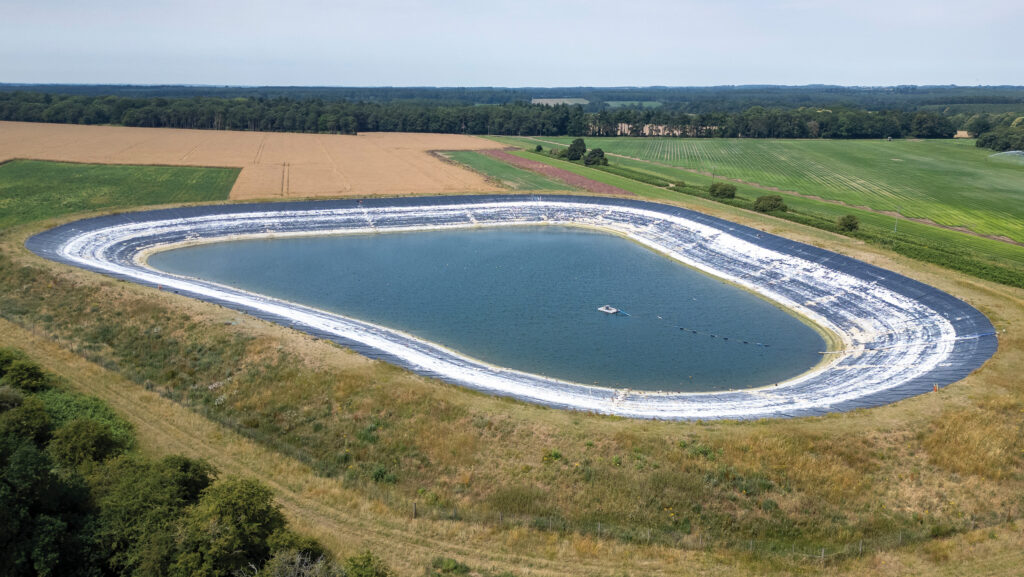
Scaling up from roof capture, tanks and ponds, on-farm reservoirs have the capacity to transform water security, particularly for arable and field-scale vegetable units that rely on irrigation.
Looking ahead to potentially drier summers and tougher abstraction rules there is increased interest in reservoir construction.
The benefits include huge storage capacity of 10,000cu m to more than 500,000cu m.
© GNP
Because of their scale, the relative cost per cu m is low compared with other storage options.
However, the construction, stringent planning and complex regulatory hurdles mean projects have lengthy timescales and require a large capital investment.
There are further, ongoing costs incurred through pumping and distribution of the stored water.
The decision-making process must therefore be carefully considered with advice sought at every stage.
Reservoir construction phases
Water Resources East suggests there are four key stages from concept to completion.
- Define the need Estimate water requirements, factoring in additional needs if weather patterns continue to change.
- Feasibility Check the site constraints and water availability. There is no point in building a reservoir that cannot be filled or where planning barriers exist
- Permissions Once the feasibility of the site is established, the third stage can begin by securing abstraction licences, planning permission and environmental assessments
- Construction and operation Only begin this final phase once the need, feasibility and permissions have all been secured. (Source: WRE Planning Farm Reservoirs)
Also bear in mind the timescale for the process, which is likely to be 18-36 months but could vary according to the catchment, planning, regulatory procedures and the environmental sensitivity of the site, suggests Teresa.
It is vital to understand that a reservoir is a significant, engineered earth structure and not just a large hole in the ground, she says.
The geology, water table and drainage infrastructure must be factored in among a list of potential causes of leaks and failures.
Costs
Costs are incurred during the planning and regulatory phase, construction and ongoing operation of the reservoir.
Construction costs vary according to scale with price per cu m reducing as volumes increase.
A key cost-versus-risk decision is whether to line the reservoir.
Reservoirs are either unlined in areas where clay can provide sufficient impermeability or lined with a synthetic membrane.
Suggested construction costs for an unlined reservoir are £2-£5/cu m of water storage, while lined reservoirs are likely to cost as much as 40% more.
Design, investigations and certifications then typically add 15% for this.
On top of these costs, operating costs can lie between 1-2% of the build cost for maintenance and water pumps.
Case study
Transition Farmer Eddie Andrew has completed the construction phase of a 30,000-litre underground water tank at Cliffe House Farm, near Sheffield, Yorkshire.
The aim is to reduce the farm’s reliance on mains water to cut the costs and even out peaks and troughs in rainwater supply, says Eddie.
The tank was installed during the build of new cow housing with the frame and roof erected before the floor was dug out to create space for the water storage.
Sealed concrete flooring and wall panels were installed to line the tank, which was then covered with a metal deck, capable of withstanding housed cows and machinery.
Cattle are already using the housing, which acted as a feeding site and shelter during the extreme drought conditions in the summer.
“We brought cows into the house during the day for feeding and to relieve pressure on grazing,” says Eddie.
Despite the lack of rainfall, tank-filling is under way with water captured from the new shed’s 50x60m pitched roof, he explains.
Guttering and pipework has been installed but a UV filtration system, which could reduce contaminants, is yet to be added.
“Our primary aim is to capture water that we can use to wash down yards and equipment, saving the cost of mains water supply,” says Eddie.
“But we are considering a filtration system that will create drinking-quality water for the cows,” he adds.

Explore more / Transition
Follow the experiences of our 16 Transition Farmers and access in-depth supplements, expert webinars, live events and practical content covering the challenges and opportunities facing farm businesses.
Transition is an independent editorial initiative supported by our UK-wide network of partners.
Explore the Transition hub for the latest insights, resources and events.
