Why growing risks raise value of straw-for-muck deals
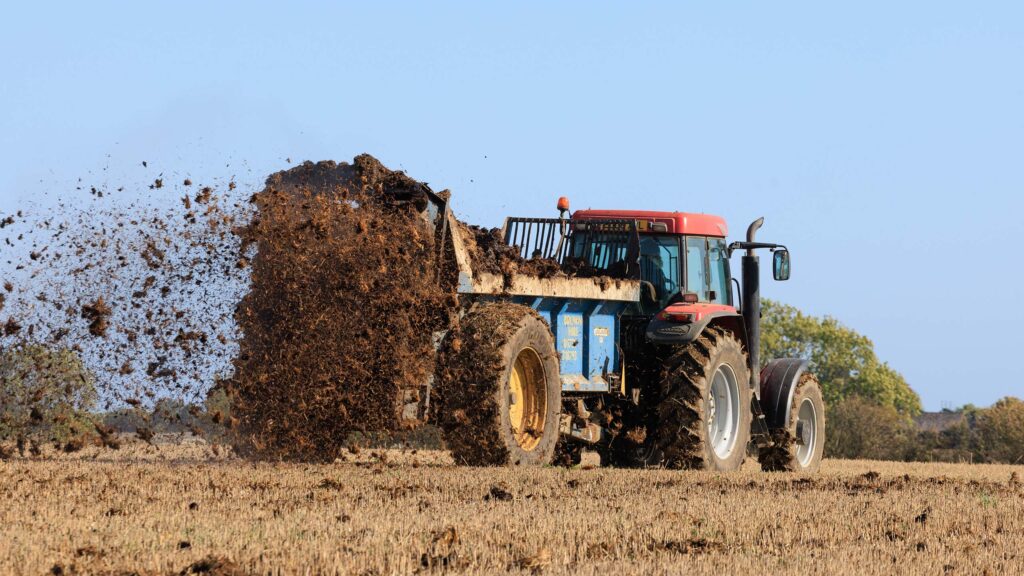 © Tim Scrivener
 The growing risks posed by regulation, pollution and volatile fertiliser markets, alongside the drive for soil improvement, are making straw-for-muck arrangements more valuable than ever.
These deals offer cost-of-production benefits for both parties but it is not simply a case of balancing the nutrients and the finances, says William Waterfield of the Farm Consultancy Group. There are also practicalities to consider and clarify to make things run smoothly.
See also: How focus on cost of doing work lifts dairy efficiency
“Straw has become a more valuable crop over the past few years and there’s a growing reluctance to let it go – soil organic matter is being taken more seriously and cover crops can be drilled into stubble where the straw is well chopped,” he says.
Concentration of production
Livestock and dairy units are becoming larger and more concentrated, so their individual demand for straw and its security of supply is becoming a bigger issue, as is the handling of the muck they produce.
In some areas the rise in maize growing for AD feedstock is reducing the availability of cereal straw for livestock and dairy farms, many of which have serious issues with soil nutrient levels, with soil phosphate and potassium indices at four, when applications under the Farming Rules for Water should be limited to crop requirements.
Straw-for-muck agreements help manage this, with the livestock or dairy farm valuing the straw at the cost incurred for baling and transporting it from the harvest field and back to the arable farm as muck, rather than at what it would have cost to buy the straw in.
For the arable farm, the value of muck is costed against the bought-in nutrients it replaces, with farmyard manure (FYM) also helping restore soil organic matter levels, aiding moisture retention, nutrient uptake, and resistance to disease and pests.
Also in the mix is the increasingly unpredictable fertiliser market, where both price and supply have been fluctuating wildly in recent seasons.
Longer term benefits
William suggests there is a place for longer term arrangements than the current annual agreements which often roll over from season to season. “It’s to their mutual benefit to agree longer term arrangements, then both can plan on that understanding,” he says.
“The financial values attributed to FYM and slurry overlook the fact that more than 60% of the nitrogen and 50% of the phosphate applied is not used by the current crop and some of it will be available to subsequent crops, although how much is difficult to say.
“Then there is also the value of the soil improvement in terms of carbon, and the biology that comes with it.”
Key terms to include in a straw-for-muck agreement
- Straw volume With the variability of straw yields, deals should probably be structured around tonnages of straw or number of bales rather than an area and a volume or tonnage of farmyard manure (FYM) or slurry coming back, says William Waterfield of FCG.
- Typically 7-11t of FYM will be produced from each tonne of straw supplied. Simply valuing the benefit to the current crop in terms of nutrients suggests that FYM is worth about £11/t or £8/cu m, with dairy slurry (4% dry matter) about £3.25/cu m, he says.
- Nutrient analysis No two samples of FYM or slurry are the same, so having an analysis makes sense as this can help adjust the ratios in the agreement. “The nutrient value of muck from a beef or sheep unit that feeds very little concentrate will be much lower than from a dairy unit,” says William. “And if we see [environmental] permitting coming into the dairy sector, there will be much closer analysis of slurry and FYM.”
- Timing Getting straw off the field is usually required within seven days after combining, subject to some allowance for bad weather. An agreed period for returning the FYM should be included, along with details of where it is to be tipped.
- Baling and transport This is usually the responsibility of the livestock or dairy producer, both for taking the straw off the field and returning it as muck.
- Spreading The responsibility and cost of this is usually with the arable farmer, but needs to be made clear in the agreement.