Farmer anger as Ukrainian cage eggs undercut UK market
 © Adobe Stock
 UK egg industry representatives and farmers have raised concerns about food safety standards, equivalence, and imports undercutting producers, after a recent shipment from Ukraine showed eggs not meeting UK standards.
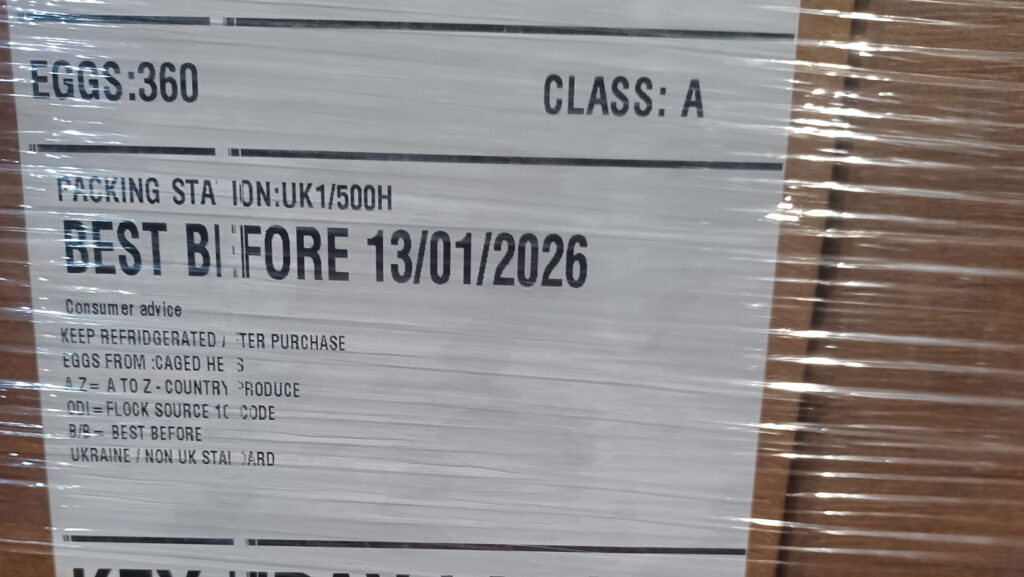
The consignment was spotted by British Free Range Egg Producers Association head of strategy Gary Ford, at Smithfield Market on Monday (22 December) carrying a label “From caged hens – No-UK standard).
In the first six months of this year, figures from the Animal and Plant Health Agency also show that the UK imported 8m kg of eggs from Ukraine, 7m kg from Poland and 5m from Spain.
See also: Pig and poultry systems targeted in animal welfare strategy
Mr Ford said: “The industry remains deeply concerned about future Ukrainian imports and the implications of any renewed trade agreement.
“Fair trade must be the foundation of policy, ensuring UK animal welfare standards are upheld and that production methods banned here, such as battery cages, are not indirectly reintroduced through imports.”
© Gary Ford
He added that farmers feel undermined when lower-welfare imports enter the market, as highlighted by the recent egg imports at Smithfield Market on the same day the government published its Animal Welfare Strategy, aiming to phase out enriched colony systems in the UK.
Equivalence
South Wales free-range egg producer Victoria Shervington-Jones said the imports were a huge concern.
“We work so hard to make sure our eggs are safe and are audited to an inch of our lives and follow the Lion code and RSPCA Assured standards.
“Why import when we have no idea what is being sent over?”
Nick Allen, British Egg Industry Council chief executive, said British Lion eggs are produced to world-leading food-safety and traceability standards, backed by more than 700 auditable criteria and a robust Salmonella control programme.
“By contrast, the Ukrainian egg sector does not yet operate to equivalent levels of food safety, assurance or enforcement,” he said.
If the UK government is serious about championing high standards, supporting British farming, and protecting public health, “then imports produced to lower requirements must not be allowed to enter our market”, he added.
Food safety standards
Recent international incidents involving Salmonella and antibiotic residues in Ukrainian eggs highlight the real risks of allowing imports produced under weaker standards.
“Bringing in eggs that fall short of the standards required here in the UK undermines the hard work and investment of our British farmers and exposes consumers to unnecessary food-safety concerns,” Mr Allen said.
Mrs Shervington-Jones added that while consumers might be able to distinguish imported eggs on the shelves, the choice is removed when eggs are used as ingredients in cakes and quiches.
Policy failings
John Seed, a poultry and arable farmer at Woodend Farm near Duns in the Scottish Borders, runs a 32,000-bird free-range laying flock. He said the situation exposed a lack of joined-up thinking between food and agricultural policy in Scotland, pointing to the Good Food Nation Plan sitting alongside uncoordinated rural initiatives.
“UK farming families are heavily regulated, facing costly and near-impossible standards, while consumers are encouraged to buy products produced elsewhere under lower standards,” he said.
Mr Seed blamed retailers rather than policymakers for driving this imbalance, arguing government must enforce a fairer market. “If this continues, we risk offshoring production and shutting down UK farming.”