

How a dairy farm solved planning permission and succession
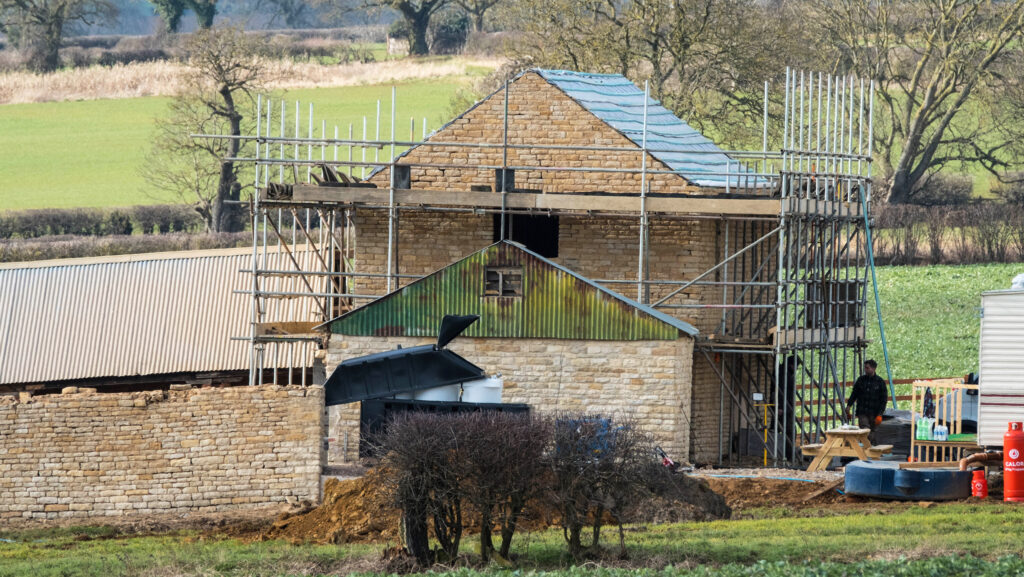 © Tim Scrivener
 One dairy farming family is looking forward to building a new home on their holding in Derbyshire, thanks to the use of planning guidance which requires local authorities to consider farming succession in its decisions.
The older generation of the family has farmed there since 2006.
Their son now does the majority of the milking and other work on the 73ha holding, where they have 100 cows, as his parents reduce their labour input.
The son was recently brought into the partnership with a majority share as part of the succession process but also linked to gaining planning permission for the new house.
See also: Planning conditions: what they are and why they matter
Currently the son, his wife and young children live several miles away and while not far, it’s much more practical to be on site.
Getting planning permission in the countryside is challenging in any circumstances, says Charles Holt of the Farm Consultancy Group, who has been advising the family and supporting their application.
However, it is possible and in some cases, a little-known principle in planning practice guidance can be used to justify a further dwelling on a farm, he says.
Essential need
The usual route to achieving permission for another dwelling on a farm is to prove an essential need for someone to live on site.
“This all had to be done in this case but frankly, it was too small an enterprise to justify a second farm dwelling on livestock numbers grounds alone, with just 100 cows,” says Charles.
The planning practice guidance that was used in this case states that planning authorities must consider whether the provision of an additional dwelling on site is essential for the continued viability of a farming business through the farm succession process.
“It doesn’t detail what the succession process is or should be, so it’s up to the applicant to demonstrate that succession is taking place,” says Charles.
“In this case, that involved the son joining the partnership and taking a 51% majority share in it, all of which was drawn up properly and legally.”
The business case had to be shown, needing detailed information about the farm operation and budgets to be presented to the planners, including evidence from the farm’s accountant.
Charles also worked alongside planning consultant John Church on the application.
“Achieving planning through this route is not a given, and it’s not quick, but it’s a very good opportunity for some people in the right situation,” says Charles.
It is generally only livestock holdings that would be able to successfully use the “essential” nature of the need for an additional dwelling, he says, adding that this could include equine businesses such as stud farms.
The permission granted on the Derbyshire dairy farm includes a Section 106 agreement. These are used to impose conditions on a planning consent.
In this case, the agreement ties both houses on the farm to the land, so they cannot be sold away from the land, nor can the land be separated from the houses.
The planning process and succession plans in this case worked to complement each other.
Planning history
Charles originally advised the older generation in 2006, helping them first achieve permission for a temporary dwelling on a greenfield site when they set up their dairy unit.
The temporary permission was granted in 2007, with permanent permission for a house granted in 2012.
The process began in 2021 to gain permission for the new accommodation, which will be a detached three-bedroom bungalow on a greenfield site.
Farm succession and accommodation – Scotland
Under Scotland’s National Planning Framework 4 (NPF4), introduced in 2023, National Policy 17 promotes the development of rural homes to ensure the needs of people and communities in rural and island areas are met in a sustainable way, says planning lawyer Elaine Farquharson‑Black, a partner at law firm Brodies.
The policy sets out the circumstances in which new homes in rural areas will be supported.
These include supporting the sustainable management of a viable rural business or croft, and where there is an essential need for a worker (including those taking majority control of a farm business) to live permanently at or near their place of work
It also supports single homes for retirement succession of a viable farm holding, subdivision of an existing residential dwelling and reinstatement of a former dwelling house or a one-for-one replacement of an existing permanent house.
National footing
Some local development plans previously had policies which supported farming retirement and succession homes, says Elaine, but the NPF4 put this on a consistent national footing.
“The most frequent scenario is that the younger generation moves into the main farmhouse and a new house is bult on the farm for the retiring generation. It has to be a viable farm business.”
While agricultural occupancy conditions are no longer applied in Scotland, Section 75 agreements often tie permissions for farm accommodation to the land so that the titles cannot be separated for sale.
Encouraging younger farm business managers – Wales
The Welsh Assembly Government wants to encourage younger people to manage farm businesses and promotes the diversification of established farms.
Its planning technical advice known as TAN6 – Planning for Sustainable Rural Communities – supports approval of additional dwellings where a new rural enterprise dwelling is applied for on the grounds that the additional accommodation will facilitate farm management succession.
Details of secure and legally binding arrangements are needed to show that management of the farm business has been transferred to someone younger than the person currently responsible.
Alternatively, it can be shown in the application that transfer of management is conditional on planning permission for the additional dwelling being granted.
One additional dwelling
Approval can be given for only one additional dwelling in a succession case, and it must also be demonstrated that the management successor is critical to the continued success of the farm business, also that the need cannot be met in any other reasonable way.
Where permission is granted, planning authorities will tie the new dwelling to the holding with a legal agreement.