How a Suffolk farm manager is future-proofing business
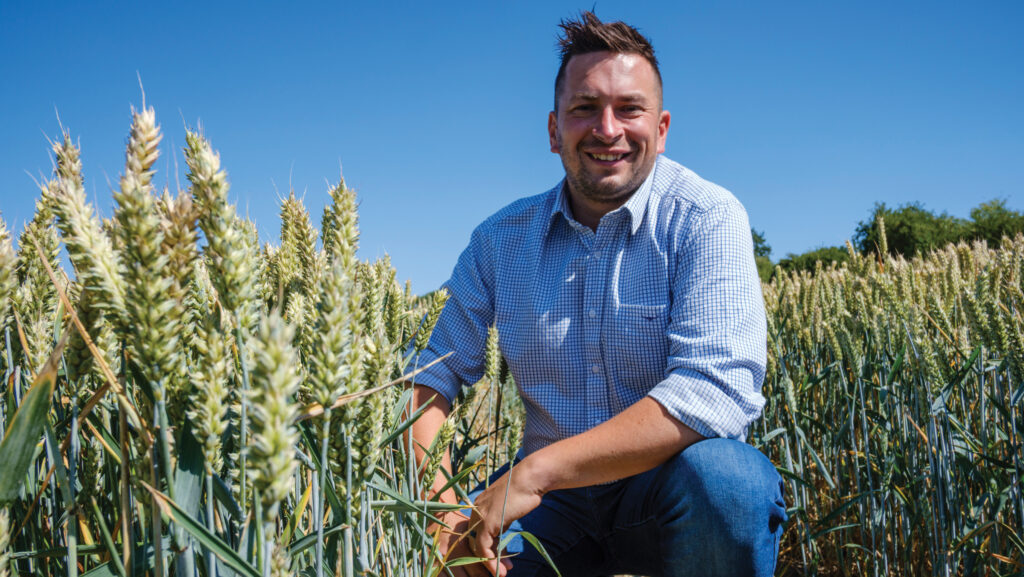 Ryan McCormack © Jason Bye
 The technical, practical and environmental elements of the business at Dennington Hall Farms in Suffolk have moved up a gear, while always keeping the medium and long term in focus.
The business describes itself as “a family-run farm where regeneration and sustainability meet innovative farming techniques,” and manager Ryan McCormack is pushing on all three fronts.
His pursuit of knowledge to improve decision making and efficiency is constant; last week he took delivery of an OptiGene MDX4A plant DNA reader to give more insight into disease pressure on crops, leading to better fungicide targeting.
See also: Farmers Weekly Awards 2025: farm manager of the year
“We’ll be operating this ourselves and feeding back to OptiGene. We’re one of the first to have this on farm and trialling it, so that’s really exciting,” says Ryan, Farmers Weekly‘s 2025 Farm Manager of the Year.
Another recent development was a successful application to Defra’s Accelerating Development of Practices and Technologies fund (Adopt).
This supports collaborative farmer-led, on-farm trials or experiments to generate, test and demonstrate innovative solutions to farming challenges.
The Roots of Change project in which the farm is involved under Adopt began in winter, in collaboration with Northumberland farmer Thomas Todd, the National Institute of Agricultural Botany and Limagrain.
It looks at the impact of cover crops on the soil and nutrients, and on following crops.
“We’re looking at growing milling wheat after a summer catch crop but also having legumes as a bicrop.
“We’re looking at malting barley following an overwinter cover crop with legumes and at the impact of the nutrient density of not only the soil but what the tissue sample and the specification of the grain will be.”
This year sees more seed crops in Ryan’s 12-year rotation to try and add value.
The Wildfarmed winter wheat acreage has increased and Ryan is working with a drone firm on seeding cover crops to reduce power costs.
Capital investment
With the new cattle shed completed, the next big capital project is grain storage. A plan has been finalised for a 3,000t grain store and dryer, increasing both capacity and efficiency.
As well as being better able to keep up with the combine and offering more marketing flexibility, incorporating a biomass boiler into the plan will reduce drying costs and reliance on fossil fuel markets.
“We’re happy with the design and what we want on the farm, and soon will be progressing through the planning stage,” says Ryan.
This will bring the 1,600ha farm’s long-term grain storage to between 9,500t and 10,000t. It also has 1,000t of medium-term storage. Solar is also a focus for the future.
Looking for private funding sources for air, soil and water health is ongoing and a recent result of this search is the completion of a 5-6ha wetland project on river meadows, with funding from the Essex & Suffolk Rivers Trust.
“This is a full-scale wetland project creating habitat for breeding waders and it will create a bit of a flood defence for the village because the river will be able to overflow into the wetland areas,” says Ryan.
“It’s spectacular and we’ve had a couple of lapwing displaying, which has been a KPI for our wildlife and conservation efforts – hopefully they will stay and breed.”
Local outreach
Community engagement is one of the core values of the business which hosted a free full village barbecue at the end of August, supplying its own Red Poll burgers for 140 people.
The event included a couple of hours in the yard, talking with neighbours and farm staff, seeing some of the kit and livestock. This is now set to become an annual event.
Meat sales success
Last year saw the launch of boxed beef sales from the farm’s herd of Red Poll cattle. Roughly one animal a month is butchered for this, with boxes selling out within 24-48 hours.
From a standing start last year there are now 300 customers on the mailing list and the farm also supplies a local butcher.
The same approach is taken with the farm’s wild venison, with boxes available every three to four weeks in season. “It’s proving very popular and we’re shipping it UK-wide,” says Ryan.
The 2026 Farmers Weekly Awards
 The 2026 Farmers Weekly Farm Manager of the Year Award is sponsored by MeritAg Check.