How old military installations can yield value for farms
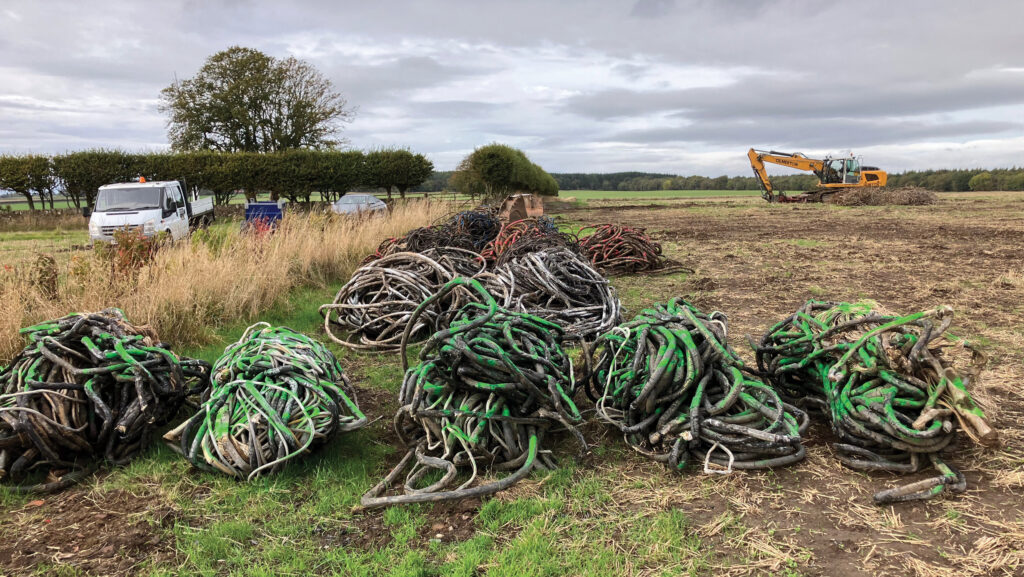 Unused cables can have a significant value © Gilmerton Land Services
 David Kinloch has been searching for buried treasure for more than 55 years, but it’s not gold and silver that excites him. The owner of Gilmerton Land Services is more interested in cables and pipes left over from redundant military and civilian infrastructure projects.
“There’s a tremendous amount of stuff still left out there,” says Sir David. “For instance, there were 700 airfields during the Second World War, and there were also 50 or so Chain Home radar stations down the east and west coasts.
“After that came Rotor [an air defence radar system] during the Cold War, when a lot of the Chain Home stations were upgraded to detect any potential Soviet bomber attacks. Obviously, all the cabling for these kinds of sites had to be largely underground – much of it remains.”
See also: Why valuation preparation is key under new IHT relief regime
Old factories also often had their own large water mains, which can be quite valuable, says Sir David, who has recently worked on pipes installed in 1905 to supply the Nobel Explosives Factory in Ayrshire, then the world’s largest munitions factory.
He also believes retired reservoirs could be another source of valuable pipework. “There are a lot of dams that have become disused, and I’m convinced there is a lot of cast iron up in the hills or in remote areas where there has been water capture.”
Due diligence
A key part of the process, once a landowner has alerted Gilmerton Land Services to the presence of potential buried material, is to assess what can be recovered and, importantly, what should remain undisturbed.
“Developers, for example, will often come across pipes and cables they didn’t know about. Everybody will assure them they are no longer live, but still, nobody is going to want to put a hammer through them.
“As part of our initial survey, we’ll contact all the relevant utility companies. Many maps of old cables and pipelines aren’t that accurate, so it’s very important to get that survey right.
“You don’t just turn up and start digging unless you know more than the farmer is aware of about their land.”
For former military installations and other historical infrastructure, Sir David will also check that they haven’t been listed.
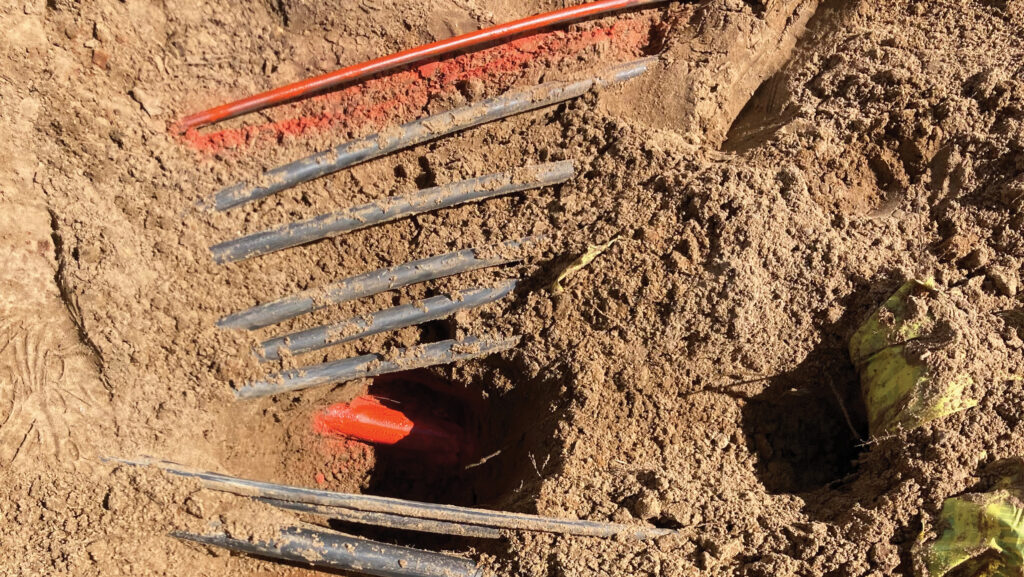
Knowing which cables are still in use is crucial © Gilmerton Land Services
Risk and reward
In terms of how much a landowner could receive, the potential value of any materials that might be recovered is calculated based on metal market prices. This is then used to offset the cost of the digging and extraction process.
If more metal than expected is found, the extra value will be shared with the owner. However, if there turns out to be less, Gilmerton Land Services takes the hit. “It’s what we call a guaranteed minimum payment. It can be a bit of a lucky dip, but generally people end up with more,” says Sir David.
Top four finds
- Copper earthing plates
- Heavy mains cable
- Lead water pipes
- Cast iron water mains
If a farmer wants to schedule the excavation sometime in the future to tie in with the completion of harvest, for example, the returns can fluctuate slightly, given the volatility of metal markets.
For those worried that a utility company will want a share of the scrap value, there is little to worry about, Sir David says. “Everything has already been written off, so it has no value on their books.”
A very big project, such as a large airfield, can generate a six-figure return, but often the biggest return to a farmer is getting all their land back in good condition once any infrastructure has been removed and making fields more manageable [see panel].
“You have to treat the land with the respect it’s due,” says Sir David. “You need to understand the ground conditions on the farm, including drainage and utilities.
“Whenever we remove any soil, we are always careful to separate it so the topsoil goes back in the right place without any delay. On some projects, it’s back down within six hours. We spend a lot of time talking to the farmer about what they want.”
Another good reason to take out old pipes and cables is the risk of pollution, Sir David points out.
“A lot of water pipes used to be made from lead, but older electricity cables on wartime military bases, which were never designed to be that robust because nobody thought the war would last very long, were also sheathed in lead that has now oxidised.”
Land recovery
For one Scottish farmer, it wasn’t the value of the buried infrastructure that was the most important outcome of digging by Gilmerton Land Services.
Five reinforced-concrete turrets, part of a radar system linked to a nearby Cold War nuclear bunker, had been disrupting fieldwork on his coastal arable unit for years, but removing them was clearly a specialist job.
“Somebody once resorted to dynamite, but it barely scratched the concrete because it was so thick and contained so much rebar,” says the farmer, who prefers to remain anonymous.
Even though the job took longer than expected – “it was pretty brutal, the concrete was 3m thick at one point,” explains Sir David – the recovery of a large amount of lead cable meant the job was largely cost-neutral for the farmer, who says: “I’ve now got a level field that’s much easier to combine,” he points out.
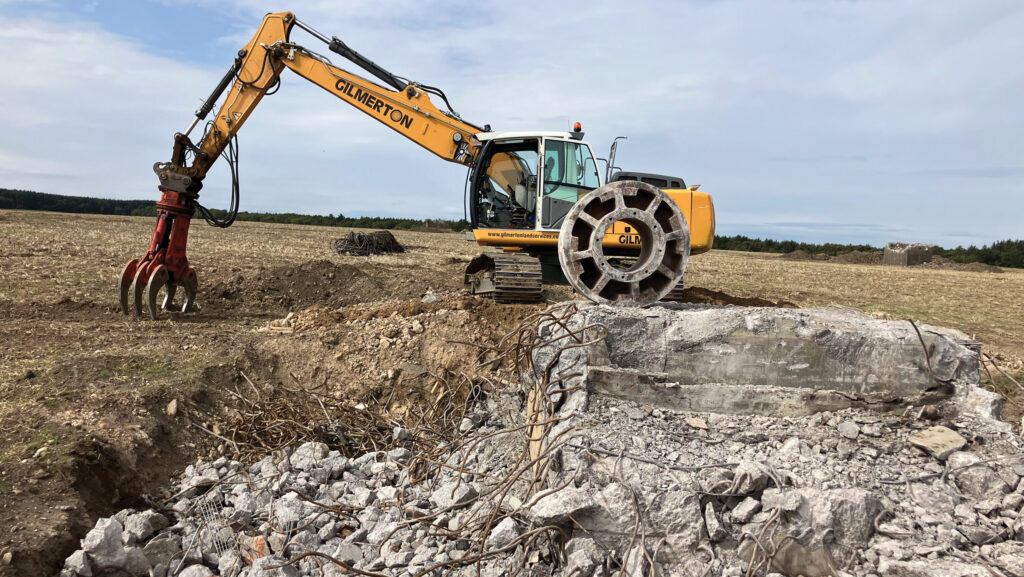
Removing concrete can be tough going © Gilmerton Land Services