English barley harvest falls to 14-year low as wheat edges higher
 © Tim Scrivener
 England’s barley harvest fell to its lowest level in more than a decade in 2026, tightening domestic supplies, while wheat production edged higher thanks to slightly better yields.
Provisional figures from Defra put English wheat production at 10.8m tonnes, up 0.8% on 2025, despite a 1.8% reduction in harvested area. Average yields increased by 2.7% to 7.2t/ha, although this remained below the 10-year average of 7.9t/ha.
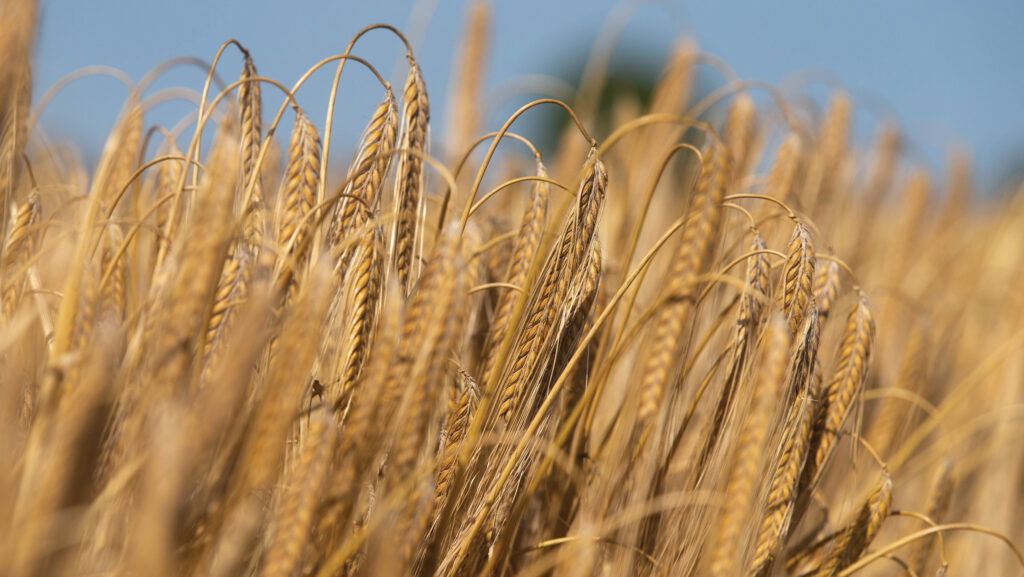
Barley production, meanwhile, fell by 11% to 3.7m tonnes, driven by a smaller spring crop and an 8% yield decline.
See also: Find all our market information in one place
Despite the lower availability, recent trading activity has seen several UK feed barley vessels loaded for export, mainly destined for Ireland. Much of the grain has come from northern Scotland, where weaker demand from the malting and distilling sectors has left a surplus.
Andrew Dewing, managing director of Dewing Grain, said barley prices had largely followed wheat lower, despite what he considered an excessive discount between the two grains.
Ex-farm prices on Wednesday (14 October) put feed barley at £182.6/t compared with feed wheat at £196.2/t, according to merchant data collected by Farmers Weekly. At these levels, there is limited appetite among farmers to sell, said Mr Dewing.
“Barley is shirt-tailing wheat,” he said. “The wheat market is drifting and barley is going down in unison, trailing at too big a discount. I think as time goes on this will narrow.”
Wheat markets remain caught between geopolitical risks and plentiful global supplies, with renewed attacks on Ukrainian energy infrastructure undermining hopes of progress towards easing disruption to Black Sea exports.
The latest CRM market report said wheat futures had recovered from early selling after doubts emerged over a Russia-Ukraine energy ceasefire announced by US president Donald Trump. Russia subsequently attacked Ukrainian gas and power facilities, adding to uncertainty over the outlook for grain shipments.
Despite the renewed tensions, prices had shown a relatively muted response. Mr Dewing said the market’s resilience was difficult to explain given the potential implications for grain flows from Russia and Ukraine.
“Everyone was fearful when the war began four years ago, but now the price is barely moving,” he said. “The market seems immune to the lack of flow of wheat and corn coming out of Russia and Ukraine.”
He added that supplies from the latest UK harvest had limited the immediate impact, but warned that continued disruption would eventually affect prices.
He also questioned whether reported stocks were as plentiful as suggested by the AHDB, saying farmers had sold a greater proportion of their grain than expected.
“Fundamentally, the UK is short of wheat and will have to import,” he said. “But if feed wheat went below £200/t in the east of England, there would be no sellers.”