How British agriculture is helping China to feed itself
 © AdobeStock
China bought £173m of British pigmeat last year, making it the UK’s biggest market outside Europe. Chinese consumers also provide a lucrative outlet for products such as offal and feet, so helping UK producers extract more value from the whole carcass.
“Those products are really highly valued in China and they’re in high demand,” says Susan Stewart, head of international trade development at AHDB. “That ultimately offers really good carcass balance.”
See also: UK exports hit £2bn despite tough global trade
But while Britain works to maintain access to this crucial market, one of its leading agricultural genetics companies is helping Chinese pig producers become more productive.
UK-listed Genus, through its porcine genetics business PIC, has formed a joint venture with state-backed Beijing Capital Agribusiness (BCA) to commercialise its genetics in China.
BCA owns 51% and Genus 49%, with Genus retaining its intellectual property and receiving royalties.
Under an earlier agreement in 2019, Genus said it would license intellectual property (IP) and “transfer know-how” to BCA’s Future Bio-Tech subsidiary to aid the development of porcine reproductive and respiratory syndrome (PRRS)-resistant pigs in China.
© Lixu/iStockphoto
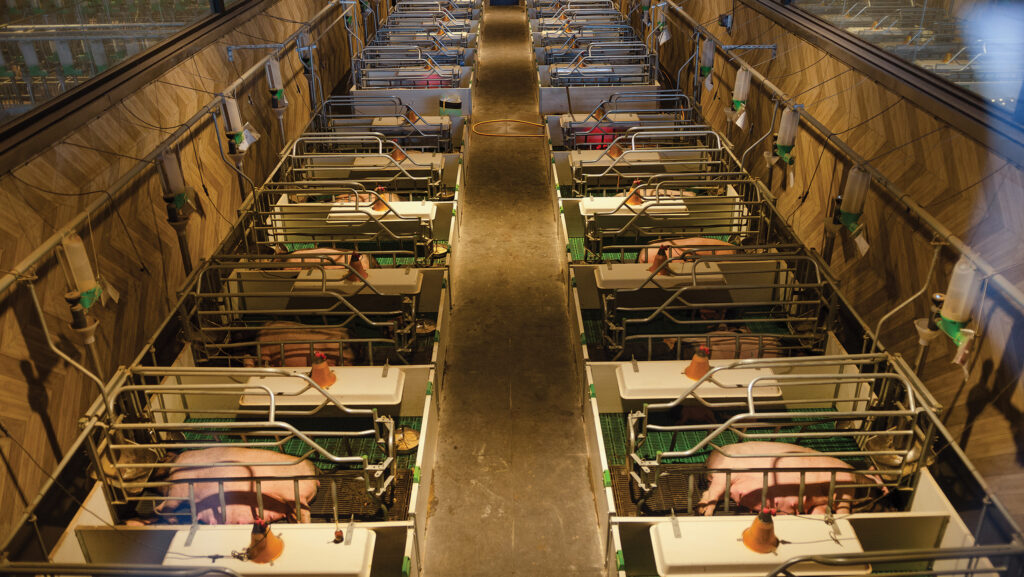
PRRS is one of the world’s most damaging pig diseases, causing reproductive failure, mortality and reduced productivity. Research published last year modelled what could happen if resistant genetics reached 70% adoption in China over 12 years.
Under that scenario, Chinese hog production would be about 11% higher, while production costs would fall. The study was commissioned by PIC and relies on assumptions about adoption, costs and demand, making it a “scenario” rather than a forecast.
Despite these developments, Ms Stewart is still confident that China will remain a huge pork buyer. “I don’t necessarily see a point where China’s going to stop importing pork full stop,” she says.
However, the OECD-FAO Agricultural Outlook 2026-2035 identifies China’s efforts to expand domestic pork production as a factor reducing its reliance on imports.
The AHDB is therefore already developing alternative markets, including Vietnam and Mexico, although none approaches China in scale.
“There isn’t another China,” Ms Stewart says. “But we can ensure we have a diverse portfolio, so we can flex and utilise those other markets.”
Who owns the capability?
Genus says its competitive advantage cannot easily be replicated.
“Our business is built on continuous innovation, extensive biological data and decades of accumulated expertise,” a spokesman told Farmers Weekly.
“These capabilities are not easily replicated and continue to evolve through ongoing investment in research and development.”
The company sees “significant long-term growth potential in China” through the BCA partnership and says wider use of its genetics and technologies will improve animal health, reduce reliance on antibiotics, and improve global food security.
But Prof Alicia Ellis, who directs the Centre for Agriculture and National Security at Arizona State University, says retaining legal ownership of intellectual property is only part of the equation.
“Even if they retain the legal rights to the IP, what technology and genetic resources ultimately are shared? What capabilities does the Chinese partner acquire? And can it eventually reproduce those independently, even if they don’t technically own the IP?” she asks.
She points to US berry giant Driscoll’s as an example of how capability can shift over time.
The company entered China with premium blueberry genetics and sophisticated production techniques, but domestic production then rapidly expanded, aided by state-backed financing, and China became the world’s largest blueberry producer.
“Obviously the blueberries are not strategically important themselves, but China’s strategy is: a foreign company enters China thinking they’ll get market access, bring the genetics and production know-how with it.
“Chinese firms acquire or reproduce the capability, state-backed financing helps scale domestic production, and China goes from lacking the capability to becoming the world’s largest producer and competing with the company that helped build the industry,” Prof Ellis says.
Britain helped build the bridge
Despite the risk, Britain has actively participated in building Chinese agricultural capability.
At least £20m of UK public money was committed through two major programmes aimed at applying British science to agricultural challenges in China.
A Science and Technology Facilities Council-led programme launched in 2014 provided £12m for 32 research activities, while the separate 2017 Newton UK-China Agritech Challenge offered a further £8m.
Projects spanned remote sensing, precision farming, robotics and crop-spraying drones, with British researchers developing technology including flight control and spray-path-planning systems alongside Chinese partners.
Some worked directly with Chinese commercial agricultural drone manufacturers Quanfeng and Waobot.
And those programmes were only part of a wider network of publicly backed UK-China agricultural research.
Other collaborations have covered livestock disease and diagnostics, nitrogen use, crop science and biotechnology, including the long-running partnership between the John Innes Centre and the Chinese Academy of Sciences.
Established in 2014, the CAS-JIC Centre of Excellence for Plant and Microbial Science (Cepams) established research operations in Norwich, Beijing and Shanghai. This year it was renewed for another five years and expanded to include The Sainsbury Laboratory.
JIC says protected knowledge, materials and technology are reviewed before being shared, while ownership and permitted use of jointly generated IP are agreed for individual projects.
It does not impose blanket restrictions on collaboration by country or scientific discipline, such as genetics, synthetic biology or artificial intelligence (AI).
Instead, individual projects receive additional scrutiny where export controls, national security legislation or potential military and dual-use applications are relevant.
JIC argues the benefits of collaboration run both ways.
“Challenges such as crop resilience, sustainable agriculture and food security are international in nature: their causes and consequences cross borders, and no single institution or country has all the expertise, resources or perspectives needed to address them,” said a spokesman.
Cepams gives UK researchers access to complementary expertise, biological resources, datasets and research environments, JIC says, while strengthening scientific networks and accelerating discoveries that could benefit UK farming and the bioeconomy.
Security landscape changes as risks escalate
The environment in which collaborations such as the one between the John Innes Centre and the Chinese Academy of Sciences operate has changed markedly since their joint initiative, Cepams, was established.
The UK government’s Research Collaboration Advice Team (Rcat) was created in 2021 to help academic institutions navigate national security risks. It launched its advisory service the following year, and has since engaged with more than 155 research institutions.
Among the technologies on which it most commonly advises are AI, synthetic biology and advanced robotics.
JIC says its staff meet regularly with the team, although it did not confirm whether Rcat assessed the 2026 Cepams renewal.
Farmers Weekly is aware that Rcat is also briefing academics at other agricultural universities, though the government declined to provide a breakdown of its engagements by discipline.
At the latest UK-China Joint Commission on Science and Technology in 2025, the two countries agreed to prioritise R&D co-operation, including in agricultural research.
A government spokesman said the UK would “never compromise on our national security”, while continuing to support collaboration with China where it is secure and mutually beneficial.
Separately, a September MI5 alert over the China General Technology Research Institute (CGTRI) illustrated the wider research-security concerns facing UK institutions.
There is no suggestion that JIC, Cepams or the agricultural collaborations examined by Farmers Weekly were connected to CGTRI or espionage. However, the warning demonstrates how far Britain’s approach to research security has shifted since many UK-China scientific partnerships were established.
A wider strategy of self-determination?
London-based consultancy Systemiq believes China’s aspiration to expand its own independent food base may be occurring on large scale.
The central hypothesis of its China’s Food Future report is that “China has begun to apply to agriculture some of the same system-level tools it has previously used in sectors such as energy and transport”.
China’s economic development created substantial dependence on imported food and agricultural commodities, and Systemiq argues Beijing is increasingly uncomfortable with that exposure.
The report envisages a scenario in which improvements in conventional agriculture – including genetics, animal productivity and feed efficiency – are followed by potentially more disruptive developments such as biomanufacturing.
It suggests Chinese agricultural import demand could peak around 2030, with soybean imports 25% lower than 2025 levels by then.
Systemiq stresses this is a scenario, not a prediction, but it shifts the focus from individual deals to the cumulative direction of travel.
Timeline: China seeks greater agricultural capability as Britain helps build it
President Xi Jinping © Imago/Alamy Stock Photo
2013 – Xi Jinping says China’s “rice bowl” must be held in its own hands, with its food supply based principally on domestically produced grain
2014 – The John Innes Centre (JIC) and Chinese Academy of Sciences establish the Centre of Excellence for Plant and Microbial Science (Cepams)
2014 – The UK launches a £12m Newton-funded agri-tech programme to apply British expertise to agricultural challenges in China
2015 – JIC establishes a further alliance with the Chinese Academy of Agricultural Sciences
2017 – A separate Newton UK-China Agritech Challenge offers up to £8m of UK public funding for projects to tackle agricultural challenges in China
2019 – Genus agrees to license IP and “transfer know-how” to state-backed Beijing Capital Agribusiness’s Future Bio-Tech to enable development of PRRS-resistant pigs in China
2025 – China publishes its plan to become an “agricultural powerhouse” by 2035, emphasising greater self-reliance in agricultural science and technology
2025 – Research models Chinese hog production almost 11% higher under a scenario in which PRRS-resistant genetics reach 70% adoption over 12 years
2026 – Genus and state-backed BCA establish a joint venture to commercialise PIC genetics and PRRS-resistant pigs in China
2026 – Cepams is renewed for another five years and expanded to include The Sainsbury Laboratory
2026 – MI5 warns UK universities over research funded by China General Technology Research Institute