How deeply is China embedded in British farming?
 © Adobe Stock
As China pursues greater control over its own food production, its commercial interests are becoming increasingly established in Britain’s agricultural supply chains.
In 2026, Chinese businesses occupy positions that offer both profitable opportunities and potentially valuable information about how British agriculture operates.
The advantages to the UK are clear, with overseas investment supporting scientific research and new machinery offering farmers ways to cut costs and improve efficiency.
But the growing involvement of Chinese businesses also raises questions about access to commercially valuable information, control over technology and the resilience of British agriculture if international relations deteriorate.
See also: How Britain is helping China to feed itself
A window into Britain’s grain market
Cofco International, part of China’s state-owned agricultural trading group, operates in Britain’s grain market, including through its Ipswich port facilities.
An experienced grain trader told Farmers Weekly that the number of merchants buying directly from farms had fallen from more than 2,000 in 1977 to between 80 and 100 today, concentrating market knowledge among relatively few businesses.
“They’ve got instant market information about the state of the UK industry, because they’re participating in it,” they said.
Through its trading activity, Cofco has access to data on British grain availability, prices and market conditions.
Whether that information is shared with its Chinese parent or state authorities is open to speculation.
Cofco’s international purchasing behaviour also illustrates the potential intersection between commercial decisions and Chinese government policy.
In November 2025, the company purchased American soya beans following a US-China trade agreement, despite US supplies being considerably more expensive than Brazilian alternatives.
The purchases were consistent with Beijing’s commitment to resume buying American agricultural products, although it is unclear whether Cofco was specifically instructed to make them.
There is no evidence of comparable politically-directed purchasing in Britain, but the episode demonstrates how the commercial activities of a state-owned grain trader can align with wider government objectives.
Cofco did not respond to opportunities from Farmers Weekly to address questions about its UK operations.
China’s stake in the meat trade
Chinese state-linked ownership also extends into the meat supply chain. Bright Meat Group holds a 50% stake in New Zealand processor Silver Fern Farms, whose long-standing UK business recorded turnover of £118m in 2025.
The processor is owned equally by a New Zealand farmer co-operative and Bright Meat Group, linked to Chinese state-owned Bright Food.
Its UK accounts have described Bright Foods Group as the “ultimate controlling party” since 2024, although Silver Fern Farms remains jointly owned.
The partnership gives the Chinese state-linked shareholder a substantial position in a business supplying international meat markets, including Britain.
Access to information about customers, pricing and trading conditions could be valuable not only commercially, but strategically, offering insights into overseas food supply chains and market conditions.
Silver Fern did not clarify what commercial information its Chinese shareholder can access or explain the control designation in its UK accounts when approached.
Anna Nelson, chairman of Silver Fern Farms Co-operative and co-chairman of Silver Fern Farms Ltd, said export decisions were made by management according to commercial considerations and emphasised the strength of New Zealand farmer representation.
Chinese drones take off
Chinese influence in UK agriculture is also growing through the technology farmers are adopting.
British taxpayers have helped fund agricultural drone research involving Chinese manufacturers, and now Chinese-made drones are beginning to establish a commercial foothold on British farms.
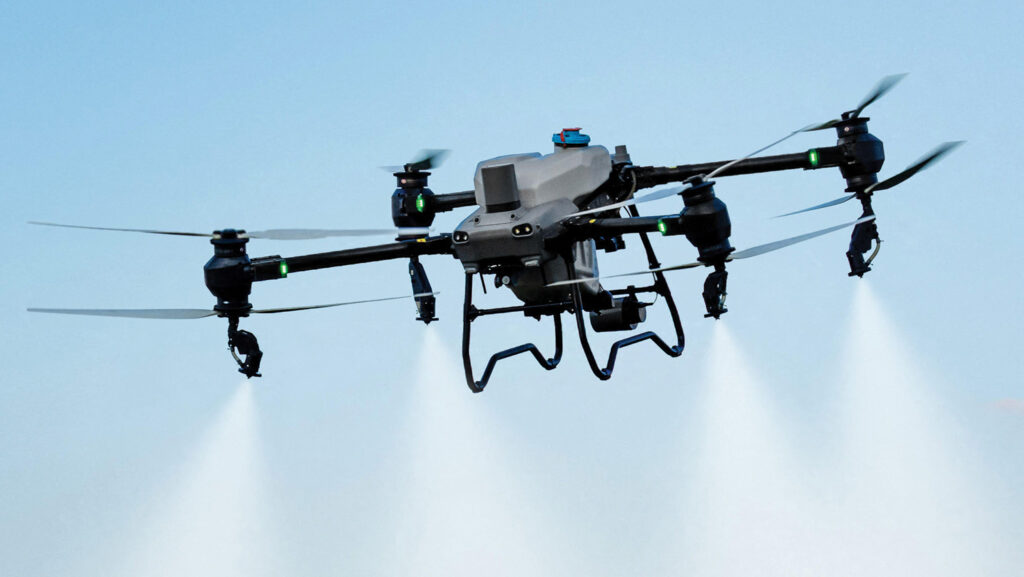
Drone spraying fertiliser © ronstik/Alamy Stock Photo
One manufacturer is XAG, a Chinese agricultural technology company specialising in drones for spraying, spreading fertiliser and sowing crops.
Its UK distributor, AutoSpray, says it has invested about £1.5m over four years developing the evidence and regulatory framework needed to bring the technology into commercial use in Britain.
That groundwork could eventually benefit rival manufacturers entering Britain, but XAG may already have secured a substantial market advantage by the time they arrive.
For farmers, the attraction is clear. Drones can spread fertiliser on maize, establish cover crops, reach waterlogged or steep land, and make targeted applications without the same soil damage or access restrictions as conventional machinery.
One Lincolnshire operator reported covering 700ha of Sustainable Farming Incentive cover crop work in a week, with sufficient demand to train another pilot.
AutoSpray is developing a new generation of operators through its training programmes, alongside a network of about 40 existing UK operators.
Chief executive Robert Pearson believes agricultural drones could move from a niche activity to a mainstream contracting service within 12-18 months, although he expects them to complement rather than replace conventional machinery.
Autospray’s relationship with XAG has also allowed the British distributor to influence the manufacturer’s technology. XAG developed a flight-termination function at AutoSpray’s request, helping satisfy UK aviation requirements.
But the relationship raises longer-term questions about data and software control. Mr Pearson says customer records, risk assessments and flight planning are managed through its own UK software.
The XAG app controls the aircraft, which can operate without an internet connection, meaning flights are not dependent on a continuous connection to Chinese servers.
Operators must initially log into XAG’s system, however, and crash records are automatically uploaded to its Chinese cloud servers when connectivity is available.
Other operational data can be shared voluntarily, while high-definition mapping uploads have been disabled.
XAG also develops the aircraft’s firmware, which determines its functionality. AutoSpray says updates are discretionary and tested in Britain before installation, rather than being imposed remotely.
These distinctions are important because software control and data access are separate issues.
A drone may operate independently in the field while still relying on its manufacturer for future updates, repairs and functionality.
AutoSpray wants UK or European data storage as the market expands, following arrangements Mr Pearson says XAG has established in the US.
Ultimately, however, the decision to invest in local servers rests with the Chinese manufacturer.
Beyond the drone
The same considerations extend to more familiar farm machinery.
Chinese manufacturer FJDynamics is expanding its British presence through dealers supplying affordable autosteer and guidance systems.
Its UK distributor, HFM SmartFarm, has worked with the company since 2021, while FJD has promoted its technology through other British dealers and exhibited new products at Lamma this year.
Its systems can integrate with farm management software, but Farmers Weekly has been unable to establish what information from British farms is transmitted to FJD, where it is stored or who can access it.
The company’s own cybersecurity report, published in August 2025, also disclosed 11 vulnerabilities in its AT2 system and associated software, including three rated severe.
These included a weakness allowing unauthorised access to data from other connected devices, insecure software updates that could permit remote code execution, and communications that exposed login credentials.
FJD said it had addressed the vulnerabilities through measures including encryption, tighter access controls and software updates.
The findings highlight the importance of security in connected farm machinery, particularly as guidance systems become integrated with other equipment and farm management platforms.
FJDynamics declined to respond to Farmers Weekly’s questions about its UK operations and data arrangements.
Who controls Britain’s crop science?
At Syngenta’s Jealott’s Hill research centre in Berkshire, the potential consequences of overseas ownership relate to the development of crop protection products.
Jealott’s Hill is Syngenta’s largest research site worldwide and its only facility capable of undertaking the entire crop protection R&D process, from discovery through to product safety.
The site brings together specialist scientists, laboratories and decades of accumulated expertise, helping develop technologies that farmers internationally may eventually rely upon to control weeds, pests and diseases.
Syngenta, ultimately owned by Chinese state-owned Sinochem, is investing £100m in a new BioSTaR facility, bringing together about 300 scientists and strengthening the UK’s position in agricultural research.
The investment is a substantial benefit to Britain, but agricultural security specialist Prof Alicia Ellis, from Arizona State University, believes ownership of such capabilities deserves particular scrutiny.
“Could ownership decisions eventually move research, intellectual property or scientific capability elsewhere?” she asks.
“And if they did, could the UK recreate that capability? This one is a really difficult capability to reconstitute. It’s not just building infrastructure, it’s decades of scientific research.”
Syngenta told Farmers Weekly that its global R&D strategy is managed through governance structures in Basel, Switzerland, and patents are filed through Swiss company Syngenta Crop Protection AG.
It says research information is protected by legal and internal safeguards, but declined to detail licensing arrangements, data storage or access rights, citing commercial confidentiality and security considerations.
The response did not establish whether Chinese group entities can access research developed in Britain, or what role its ultimate parent plays in decisions about future UK investment.
For Prof Ellis, the principal concern is that Britain’s reliance on overseas agricultural technology could grow faster than its understanding of the risks.
“We should be asking the security questions before these technologies become deeply embedded in agriculture production, not afterward,” she says.