How to unlock the best value from development land
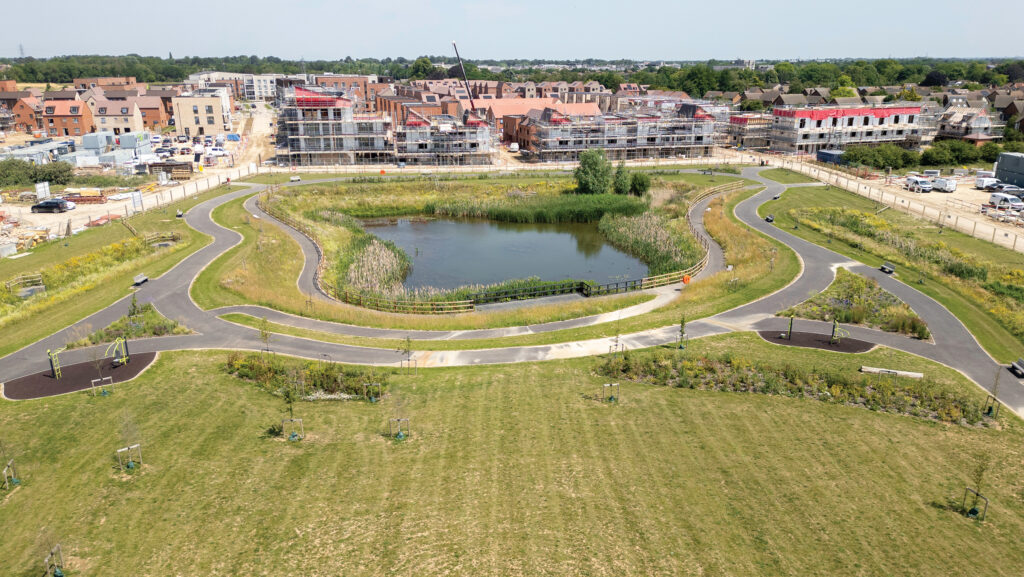 Darwin Green in Cambridge © Bidwells
 The British countryside is caught in the middle of a house-building battlefield.
On one side is a government desperately relaxing planning and environmental rules to help deliver on a promise to build 1.5m new homes by the end of its first term.
On the other, a formidable array of economic hurdles that leaves little incentive for construction firms to get more spades in the ground.
See also: Farm values: Buyers and sellers cautious in tricky market
Trapped between the two are farmers and landowners with potential development sites that are falling in value, attracting less interest from potential purchasers and taking longer to build out, even if a buyer can be found.
Quantifying the drop in values is difficult as development land prices are even more location-specific than for farmland.
But, on average, the Knight Frank residential development land index reports a 5.5% slide in greenfield values in the second quarter of this year alone.
Savills’ development land Index, which also tracks regional markets, shows the biggest falls in the south-east of England, where prices are down almost 8% over the 12 months to the end of June.
But as the chart shows, the picture isn’t uniformly gloomy.
Average prices for greenfield sites in the north of England and Scotland actually rose over the same period.
Pressures
Housebuilders are facing an almost perfect storm of pressures, which is making them increasingly selective when it comes to acquiring new sites.
Buyer sentiment has been rocked by conflict in the Middle East, which has boosted inflation and pushed up mortgage rates, while the same inflationary pressures are adding significantly to already-high build costs.
“Growth in construction costs has outpaced house prices since 2021,” points out Hamish Simmie of Savills’ residential research team.
“The costs of building a home in England have increased by an estimated £76,000 over the past five years, according to the Home Builders Federation.”
Despite recent reforms, the planning system is still perceived as a significant barrier, says Oliver Knight, head of residential development research at Knight Frank.
“Planning delays were identified as a challenge by 64% of the respondents to our latest quarterly survey of small and volume housebuilders.”
The burden does not stop there. Affordable housing requirements, the Community Infrastructure Levy (CIL), Section 106 contributions, nutrient neutrality and biodiversity net gain can all further erode what a developer can afford to pay for a site.
“All these various financial obligations on development all come off the land value,” says Ian Barnett, group land director at property services firm LRG.
In some cases, he says, the impact has been dramatic, with land values falling by as much as 40%.
“Some landowners want 2016 values, but with 2026 planning policy this isn’t going to happen, and it’s important landowners acknowledge this and understand why.”
At the same time, weaker new-home sales are making housebuilders much choosier about where they invest.
Ian says some promoters have secured planning permission only to find housebuilders reluctant to take on another site in an area where significant development is already under way.
Location, location, location
Headline indices disguise a market that varies hugely by location. Ian says sites with good transport links, schools and services have proved much more resilient, while secondary locations and villages where buyers have to travel further for amenities are being hit harder.
“It’s definitely more of a buyer’s market,” he says.
Mark Buddle, head of land and development at property consultancy Bidwells, agrees. “It’s always location, location, location,” he says.
Primary sites can still sell in almost any market, whereas appetite for more marginal locations can be limited.
Ultimately, Mark says, housebuilders are asking how much homes will cost to build, what they will sell for and how quickly they will sell.
Slower sales mean developers have to carry their investment for longer, which feeds directly into the price they can pay for land.
George Paton, founder of strategic development land consultancy Paton Land, is more upbeat.
“I don’t think it’s a tricky market. I’m going to call it patchy. It depends where you are,” he says.
Sites with good road and rail connections to employment centres such as London, Birmingham and Bristol can still attract strong demand, says George, while the amount of competing development land locally also matters.
Right permission
In this more selective market, planning permission alone may no longer unlock the best value, says Ian. “Historically, the problem was always: will you get planning permission?” he says.
“The overwhelming concern now is almost: what’s the exit strategy? What’s the value going to be? Is there going to be demand?”
That means thinking about the eventual buyer while the scheme is being designed.
A consent with the wrong mix of homes, inadequate parking or an awkward layout may need to be amended before a housebuilder starts work.
“If they’ve got to replan or redesign it, and that takes another 12 or 18 months, they’re going to factor that into their price,” he says.
Mark makes a similar point. The objective should be a deliverable planning permission, with access, power, water, drainage and sewage capacity addressed wherever possible.
Value increasingly lies in a site a housebuilder can actually get on and build.
Outlook
Some of the factors holding back the market should start to dissipate next year, but, according to Mark, the government’s 2024 reforms of the much-maligned planning system could, ironically, mitigate some of that positive impact.
“It takes a long time for people to put deals together, but we’re beginning to see sites now coming through the planning system following the government planning reforms.
“I think we’ll see more planning permissions over the next couple of years, which is going to have its own impact on land values.
“The market going forward could be quite difficult. There are just not enough house builders and developers to build the volume of planning permissions that are going to be coming through.
“They will be able to pick and choose what they want to buy, where they want to buy, and how they want to buy it.”
George, however, says an emerging breed of housebuilder, sitting between the large companies and smaller building firms, that is backed by private equity and pension funds could take up some of the slack.
Housing associations are also becoming more active, says George, who has just sold a 270-home site near Cirencester in Gloucestershire for what he describes as a “record price”.
The government has also just announced a deposit scheme to help first-time buyers trying to get on the property ladder.
“It’s a welcome move, but we are still waiting for the details so it’s difficult to predict whether it will make a meaningful impact on a housing market that Labour really needs to get moving,” says Oliver.
“The Office for Budget Responsibility previously forecast that the planning reforms already announced would deliver a £6.8bn fiscal boost to the economy by 2030.
“If increasing consents aren’t being turned into deliverable homes, that starts to look very shaky,” he says.
Whatever happens, Ian warns farmers against treating potential development sites as long-term nest eggs.
“The assumption is that if you hold on to land for long enough, a developer will eventually pay more for it. Previously that may have been true, but not anymore.”
Maximising the development value of your land
- Get specialist advice early Get an experienced land agent, planning consultant and development solicitor to assess the site and route to market.
- Understand what your land is really worth Rising construction, finance and planning costs mean historic neighbouring deals may be a poor guide to today’s value.
- Think about the buyer from day one Consider who will buy the site, what they want to build and how easily the homes will sell.
- Get the right permission, not just any permission The wrong housing mix, layout or parking could force a redesign and reduce the price offered.
- Tackle infrastructure problems early Access, power, water, drainage and sewage capacity can make or break a site, even with planning permission.
- Don’t overmarket the site Approaching too many developers can make land look problematic, warns Ian Barnett. Target credible buyers.
- Spend money selectively Commission technical work only when it improves prospects or value.
- Watch the local plan Calls for sites, housing-land supply and the local-plan cycle can all influence prospects.
- Choose your development partner carefully Understand how options and promotion agreements allocate valuation, costs, risk and reward before signing.
- Keep an open mind about what the land could become Housing is not always best. Logistics, employment, care or renewable energy may offer greater value.
Option or promotion agreement?
How land is brought forward affects the return.
George Paton favours promotion agreements.
“I think options have had their day,” he says, arguing that promoter and landowner are aligned in seeking the highest sale price.
Mark Buddle isn’t so sure. With more consented sites competing for buyers, he believes options could start to become more attractive again.
“Having a developer on the hook might actually become quite an important thing,” he says. The developer is also the likely buyer.
Hybrid agreements are also a possibility, says Ian Barnett, but whichever route is chosen, genuine partnerships will deliver the best results, he urges.