IHT planning brings Norfolk bare land block to market
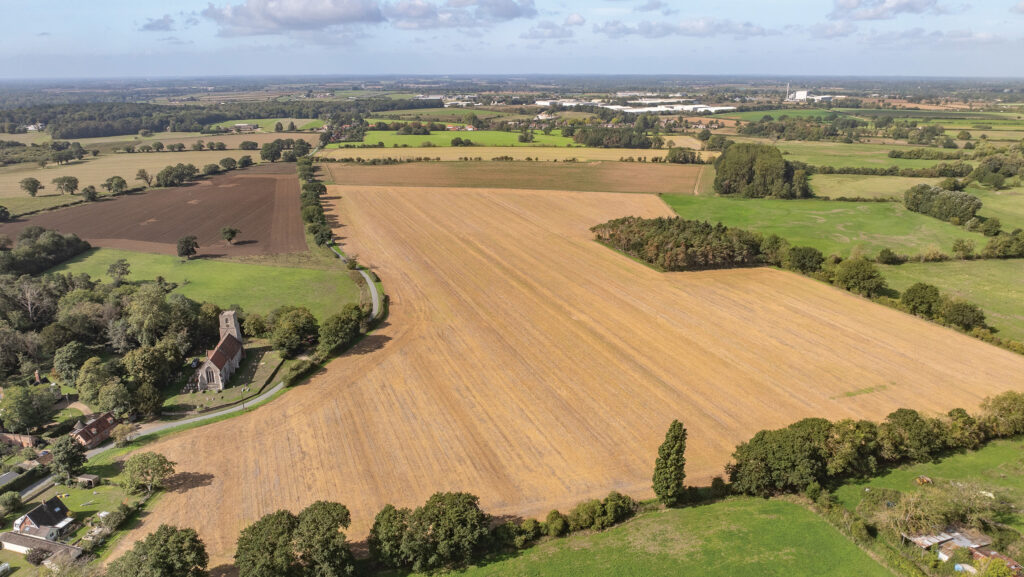 Wilby © Ceres Property
 Inheritance tax planning sees the launch this week of a 171-acre ring-fenced block of land in Norfolk.
The sale at Wilby offers 85 acres of arable land currently farmed in-hand in a rotation of winter and spring cereals, winter oilseed rape, sugar beet, potatoes and peas.
Grassland, water meadows let for sheep grazing and woodland make up the rest of the acreage.
The land has well-drained, calcareous, fine silty and clay soils over chalk, suited to cereals, grassland and permanent pasture.
A Countryside Stewardship (CS) Mid-Tier agreement is in place, as well as two Sustainable Farming Incentive (SFI) agreements.
See also: Durham let farm, Oxfordshire and North Yorks holdings launched
The land may offer opportunities for environmental enhancement, biodiversity net gain and natural capital uses, says Oliver Lukkies of selling agent Ceres Property.
“The property is inclusive of the site of a former farmhouse and an orchard, which may have potential for future residential development subject to planning,” he adds.
Ceres Property is seeking offers in the region of £1.25m and is also lotting the sale two ways.
The same agent is also launching a ring-fenced farm near Haverhill, Essex.
Sturmer has 85 acres of productive Grade 2 arable land across two fields that are suited to modern agricultural machinery.
The land is well drained, says Oliver, with calcareous clay soils to support arable cropping, particularly winter cereals.
“Recent cropping includes winter cereals, spring cereals, pulses and oilseed rape,” he says.
The land is subject to an SFI agreement.
There is a three-bedroom farmhouse, with an adjacent traditional steel portal-framed farm building with potential for conversion or redevelopment.
This sale is guided at £1.25m.
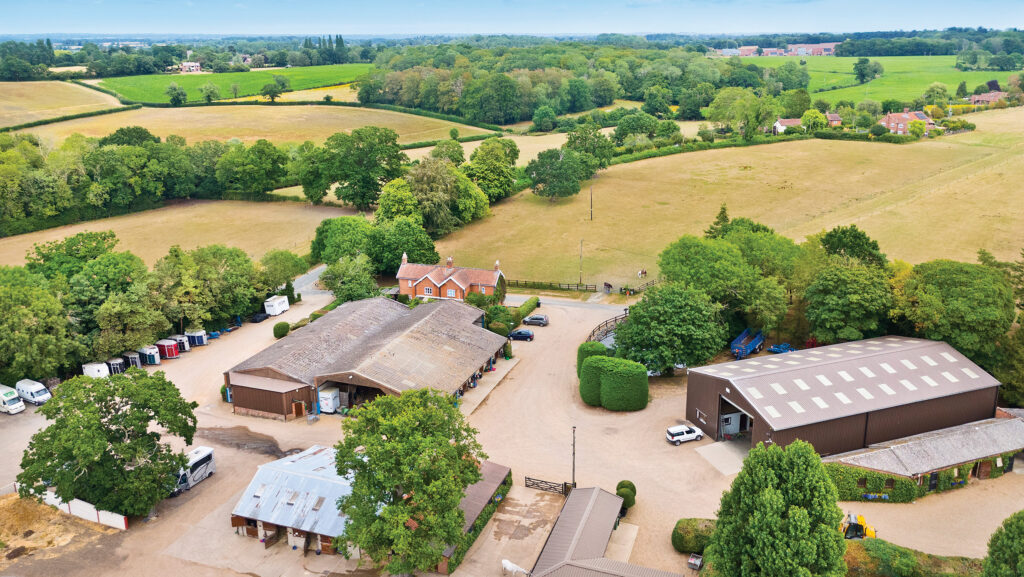
High Ash Farm © Savills
Norfolk let farm
For buyers seeking a farm investment opportunity, High Ash Farm at Caistor St Edmund, Norfolk, has come to the market with 452 acres. The holding is let on an Agricultural Holdings Act (AHA) tenancy and has an established livery business.
This diversification was established in 1974, offers DIY, assisted and full livery, with 27 stables, a secure tack room and a feed room.
There are 10 miles of riding, 30 cross-country jumps, a 50x25m outdoor all-weather manège, and a large parking area for trailers and lorries.
A general-purpose building includes an integral farm office, workshop and a store.
The Grade 3 land has a history of arable cropping, but much of it is now sown to grass to support the livery business.
The remainder of the land is subject to two CS Mid-Tier stewardship schemes and an SFI agreement.
There are some parcels of woodland that are let on a farm business tenancy (FBT).
Two cottages are sub-let by the current AHA tenants on assured periodic tenancies.
Conservation and wildlife are at the forefront of the tenants’ decisions, it says, and are a key component of the farm.
Hedges have been planted, woodlands managed for wildlife, and ponds created and enhanced.
“These efforts, combined with the environmental schemes, have resulted in a variety of wildlife including birds, animals, flora and fauna and created a wildlife haven,” says the firm’s Tom Goodley.
The sale is guided at £2.5m.
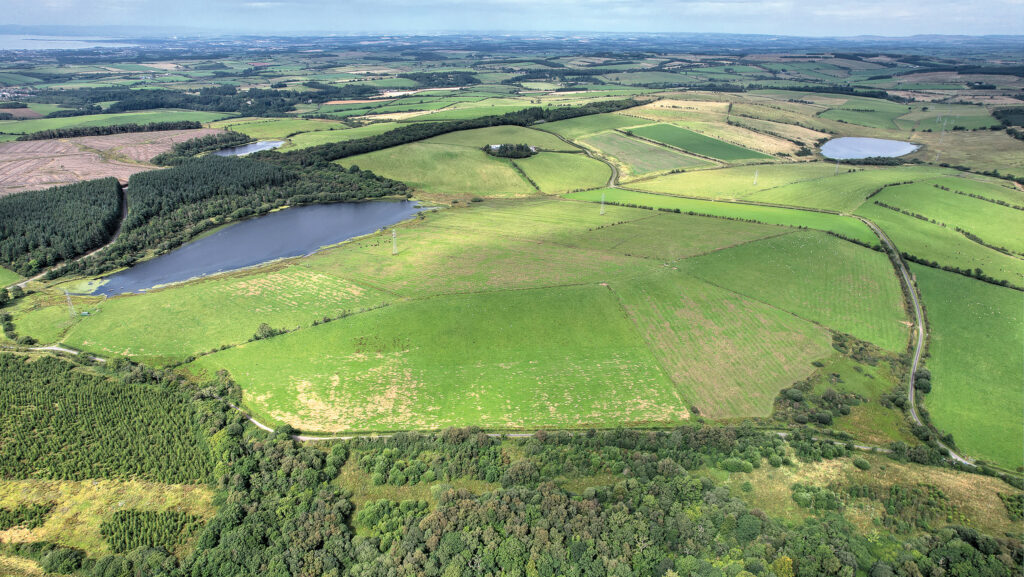
Drumbuie Farm © Savills
Ayrshire bare land
Savills has also launched a 103-acre block of land at Drumbuie Farm in Maybole, south Ayrshire.
The land, set in a ring-fence, split into five fields, and currently rented on a seasonal grazing licence, is predominantly class 4(2), which is land capable of producing a narrow range of crops, primarily grassland with short arable breaks of forage crops, according to the James Hutton Institute land classification maps.
It ranges in aspect from 127m to 161m above sea level, is all sown to grass, and has access to Barnshean Loch.
Sian Houston, of Savills, says the block could be a useful addition to an existing farm business or for lifestyle and equestrian interests.
Offers over £395,000 are being sought, and the land is also offered as two lots.