Planning consent and lotting – when do they help a farm sale?
 If allowed, lotting could have raised the sale price of the Kirkham Estate © GSC Grays
 Maximising the value of your assets is clearly a sensible strategy when preparing to sell your farm, but sometimes the rewards don’t outweigh the time, effort and costs involved.
Securing planning consent on redundant farm buildings, particularly for residential conversions, is likely to be one of those cases, according to farm agents from across the country.
Read also: Common issues that hold up farm sales
Planning consent
Philip Hoare, head of farm agency for Savills in central England, says he has had several clients who were disappointed that consents gained under permitted development rights (Class Q) for barn conversions didn’t add more to the value of their properties.
Interest has risen in gaining consent since the Class Q rules were changed to allow multiple dwellings to be created from redundant agricultural buildings, says Philip.
“People see it as the sort of golden egg that is going to produce millions of pounds of development money.
“But in reality, are you actually going to convert the redundant grain store in the middle of the farmyard into five dwellings? Probably not, because of the wider impact of the development.”
Limited appeal
Consents gained under Class Q also lapse after three years, which can limit their appeal to potential buyers, says Philip.
“What we seem to come across time and time again is that with about six to nine months left, people come to us and say, ‘I think we’re going to get the farm on the market now’.”
John Coleman, head of farm agency at north-of-England specialist GSC Grays, confirms that he regularly encounters potential vendors with an overly optimistic idea of how much value a planning consent adds.
“You get invited to a pitch, and the first thing somebody proudly says is that they’ve spent the past three years achieving planning for converting a steading.
“But then you have to break the news that it actually doesn’t change the value of the farm one iota, because what adds value in one area will diminish the value of the farm in other areas.”
The message from East Anglia is the same. “In the past 15 years, I don’t think I’ve ever recommended that anyone who’s thinking of selling their farm should try to get planning permission for anything,” says Brown & Co’s Lincolnshire-based Charlie Bryant.
Potential v permission
Another issue with gaining planning permission is that even where some kind of development makes sense – for example, an off-lying or village-bound range of redundant buildings – a purchaser will generally want to amend any consents to suit their own tastes and objectives.
“I would identify the potential and market that, rather than the actual planning permission,” advises Charlie.
“You could spend an awful lot of money getting a scheme drawn up in a certain way, which isn’t the way someone else would do it.”
The risk of applying for planning permission and getting turned down should also be considered, says Philip.
“That could be a real negative for a sale. It adds weight to the argument that you should sell a dream to a prospective buyer, but actually let them take on the risk and cost of delivering those dreams.”
Pre-application advice
Despite not placing much value on actual planning consents, agents point out that highlighting development opportunities is still a crucial part of their marketing process.
A cost-effective way to do this is via a pre-application notice to the local planning authority, if available.
These involve an informal discussion with your local council’s planning officer, allowing you to test your development ideas, understand policies, identify potential problems, such as access, and get feedback on what is likely to be permitted.
Costs vary depending on the level of detail required.
“If I think there are some genuine development opportunities on a farm that we’re going to be selling, my first bit of advice would be to put a pre-application notice into the local authority to establish the principles of what could be achieved,” says Savills’ Philip Hoare.
Charlie Bryant at Brown & Co explains: “The beauty of a pre-application inquiry is that it gives any buyer some comfort that whatever their intended use, it is probably going to be a runner.”
John Coleman at GSC Grays is also a fan, although he says some local authorities in the north of England no longer offer them.
“To me, they are potentially just as valuable as full planning, because you’ve established a principle for change of use.
“And if you can do that, then a good marketer will be able to promote those opportunities in the marketplace and bring in a whole range of different buyers.”
To lot or not to lot?
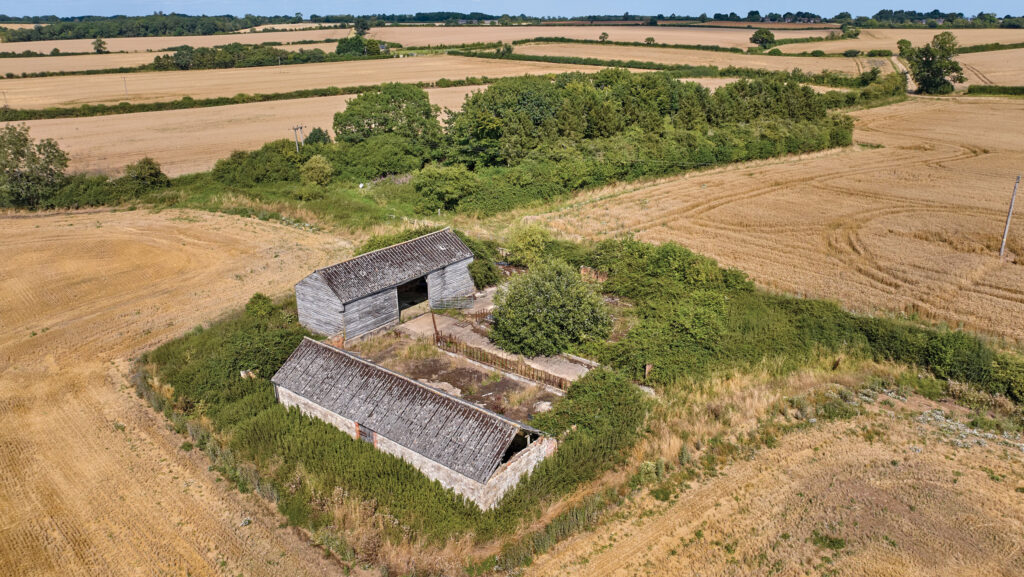
Savills used lotting at Castle Fields to identify buildings with development potential © Savills
Lotting a farm for sale, including any development opportunities, is another method that is often used to maximise values.
However, this is considered much more worthwhile than gaining planning consents, even if there can be cost implications and pitfalls to consider.
“Lotting is a good way of helping people understand how you’ve got to your magic number,” says Philip Hoare at Savills.
“We always endeavour to explain that very carefully to people.”
It can also add leverage during the sales process, adds Tristan Ward, a property specialist at law firm Broadfield.
“We do often see – even when the estate is expected to sell as a whole – genuine bids for lots being used in negotiations with the ultimate buyer of the whole, to push up the price paid.”
Weigh up the options
Whether lotting is actually worthwhile depends, of course, on whether the value of the whole exceeds the value of the sum of the parts, points out Tristan.
“That comes down to the state of the market, the nature of the asset being sold and whether there are neighbours able to acquire land in what may be a once-in-a-generation opportunity.”
Knowing who’s likely to be in the market is crucial, says John.
“When you’re selling lots of bare land, you’re looking for neighbours, because nobody’s going to travel more than 10 miles to farm a 50-acre block, so you need to be sure that you’ve got enough interest.”
Charlie says lotting had started to fall out of favour on his patch, but is now becoming more common again as the market gets tougher.
“There are fewer farmer buyers, so you’ve got to bear in mind that it could be pretty unlikely that one person is going to be able to buy the whole lot.
“You need to widen your market and accommodate more people.”
Too little lotting
Often, it is not too much lotting, but too little that can impact the value of a sale.
“I think we get more people asking to keep it as a whole because they have a sentimental attachment to the whole and don’t really want to see it split up,” says John
“For instance, we just sold the Kirkham Estate, which was 1,100 acres and had 14 houses.
“We could have probably made more money by splitting it, but the owner had made very specific instructions in her will that it should not be split up.”
Tristan says: “In my experience, where estates have been in a family ownership for many years, the seller often wishes the whole parcel to be sold as one to avoid being seen as the family member who ‘broke up’ the estate.”
In those circumstances, the seller often sub-sells the estate in lots, directing the initial buyer to transfer land to the sub-buyers, he explains.
Drafting numerous contracts for many lots, which are not needed because the estate sells as a whole, can be frustrating and costly, says Tristan.
Potential issues with not lotting
But, conversely, doing no work on the lotting means that if the asset is ultimately sold in lots, the necessary work in considering cross-rights, covenants and boundaries that may affect multiple lots needs to be done in a hurry.
“Getting this wrong can result in decades of problems and potential disputes.
“Particular risks relate to the cost and maintenance of estate water systems, where it may be necessary to set up a company to own the whole system, carry out repairs and collect service charges.”
Thought should be given to the various cross-rights, covenants and boundaries required for each lot, adds Tristan.
While some of this work may be wasted, some will not, he points out.
“Detailed knowledge of the run of pipes, roads, and other infrastructure will be helpful in preparing replies to due diligence inquiries, whether the estate is sold as a whole or in lots.”