

Where next for forestry market as investor caution deepens
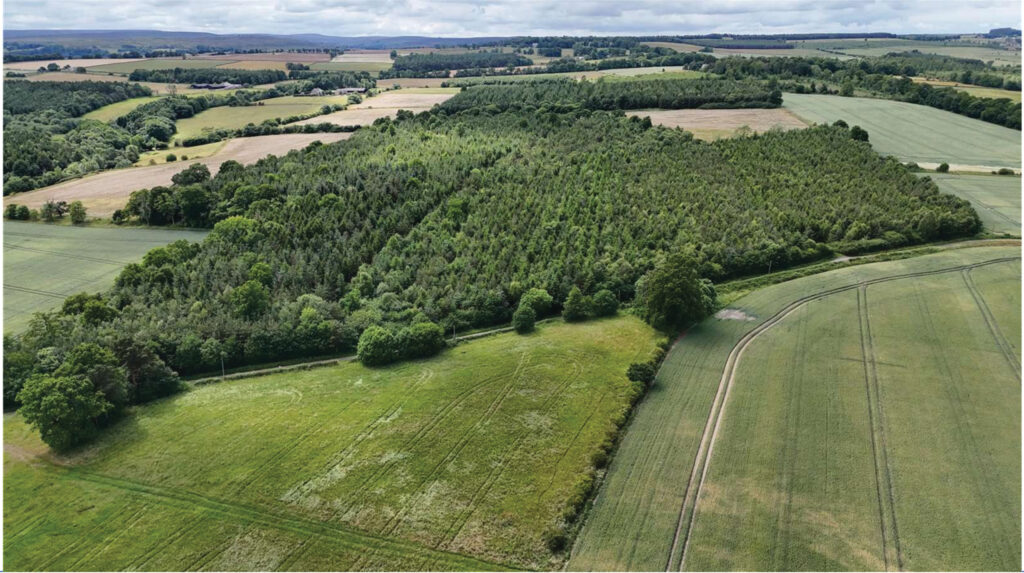 The 219ha Shotley Estate Woodlands, Northumberland, is on the market with Savills at a guide price of £3.53m © Savills
 More than £250m worth of commercial forestry changed hands in 2025 – a record sum and represented almost entirely by sales of conifer forests.
However, caution from investors means sales are taking longer to complete and values are in a widening range, depending on age and location, in particular how close plantations are to processing facilities and markets.
See also: Why a private project is looking to buy farmland for forest
Forest and woodland market specialist John Clegg & Co, which is part of Strutt & Parker, states in its 2025 forest market report that mature spruce plantations in the right locations can sell for £40,000/ha, while relatively mature plantations of the same variety in the “wrong” location can struggle to achieve £10,000/ha.
A flat timber market, relatively high interest rates, uncertainty over import and export tariffs, and the changing inheritance tax rules are all factors in this, alongside questions about the UK nations’ commitment to and policies on climate change.
In addition, the volatile political and economic backdrop is affecting all land markets.
Timber markets
The Covid years saw a massive rise in timber prices, to record levels, as supply chains were disrupted.
Since then timber prices in real terms (indexed from 2021 levels) have softened to a similar level to that of 2016, says Savills in its latest report on the market.
Volatility in this market presents challenges for long-term investment. At the same time planting is constrained by competition for land for agriculture and renewable energy, along with policy aims which prioritise broadleaved planting, says the firm.
It points out that the UK supplies only 27% of domestic timber requirements from home-grown sources and that alongside weak timber markets, operational costs continue to rise.
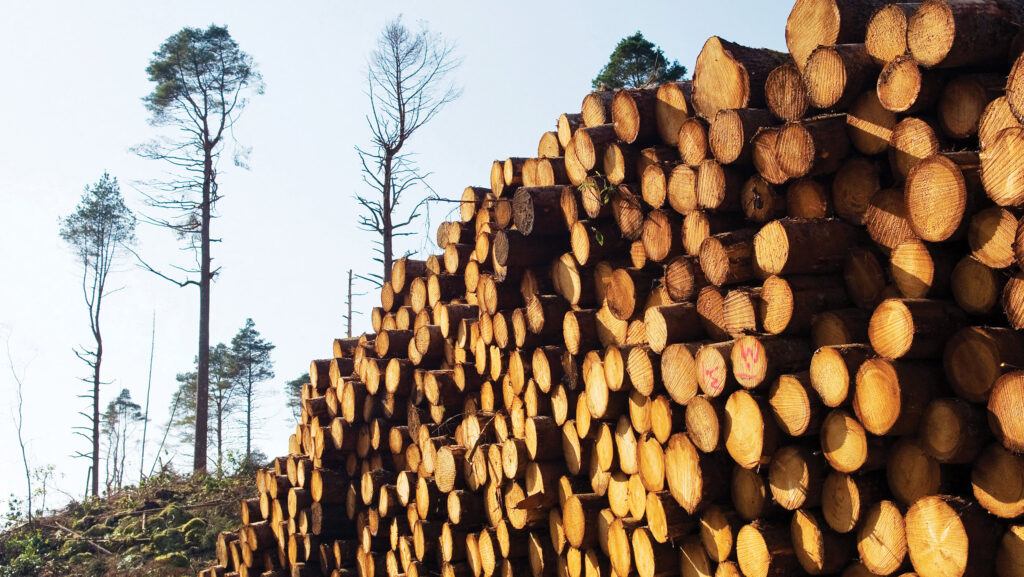
© David Lyons/Alamy Stock Photo
While the timber market is subdued in the short term, overall demand for timber remains high and the 10-year outlook is positive, says the firm.
“Woodland and other biological materials appear likely to be important in supply of new raw materials. With the apparent fracture of the global economy, reliance on imports looks likely to be unreliable.”
However, it also it warns that the percentage of conifers felled is consistently higher than the amount restocked and replanted.
In its report several new income possibilities for forestry and woodland are highlighted including carbon credits, biodiversity markets, recreation, agroforestry and renewable energy but these remain cautious markets and take time to develop.
Large sales effect
The total forest area sold in Great Britain in the calendar year 2025 is estimated by John Clegg & Co at 11,300 stocked or plantable hectares.
On a UK basis for the forestry year, from 1 October 2024 to 30 September 2025, Savills puts the area sold at 18,100ha .
Both firms stress the distorting effect of large sales in 2025.
One in particular – the Griffin Forest Complex in central Perthshire, a quality holding launched in 2023 by Savills – accounted for more than half the area sold and an estimated £130m-£145m of total sales. This land also has substantial income from 39 leased wind turbines.
While this took two years to sell, it achieved a considerably higher per hectare price than most other sales.
John Clegg & Co puts the majority of sales last year at between £10,000/ha and £20,000/ha, and excluding this large sale, average plantation prices were down about 14% in 2025, at £16,200/stocked ha, says the firm.
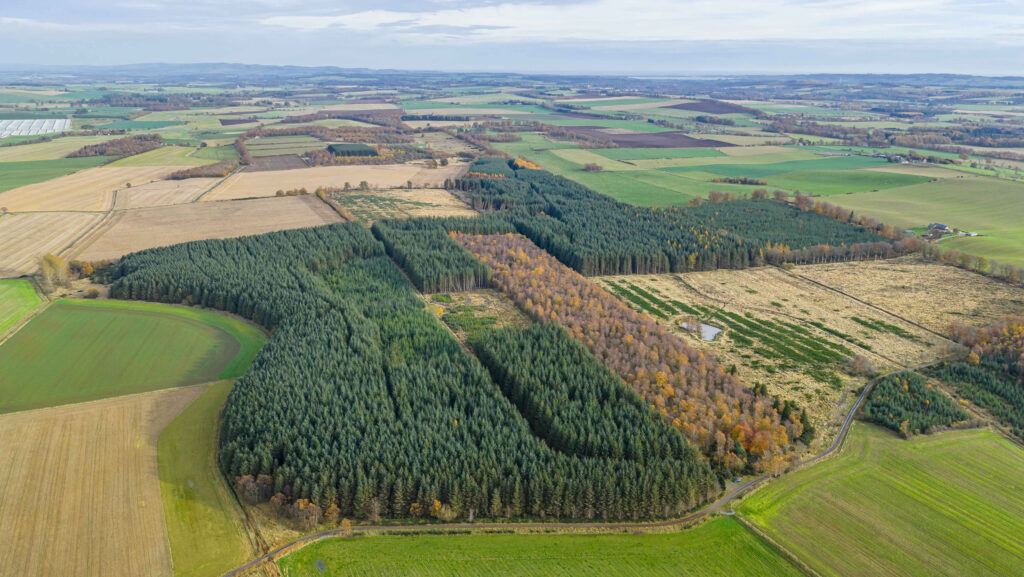
Weiris Wood, Angus, has 76ha of mixed age conifers and is on the market at £800,000 © John Clegg and Co
Sales are taking longer, with only 45% completing within six months of launch and a third taking more than a year to sell. Almost a third are selling below their guide price, although the overall average price was 102% of the guide, says John Clegg & Co.
“The forestry investment fundamentals remain in place – an underlying biological growth driver, a largely benign tax regime and strongly rising global demand for timber,” says Simon Hart, its head of forestry for Scotland.
“But until that translates into improved domestic timber prices, the forestry land and plantation market is likely to remain cautious. Good properties in the right locations are still selling well but take the same wood to the far north of Scotland and the price will be much lower.”
2026 outlook
Both firms see little coming to the market until global tensions ease. However, James Adamson, head of forestry, rural and projects at Savills’ Perth office, says: “I wouldn’t advise going to market until things settle down, we need people to stop trading blows.
“This one [Iran] is particularly unsettling as timber is a very fuel heavy business, but long-term, the fundamentals of owning trees, whether for timber or otherwise, are very positive.”
Planting land is still changing hands but at lower values and lower volumes than the peak of 2021-22, when thousands of acres of farmland was bought for planting.
“The ever-increasing challenges in getting approval, combined with mixed signals from the national governments on their commitment to climate change targets, have hit investor confidence.
“It is much easier to buy an existing woodland and avoid the hassle,” says Simon, who has a few forestry properties coming to the market this year from those who have made definite decisions to release that cash.
“We’re likely to see a slow down in activity,” he says. “Having said that, there are investment funds with a buying mandate and forestry is a relatively small market, so that can have a big bearing.”
Savills estimates that about 21% of forestry sales were off market in 2025, slightly down on the 10-year average of 25%.
Planting and targets
Planting targets continue to be missed, says Savills. The year to 31 March 2024 produced a recent high in tree planting but the rate of planting saw a further fall in 2025, with a 40% drop in the Scottish Government’s woodland creation budget blamed for this, along with a slow approvals process.
Changing priorities
While policy has historically been focused on timber production, biodiversity and carbon have risen up the agenda and since the 1990s.
Funding has prioritised broadleaved planting, which may negatively impact the rate and volume of carbon capture and increase the reliance on timber imports, says the firm.
Each UK country has its own planting target, with Defra recently increasing that for England to 210,000ha of additional planting by 2050.
Savills describes the overall UK target of 30,000ha a year as “ambitious and somewhat unrealistic”.
Climate challenges
Climate change brings not only slower growth but establishment challenges says Savills.
The prospect of more frequent hot dry summers over the next five decades and up to 39% more rain in winter will cause higher death rates among young trees.
This demands smarter planting, the choice of climate resilient species and improved water management.
New tree planting UK and by country (ha) |
|||
|
|
2023-24 planting year |
2024-25 planting year |
% change |
|
UK |
20,664 |
15,579 |
-25% |
|
England |
4,554 |
5,765 |
27% |
|
Scotland |
15,040 |
8,469 |
-44% |
|
Wales |
636 |
843 |
33% |
|
Northern Ireland |
434 |
502 |
16% |
|
Source: Savills research |
|||
Total area of trees – 2005 compared with 2025 (ha) |
||||||
|
|
2005 |
2025 |
% change |
|||
|
|
Conifers |
Broadleaved |
Conifers |
Broadleaved |
Conifers |
Broadleaved |
|
UK |
1,641,961 |
1,379,383 |
1,576,015 |
1,710,479 |
-4% |
24% |
|
England |
355,139 |
921,556 |
305,810 |
1,038,987 |
-14% |
13% |
|
Scotland |
1,064,868 |
292,916 |
1,068,261 |
441,365 |
0% |
51% |
|
Wales |
156,244 |
145,560 |
139,497 |
173,676 |
-11% |
19% |
|
Northern Ireland |
65,710 |
19,350 |
62,447 |
56,451 |
-5% |
192% |
|
Source: Savills research |
||||||