Mobile phone use in farm vehicles – the rules and penalties
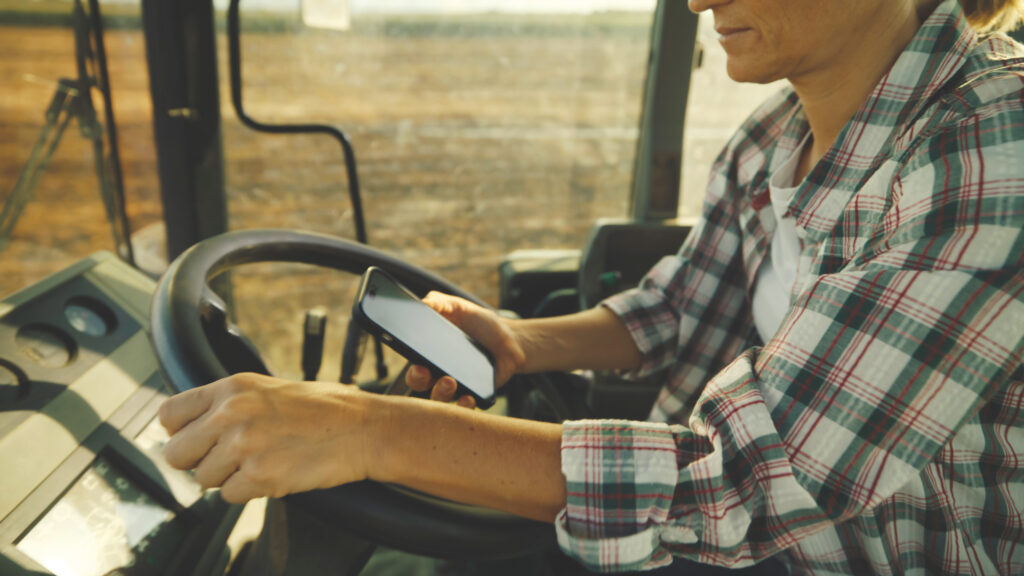 © Simon Skafar/iStockphoto
 Whether travelling for personal, business or employment reasons, it is illegal to hold and use a phone, satnav, tablet, or any device that can send or receive data, while driving a self-propelled vehicle.
The penalty is up to six points and a £200 fine and those who have passed their test within the past two years will lose their licence.
Devices must not be used in the hand for any reason, whether online or offline. This includes texting, calling, taking photos or videos, or browsing the web.
See also: How simple steps can protect and save farm lives and others
Advisers point out that a strict mobile phone use policy should be set out for employees and enforced, also that phone use is more easily visible when it takes place in a tractor cab or other high vehicle with a large glass surface.
Where such use is involved in an accident, this can have insurance implications.
“In the event of an accident while using a device the insurance implications can be significant,” says Zoe Kerswill, a broker with the Alan Boswell Group.
“If the law has been broken, the insurer has the right to refuse the claim, or limit cover to just benefit third parties (if they weren’t to blame for the accident).
“The insurer could at their discretion seek to recover these losses from the driver or policyholder.”
Multiple risks of mobile use by farm drivers
Mobile device use in moving farm vehicles is a growing problem, with social media playing a big part in this, says Mia Bambury, managing director of Safety Revolution.
Such use is not only illegal and dangerous but also presents a reputational risk. With many tractors being badged with the business name, they are easily identifiable.
“Using a mobile while moving through a village, for example, is easily captured on video by a member of the public and in turn reported or put on social media,” says Mia.
“We sit in on a lot of pre-harvest meetings and for some staff it’s their first harvest with the business, or they may be students.
“So it’s a good time to reinforce the farm’s mobile phone use policy and remind the whole team on safe vehicle operation.”
Many farm businesses use dash cameras in their vehicles to record what’s happening on the road.
“Farm vehicles are often blamed initially for accidents when another driver is actually at fault, and dash cams can help provide evidence,” says Mia.
“They can also be helpful in investigating incidents when reports are made about the way farm vehicles are driven.”
Wider detection methods
Police forces have begun using artificial intelligence (AI) on roadside mounted cameras, designed to detect drivers using a mobile phone or not wearing a seatbelt.
The AI is able to identify poor driver behaviours and road conditions.
The law banning handheld device use still applies if:
- The vehicle is stopped at traffic lights or is queuing in traffic
- A learner driver is being supervised
- The vehicle being driven turns off its engine when it stops moving
- A device is being held that is offline or in flight mode.
The only exceptions to the ban on the driver using a device in their hands is if the driver:
- Needs to call 999 or 112 in an emergency and it is unsafe or impractical to stop
- Is safely parked
- Needs to make a contactless payment in a stationary vehicle – for example, at a drive-through service
- Is using the device as a guidance system to park the vehicle automatically.
Using devices hands-free
Devices can be used hands-free, which means using a Bluetooth headset, voice command, a dashboard holder or mat, a windscreen mount or built-in satnav.
The device must not block the view of the road and traffic ahead – three penalty points can be given where there is not a full view of the road and traffic ahead or proper control of the vehicle.
The police can stop a vehicle if they think the driver is not in control because they are distracted.
Prosecution can follow, including a driving or riding ban and a maximum fine of £1,000. This rises to £2,500 for those driving a lorry or bus.
How many drivers are breaking the law?
The proportion of drivers who admit to illegally making or receiving a phone call without a hands-free kit has risen to 30%, the highest level in almost a decade, according to the RAC’s Report on Motoring 2025.
The percentage admitting to texting, emailing, accessing the internet or posting on social media has reached a post-pandemic high of 12%.
One-in-five drivers (19%) admit to checking messages or notifications, the highest level since 2016, and 11% say they have taken a photo or recorded a video with their phone while driving, up from 8% in 2024 and the highest rate since 2019.
Younger drivers are by far the most likely age group to engage in illegal mobile phone use. Well over half (58% compared to 30% overall) say they have made or received a call without a hands-free kit, and 27% have composed a message or social media post while behind the wheel.
Almost four-in-10 people (37%) have made or received a video call while driving, and 29% have taken a photo or filmed a video. About one-in-seven (14%) say they have played a game on their phone while driving.