£40m grant scheme opens for Northern Ireland farmers
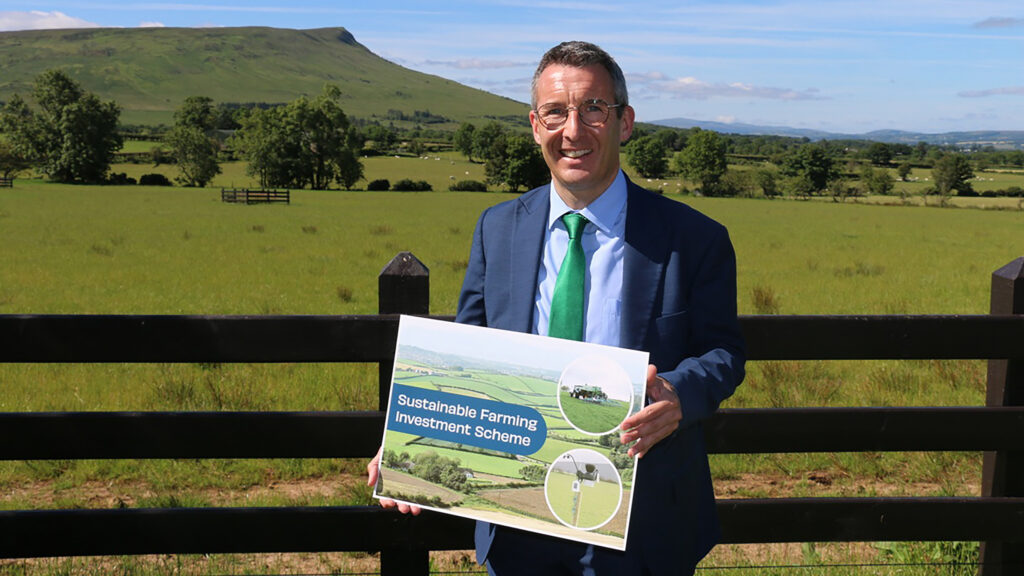 Andrew Muir © Daera
 Northern Ireland farmers will be able to apply for grants of up to £25,000 from 21 July under a new £40m scheme to support investment in on-farm technology and equipment.
The Department of Agriculture, Environment and Rural Affairs (Daera) said the Sustainable Farming Investment Scheme (SFIS) will provide 40% grant funding for eligible investments worth between £3,000 and £62,500.
The scheme forms part of Daera’s Sustainable Agriculture Programme and is designed to help farm businesses improve efficiency, animal health and environmental performance across all sectors.
See also: Proposed pollution control rules set out for NI farmers
Eligible items include equipment for livestock, grassland, crop, fruit and vegetable production, alongside slurry and resource management.
Farmers will also be able to apply for precision technologies such as camera-guided weed control systems and livestock heat and health detection devices.
Daera minister Andrew Muir said: “The scheme is a significant element within my department’s Sustainable Agriculture Programme and expands the range of support available to underpin a thriving, resilient and environmentally sustainable farming sector.”
Essential support
Applications will be made through a simple online system using a pre-priced list of eligible items, meaning farmers will not need to obtain supplier quotations.
The first application window will remain open until 11.59pm on 3 September, with further funding rounds planned over the next three to four years.
The Ulster Farmers’ Union (UFU), which has long called for a capital grant scheme, said the funding would help farmers meet growing environmental and regulatory requirements.
UFU president John McLenaghan said: “The UFU has always highlighted the necessity of grant support in helping farmers deliver on measures such as NAP [the Nutrients Action Programme].
“A capital investment scheme is not a ‘nice to have’, it is essential if farmers are to deliver the changes government is asking of them.
“Whether it is improved slurry management, safe handling facilities, nutrient use efficiency, precision equipment, low-emission technology or other practical measures, farmers need support that is timely, accessible and fit for purpose.”