

Analysis: Swinney offers reassurances, but farmers seek delivery
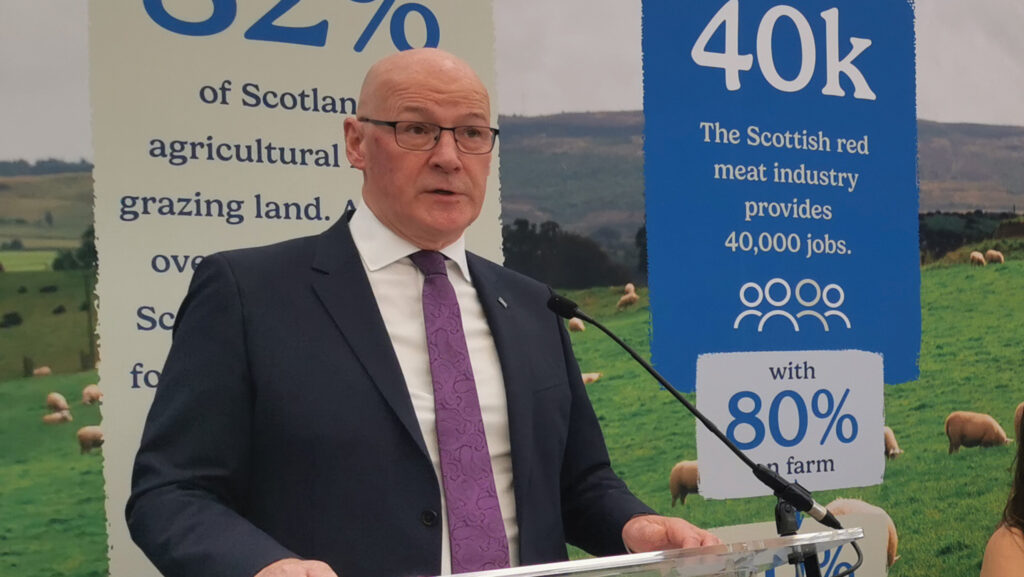 First minister John Swinney addresses the QMS Breakfast meeting at the Royal Highland Show © MAG/Philip Case
 The Royal Highland Show has always been a place where Scottish agriculture comes to take the measure of government.
Ministers arrive armed with promises, farmers arrive with questions, and somewhere between the livestock rings and the business pavilions the mood of the industry begins to emerge.
This year, one issue dominated the political conversation from the outset – John Swinney’s controversial plan to cap the price of essential food items.
See also: Scottish farmers face autumn wait for FFIS 2026 details
The first minister used a packed Quality Meat Scotland (QMS) breakfast at Ingliston to reassure producers that any future food price cap would not come at farmers’ expense. It was a message he knew he had to deliver.
The proposal, which would require supermarkets to offer selected staples such as bread, milk and eggs at capped prices, is one of the flagship commitments in the SNP government’s first 100 days.
Politically, it is easy to understand. With household budgets still under severe pressure, the idea of making basic food items more affordable has obvious appeal.
Yet for an agricultural sector already squeezed by rising costs, volatile markets and budgetary uncertainty, the proposal immediately raises a familiar anxiety – who ultimately absorbs the cost?
Mr Swinney was careful to acknowledge that concern. “[This] cannot come at the expense of farmers, growers and producers, who produce these items for us all,” he told the audience, promising close engagement with the industry as the policy is developed.
Those assurances were well received by farmers. But they also highlighted the central problem. Nobody in the room appeared entirely sure how such protections would work in practice.
In a press briefing shortly afterwards, Scotland’s agriculture minister Jim Fairlie went even further, insisting he would be “absolutely vigorous” in defending primary producers from any unintended consequences.
Speaking at an NFU Scotland (NFUS) media briefing, vice-president Duncan Macalister articulated the concern many farmers share.
If pressure created by a retail price cap is simply pushed back through processors and supply chains, the burden will inevitably land on primary producers. For businesses already operating on tight margins, that would be unsustainable, he argued.
The challenge for ministers is not simply proving that food can be made cheaper for consumers. It is demonstrating that the economics can work without further weakening the very businesses responsible for producing that food in the first place.
The Scottish Conservatives remain deeply sceptical, accusing Mr Swinney of “doubling down on a bonkers plan” that would be “bad news for those who produce Scotland’s iconic food products” if implemented.
FFIS delay
Elsewhere, hopes for fresh detail on round two of the Future Farming Investment Scheme (FFIS) at the Highland Show were dashed.
The capital grant scheme drew huge interest when launched last July, reflecting strong demand for on-farm investment across Scotland.
With £14.25m earmarked for its return, many farmers arrived at Ingliston expecting at least an indication of what the next round might look like. Instead, they were told to wait.
Mr Fairlie confirmed no announcement would be made during the show, saying farmers are still “two or three months” – or more – away from seeing FFIS 2026.
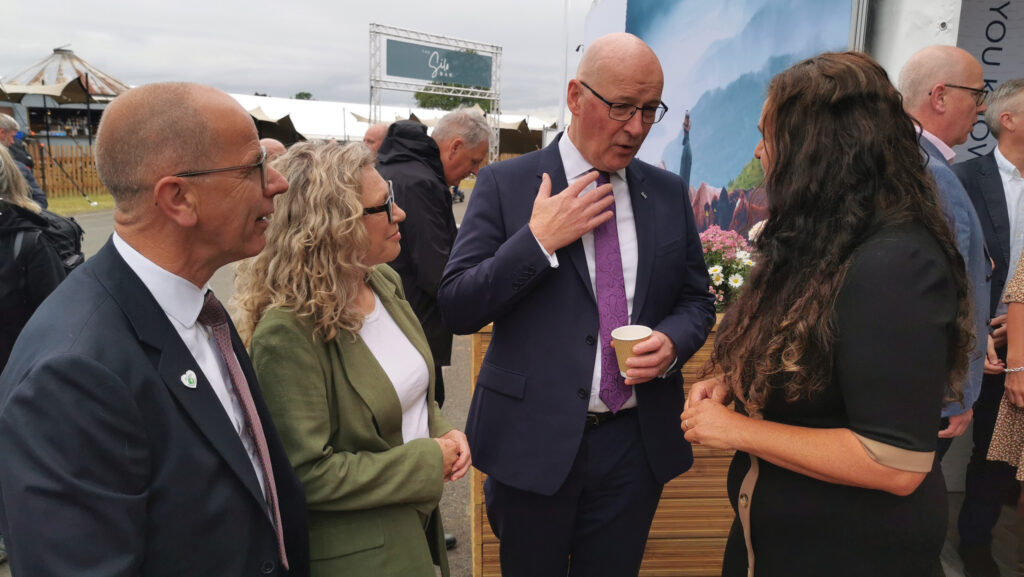
Jim Fairlie and Gillian Martin watch on as first minister John Swinney makes his point to QMS chair Kate Rowell © MAG/Philip Case
Following controversy over the heavily oversubscribed first round, the Scottish government is keen to avoid rushing the scheme. Yet the delay underlines wider frustration across the sector.
Mr Fairlie was flanked by Gillian Martin MSP, the new cabinet secretary for climate action and rural affairs, who succeeds Mairi Gougeon and has significant boots to fill.
NFUS’s own recommendations for FFIS underline the scale of industry concern. Calls for clearer scoring, transparent eligibility criteria, targeted support and longer-term funding are not about adding bureaucracy, but about giving farmers consistency.
Scottish agriculture has spent years talking about transition, reform and future frameworks, with ministers stressing investment, innovation and environmental improvement. But farming and crofting businesses making long-term decisions still lack certainty.
Investment decisions cannot be made on rhetoric alone.
Concerns
In his speech to the QMS breakfast meeting, Mr Swinney addressed some of those concerns, reiterating support for direct payments, the Small Producer Pilot Fund and FFIS, and defending the decision not to pursue livestock reductions as part of climate policy, despite Climate Change Committee recommendations.
He also highlighted plans for a Rural Renewal Bill to unlock opportunities for sustainable growth in rural and island communities.
The message was one of stability and partnership, but whether it proves convincing will depend on what follows. Policy frameworks exist and ministers speak of partnership, but farmers and crofters are demanding action, not just warm words.
NFUS president Andrew Connon summed up the mood at the union’s media briefing with a clear message to government: “Now is the time for delivery.”
Meanwhile, the union says agricultural support in Scotland is “flatlining” at about £660m a year and is urging a multi-annual funding commitment to give greater certainty.
At this year’s Royal Highland Show (18-21 June), ministers pledged support on food price caps, defended livestock farming, promised continued investment and set out a vision for rural growth over the next five years.
But reassurance alone will not resolve questions over food price controls or uncertainty around future investment schemes.
The real test for Scottish government now lies in delivering its vision.
Show ring success, but concerns remain for Scots farmers
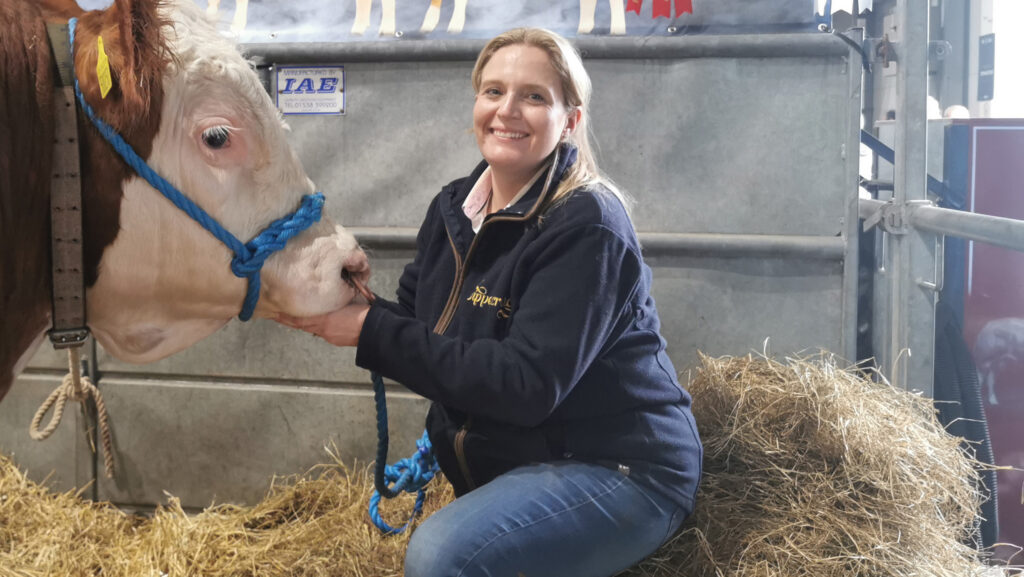
Lindsay Stark © MAG/Philip Case
Fresh from success in the show ring, two Scottish farmers are urging the new Scottish government to back the industry and provide greater certainty for the future.
Lindsay Stark, a pedigree beef farmer from Bonnybridge, enjoyed a strong Royal Highland Show, where her Highland bull Voodoo of Tippetcraig and Simmental junior bull Tippetcraig Someboy were named reserve junior male champions.
But despite the success, she says many farmers are worried about what lies ahead.
“I think there’s a lot of uncertainty at the minute,” she said, citing concerns around inheritance tax and succession planning. “The future of farming is a bit more uncertain than it has been in the past.”
Mrs Stark wants ministers to “prioritise Scottish farming”, support home-grown produce and continue programmes that encourage new entrants.
“I’ve benefited a great deal,” she said of support for women in agriculture. “I’ve been given a lot of training to improve our own enterprise.”
Jim Ramsay, a sheep and cattle farmer based in Milnmark, Dumfries and Galloway, was celebrating after his Blackface ewe, Queen Bee, was crowned champion Blackface sheep at the Royal Highland Show for the third consecutive year – a rare achievement for the same animal.
The sheep also won the overall interbreed sheep category on the Saturday.
Away from the show ring, Mr Ramsay said access to land, especially for young people and new entrants, is becoming a major concern.
“There’s a lack of land, particularly in Galloway,” he stressed, arguing that farmland is increasingly being lost to forestry and investment buyers.
Mr Ramsay wants the Scottish government to do more to protect agricultural land and rural communities.
“The land’s there to serve the people,” he said, warning that current policies are “leaving not just farming, but local people, local industries behind”.
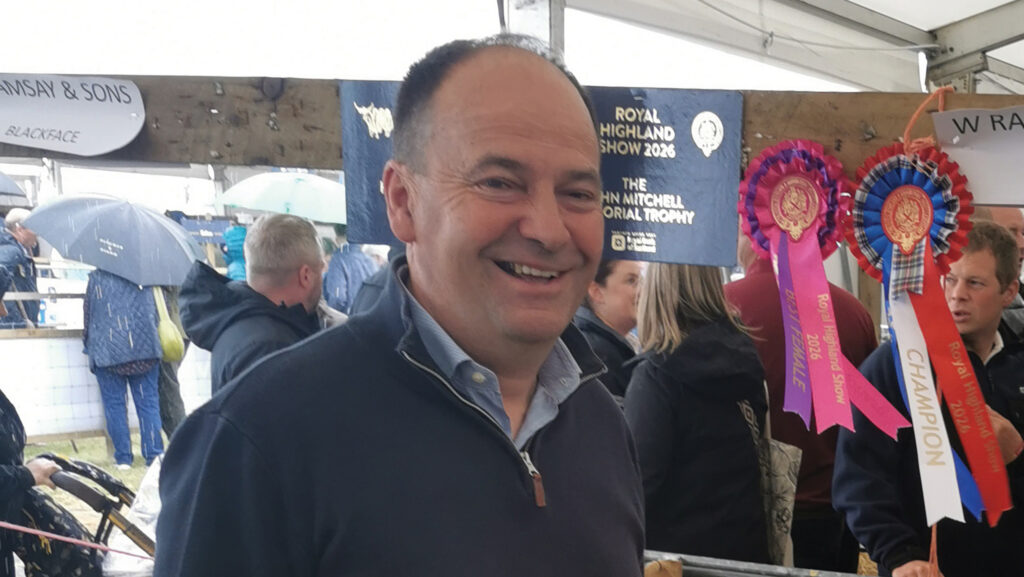
Jim Ramsay © MAG/Philip Case
Strong crowds and trade lift spirits at Ingliston
Amid ongoing policy debate, this year’s Royal Highland Show provided a much-needed vote of confidence in Scottish agriculture, drawing more than 210,000 visitors to Ingliston over four days and delivering strong trade for exhibitors despite a wet start.
Scotland’s premier agricultural event showcased the very best of the sector, featuring more than 6,000 livestock, 700 exhibitors and a sell-out Saturday attended by 55,000 people.
Show organisers the Royal Highland and Agricultural Society of Scotland (Rhass) reported strong commercial activity across the showground, underlining continued appetite for investment and innovation in farming and rural businesses.
David Tennant, head of show at Rhass, said: “After a rainy start, the sun shone over the final two days, helping to shine a light on the very best of Scottish agriculture and the hard work, dedication and resilience of our farming community.”
The show’s success comes as Rhass returns to financial health.
At its AGM in April, the society reported an operating surplus of £551,000, following losses of £1.8m in 2024 and £3.1m in 2023. Last year, the Royal Highland Show itself generated a surplus of £404,624, compared with a loss of £837,009 the previous year.
Seven key farming pledges the SNP government must deliver
- Maintain at least 70% direct payments under the future policy framework, better targeted to active farmers and crofters.
- Guarantee funding stability across core schemes, including Less Favoured Area Support Scheme and Voluntary Coupled Support (VCS).
- Back livestock through the Scottish Suckler Beef Support Scheme and wider VCS, maintaining herd and flock numbers.
- Expand new entrant support via access to public land, finance and skills, alongside creating new small landholdings.
- Extend the Small Producer Pilot Fund and strengthen support for local processing and supply chains.
- Launch a Public Sector Food Procurement Taskforce to boost Scottish sourcing in public contracts.
- Introduce a Rural Renewal Bill to deliver planning reform, diversification (via permitted development rights), land reform, tenant measures and rural-proofing.
Explore more / Transition
During the series we follow our group of 16 Transition Farmers through the challenges and opportunities as they seek to improve their farm businesses.
Transition is an independent editorial initiative supported by our UK-wide network of partners, who have made it possible to bring you this series.
Visit the Transition content hub to find out more.
