

Advertiser content
Why early action on BNG is critical for farmers
As England’s biodiversity net gain (BNG) rules come into force across the development sector, a new market is emerging – one that could reshape the economics of marginal farmland and influence how habitat is restored across the country.
But while developer demand is now locked in by law, the market is still struggling to find its feet.
That creates a risk for long-term policy stability, and a clear early-mover opportunity for those prepared to engage now.
BNG is straightforward in principle: when developers build housing, commercial units or infrastructure, they must deliver at least a 10% net gain in biodiversity.
If they cannot achieve that on the development site, they must purchase biodiversity “units” from farmers or landowners who commit to creating or improving habitat for a minimum of 30 years.
© Naturefy
The outcome is a new supply-and-demand market: developers must buy units, and landowners can sell them. But supply is currently well behind demand.
A new market built on an old problem
Biodiversity decline has historically been an external cost of development. BNG alters that by placing a statutory obligation on developers, and creating a paid role for landowners in delivering the ecological uplift.
Jim Day, founder of Naturefy, a new platform designed to help farmers and landowners access the BNG market more easily, has seen the potential first-hand.
“I’ve watched the decline in British wildlife throughout my lifetime. I care deeply about the countryside and felt compelled to do something about it,” he explains.
“That’s why I created my own private nature reserve — and the experience has been incredibly rewarding.
“Biodiversity net gain offers a chance for many more landowners to restore nature on their own land, but with a viable income stream attached.”
Restoring marginal land is not new — but the financial justification has often been weak.
Traditional schemes helped offset costs but rarely delivered strong long-term returns compared with farming.
BNG fundamentally changes that calculation by attaching measurable, tradeable value to well-designed habitat.
© Naturefy
Political winds
Many landowners have felt squeezed in recent years: increased tax exposure, reductions in agricultural subsidies, rising input costs and uncertainty around long-term policy.
Confidence across the rural economy has taken a hit. BNG stands out as one of the few recent policy changes that could support rural resilience.
It is backed by both environmental and pro-growth arguments, and crucially, it does not rely on taxpayer funding.
The Naturefy founder notes the significance: “Farmers have been through a tough period politically.
“But BNG is one of the few policies where landowners are genuinely in a position of strength.
“The government has created a framework where land can generate long-term value without relying on subsidies — and that’s a rare thing.
“With the political climate turning more supportive, landowners should grasp the opportunity.”
Political backing, developer demand and increasing scrutiny of ecological impact all combine to create a favourable moment for early suppliers.
© Naturefy
Why BNG is a potential win-win
For lower-yield land or areas with high input costs, habitat creation can offer a viable alternative income stream.
Developers are required to purchase units, and in the early stages of any new environmental market, scarcity tends to push prices up.
Jim adds: “Right now, prices are higher than they will be once the market matures.
“Early movers are likely to benefit. But there’s a catch: the market is struggling because there simply aren’t enough landowners offering units.
“If supply doesn’t increase, the policy risks being watered down or withdrawn — and this incredible opportunity to reshape the countryside could be lost.”
Unit value varies by habitat type, distinctiveness and condition.
Woodland, wetland and species-rich grassland often command higher values, but they take time to establish, meaning early entrants lock in long-term gains.
For many farms, BNG may sit alongside, not instead of, traditional production.
A market still finding its feet
Despite the potential, the market is not yet functioning smoothly.
Developers must secure units now, but many struggle to find available supply.
Meanwhile landowners face barriers including:
- ecological assessments
- metric calculations
- lengthy management commitments
- navigating legal agreements
- uncertainty over pricing
- finding credible buyers.
For farmers already under pressure, it can feel overly complex.
This imbalance has pushed some unit prices above £20,000, with a single hectare often generating several units. It’s a sign of a young market, not a long-term norm.
Jim Day highlights this early-phase volatility:
“This is the moment when landowners can both help stabilise the market and benefit from it.
“Units are being sold for over £20k and one hectare can often easily yield 5 units, so 100k per hectare!
“Great for sellers now, but likely not sustainable. Many don’t know where to start, or they are put off by the perceived complexity.
“That’s why tools that make the process simpler — and reduce risk — are so important.”
Removing barriers for landowners
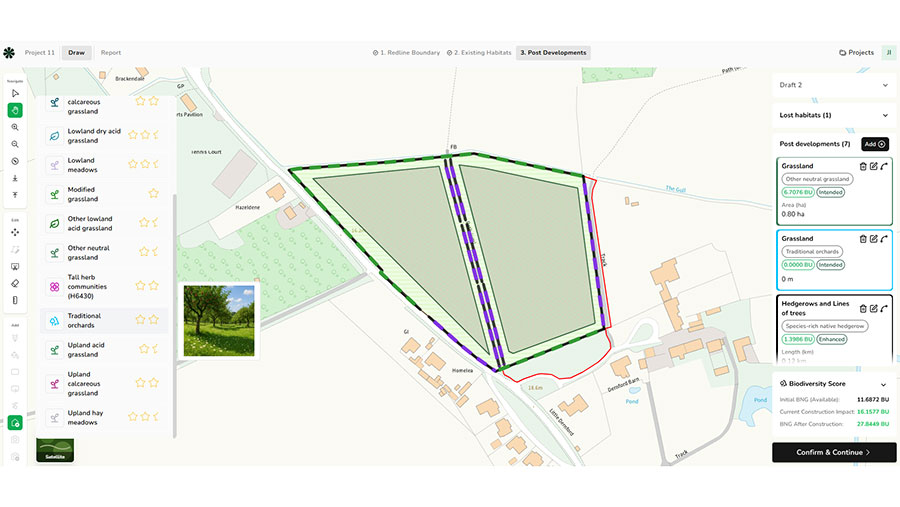
To complement ecologists and consultants, several digital tools and advisory routes are emerging to lower the cost and confidence barriers.
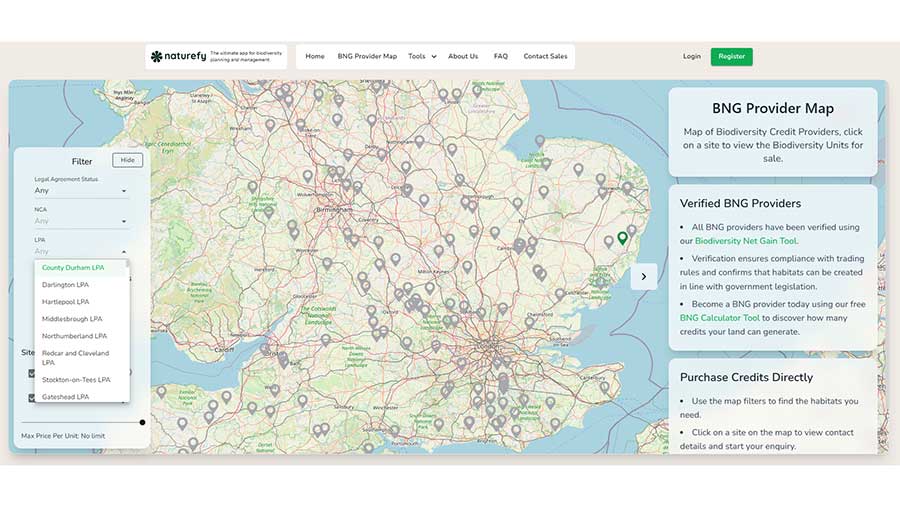
Naturefy is one such tool — a free platform where landowners can indicate interest, list potential BNG land, and be contacted by developers seeking units.
The model allows landowners to test demand before paying for surveys or committing to habitat creation.
The platform only charges when a successful match is made, helping reduce upfront risk.
Its broader aim is to increase market liquidity so pricing, supply and demand can reach a sustainable balance.
The wider point is this: farmers no longer need to navigate the BNG process alone. Practical tools now exist to help them enter the market confidently.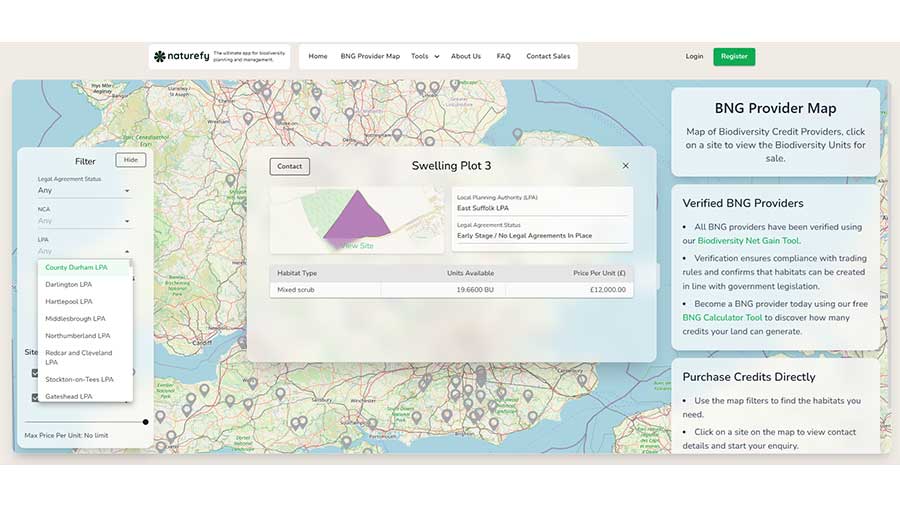
Why early action matters
Three factors give early entrants a potential advantage:
1. High initial prices driven by scarcity
Current prices reflect a thin market. As supply increases, values are expected to settle.
2. Habitat value increases over time
BNG habitats often take years to reach maximum unit generation. Those who start sooner benefit sooner.
3. Policy stability relies on supply
If the market remains under-supplied, there is a risk policymakers look to soften or adjust the framework.
Engaging early can help secure better returns and contribute to stabilising a policy that could deliver long-term benefits to rural areas.
A long-term vision for the countryside
If BNG beds in successfully, its impact could be significant:
- Diversified income for farms facing economic pressure
- Thousands of hectares of species-poor land restored
- New ecological networks linking habitats across counties
- Recovered populations of birds, insects, amphibians, and mammals
- More resilient landscapes against flooding and climate extremes.
The aim is not to remove productive land from agriculture, but to recognise where marginal or hard-to-farm land may deliver more value — financial and ecological — when restored.
Jim Day sums up the long-term potential:
“BNG allows landowners to be paid for doing something that benefits the whole country. It’s not a subsidy — it’s a fair market mechanism where developers fund the restoration of biodiversity.
“If landowners step forward now, they can secure long-term income while helping to restore the countryside we all love.”
What farmers should do next
For those considering BNG, a straightforward process is emerging:
- Identify marginal or low-value land suitable for habitat creation.
- Explore the market — including platforms like naturefy.co.uk/provider-map that allow you to advertise your land at no upfront cost.
- Speak with an ecologist to understand the potential habitats and unit generation.
- Understand the long-term management commitments, usually 30 years.
- Evaluate the financial case, including income from units and ongoing habitat management payments.
Early participation can help shape the market and lock in the current advantages.
Conclusion
BNG is one of the most significant shifts in rural land management for a generation.
It places developers under a legal obligation, rewards land managers for restoring nature, and could influence how thousands of hectares across the UK are used in future.
With political headwinds elsewhere, BNG offers a rare silver lining: strong developer demand, a functional market mechanism, and genuine opportunities for landowners who move early.
Engaging now allows farmers to benefit financially, contribute to market stability, and play a central role in restoring Britain’s natural environment.
If you’re a farmer interested in Biodiversity Net Gain, Naturefy makes it simple to get started.
Visit www.naturefy.co.uk/provider-map to list and advertise your land for free.
Provided by
Naturefy provides UK farmers with free tools to map and advertise their land for Biodiversity Net Gain and streamline compliance, helping turn nature-friendly land management into a new income opportunity.