

Advertiser content
Why UK farms need more than solar panels – Freen explains
Every farmer who has installed solar panels knows the feeling. You watch the meter spin backwards on a bright July afternoon, congratulating yourself on your foresight – and then November arrives.
The panels sit under low cloud, the grain dryer is running flat out, the milking parlour has been going since 4 a.m., and every kilowatt is coming off the grid at over 24p.
That is not an energy solution. That is half an energy solution.
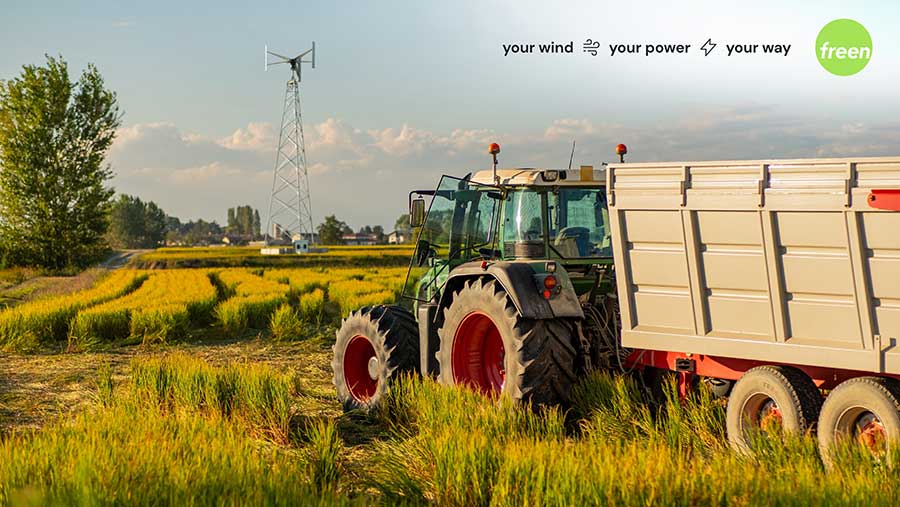
The missing half is wind. And for UK farms specifically, it fits in a way that feels almost designed.
© Freen
When farms need power most
Think about your heaviest energy demands. Grain drying kicks in when harvests come in wet, in deteriorating autumn weather. Dairy milking systems run before dawn and after dark, year-round.
Heating, ventilation, and frost protection peak in the depths of winter. Workshop machinery runs whatever the season, whatever the weather.
Solar produces none of this. Its peak output falls on summer afternoons when farm loads are often lightest.
The seasons that drive your electricity bill – October through March – are precisely the months when a solar array produces a fraction of its rated output.
UK wind does the opposite. Met Office long-term data show that wind speeds across British agricultural regions are typically 25–30% higher in winter than in summer.
The same stormy, overcast weather that shuts down solar is precisely the weather that keeps a wind turbine turning. On a farm where energy needs don’t pause for low irradiance, that complementarity is worth real money.
The numbers behind the logic
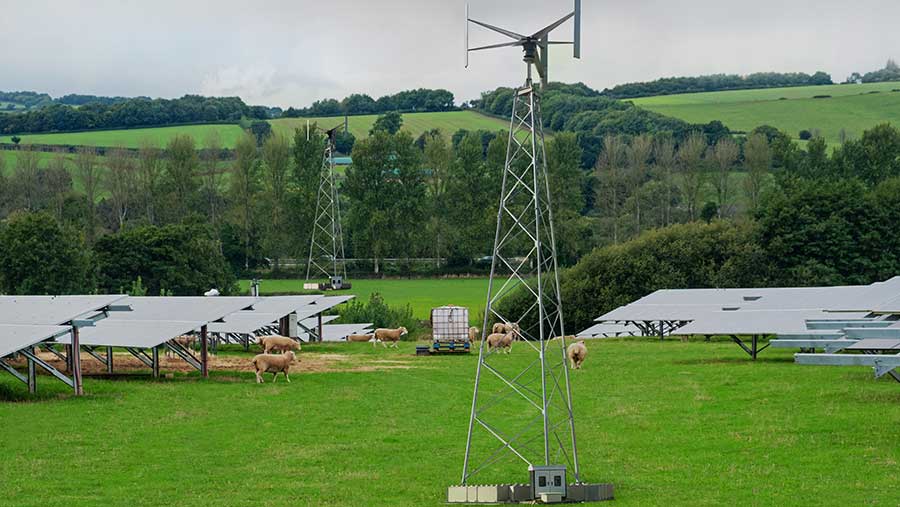
The Freen-9 is a 9 kW vertical-axis wind turbine designed to work alongside solar and battery storage on exactly this kind of site.
Its annual energy production is acutely sensitive to wind resource – which is why location matters enormously – but in genuinely exposed farm settings, the results are compelling.
At a hub-height average of 6 m/s, the Freen-9 produces around 12 MWh per annum. Push that to 6.3 m/s, typical of open agricultural sites in northern Scotland, and you are looking at nearly 14 MWh annually.
In a modelled scenario for a farm consuming 40 MWh per annum, pairing a 30 kWp solar array with a Freen-9 produces a combined system that covers around 35–39 MWh of annual consumption depending on region.
At current electricity prices of 24.67p/kWh on import and a 12p/kWh export rate, that translates to annual energy value of £7,200–£8,200 – with a simple payback in the range of eight to ten years. That is the kind of calculation that survives a bad winter.
The turbine itself is compact by agricultural standards: 6 metres in diameter, 18 metres tall on its standard tower, with a swept area of 24 m² and a noise level of 45 dB at 100 metres.
It requires no planning permission in most rural UK settings and can be relocated if your operation changes.
The Darrieus vertical-axis design handles turbulent air flows better than horizontal-axis machines – relevant on real farm sites with hedgerows, buildings, and uneven terrain.
© Freen
Grain drying: The case in one sentence
Your grain dryer runs hardest in late September and October, when electricity demand spikes and wind is picking up after summer. Solar is fading. Wind is rising.
This is not a coincidence – it is the seasonal reality of UK climate, and it makes the case for wind on arable farms almost without further argument.
The resilience argument
Energy price volatility since 2021 reminded every agricultural business that electricity is no longer just a utility cost – it is a business risk.
Rural grid connections in many parts of the UK are constrained, upgrades are slow, and reinforcement costs fall to the customer.
Farms with on-site generation – particularly hybrid systems that produce in different seasons and at different times of day – are simply less exposed to what happens on energy markets or in distant substations.
Livestock operations cannot pause during an energy shock. Cold storage cannot be switched off. Automated systems need continuity.
A wind turbine that generates through the night and through the winter is not a luxury addition to a solar system. On a working farm, it is the piece that makes the whole system actually reliable.
Making the hybrid system work
The practical configuration for most UK farms is straightforward: Freen-9 wind turbine, existing or new solar array, hybrid inverter, and a battery storage module sized to your overnight and early-morning loads.
Freen’s own BSL sodium-ion battery system is designed to integrate directly with the turbine, with a modular architecture that can scale from 7.6 kWh up to meet larger farm requirements.
The wind turbine handles the seasons when solar cannot. The solar handles the afternoons when wind drops.
The battery smooths the gaps between generation and consumption. The result is a farm energy system that actually matches the shape of your load – not just the shape of a summer afternoon.
For more information about the Freen-9 wind turbine and compatible energy storage systems, visit Freen or contact the Freen team at contact@freen.com.
Provided by
Freen is a European manufacturer of small wind turbines and energy storage systems focused on decentralized renewable energy solutions for farms, businesses and hybrid energy projects.