‘Farmland under threat from housing strategy’
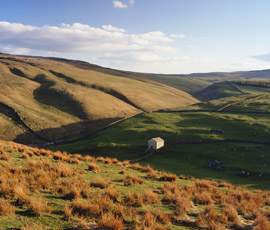
A weakening of housing development rules for greenfield sites could lead to an urban sprawl over precious countryside and farmland, warn rural campaigners.
The Campaign to Protect Rural England (CPRE) said planning minister Nick Boles’ call to increase the urbanised area was “provocative and unnecessary” and it “casts a shadow over at least 25% of our undisturbed countryside”.
Mr Boles said more than 1,500sq miles of open countryside – an area twice the size of Greater London – was needed to build homes to tackle the housing shortage.
In an interview on the BBC’s Newsnight this week, he said ministers would protect green belt, but warned that large areas of “open land” may be needed for housing.
In the UK and England about 9% of land is developed, said Mr Boles, and building new homes on an additional 2-3% of the land in England “would solve the housing problem”.
However, the CPRE warned that the planning minister’s words “undermine the principle of building on brownfield land first and risk the needless destruction of irreplaceable countryside”.
The group said England’s open, unprotected countryside, including large areas of farmland outside National Parks, Areas of Outstanding Natural Beauty and green belts, were under threat of development.
“This equates to an area almost three-and-a-half times the size of Wales now threatened by inappropriate development and urban sprawl,” said the CPRE, in a statement on its website.
“This unprotected countryside not only includes some of England’s most attractive landscapes but also provides healthy local food, habitats for wildlife, and tranquillity and open space for wellbeing.
“It helps mitigate the impact of climate change by absorbing floodwater and storing carbon, and is of huge value to millions of people who live in, visit and enjoy it.”
“He’s talking here about increasing by a third the amount of developed land. Three per cent of the country is an area about the size of Cornwall and we don’t think that you need to build on greenfield to quite this extent.”
Ben Cowell, the National Trust
New government planning reforms unveiled in March only offered protection for green belt land around towns and cities but many greenfield sites are not protected.
The CPRE said some unprotected greenfield sites under threat of development included farmland in Romney Marsh in Kent, Inkberrow in Worcestershire, Sheepwash Stripfield in Devon, Broughton Hill in Leicestershire, Wooperton in Northumberland, Southwell in Nottinghamshire and Glastonbury Tor in Somerset.
There were enough brownfield sites to build another 1.5m homes, so building more houses on greenfield sites was not necessary, the CPRE said. In addition, the UK has 330,000 long-term empty homes, the group added.
Ben Cowell, from the National Trust, branded Mr Boles’ figures as “back of the fag packet” calculations.
“He’s talking here about increasing by a third the amount of developed land. Three per cent of the country is an area about the size of Cornwall and we don’t think that you need to build on greenfield to quite this extent,” he told BBC Radio 4’s Today programme.
“You can build, actually, by using previously developed land, you can bring empty homes back into use, you can make urban areas more dense.”
Government eases planning process for farm renewables