Cognitive decline presents major challenge to farming families
 © Tero Vesalainen/iStockphoto
 Dementia is classed as the UK’s biggest killer, with someone in the country developing the condition every three minutes.
It can have particularly far-reaching consequences for farming families, where home, livelihood, family relationships and the business itself are often inseparable.
See also: How some farmers meet challenge of long-term health conditions
Rural inequalities compound the challenge. Jane Colling, an admiral nurse at Dementia UK, says rural populations are ageing faster than their urban counterparts, while dementia diagnosis rates are estimated to be 5-8% lower and accessing services can be more difficult.
“There is no hard dividing line for farmers between what’s work and what’s home,” Ms Colling says.
“The environment can provide real hazards and dangers, both mechanical and environmental.”
Recognising the signs
For South Somerset dairy farmer Neil Baker, those risks are not theoretical.
His father developed Lewy body dementia (LBD) in his 50s, initially being diagnosed with Parkinson’s disease after becoming shaky and forgetful.
Looking back, Mr Baker remembers his father repeating himself, but says gradual changes can be difficult to spot when generations of a farming family live and work side by side.
He believes farmers’ resourcefulness can also work against them.
“You’re entrepreneurial and clever and you can do workarounds. You’re probably using all those skills as a mask, and it’s not good.”
Caring for someone with a physical condition or dementia
The latest Farmers Weekly Level the Field survey asked how many in the industry have cared for someone with a physical condition or dementia. Among the 1,500 who answered the question:
- 47% had cared for or supported someone on their farm with a physical condition or dementia – 14% were doing so currently, 33% had done so in the past
- 51% had never done so
- 2% preferred not to say.
Ian Sheriff, Alzheimer’s Society ambassador and academic partnership lead for dementia at Peninsula Medical School, University of Plymouth, has encountered similar problems during earlier work with farming communities.
On one farm he found a tractor cab covered with written operating instructions.
“The tractor had Post-it notes all in the cab, and those notes said ‘pull this, push that’,” he recalls.
Simon Wheeler, of the Alzheimer’s Society knowledge team, recommends families look for patterns of declining ability rather than occasional lapses.
“If you start seeing somebody having more accidents, minor bumps and close calls, even then that might indicate there’s something going on,” he says.
Other warning signs can include unpaid bills, unusual purchases, difficulty managing familiar tasks, or increasing disorganisation.
Getting a diagnosis
Because farming is often closely tied to identity and independence, seeking help can bring its own fears.
Mr Wheeler says early diagnosis can help families understand, access support, and adapt roles, rather than losing the ability to work or contribute.
For Mr Baker, his father’s full diagnosis came as a shock.
His mother had been carrying much of the responsibility privately and it was only when she asked him to accompany his father to a hospital appointment that he heard the words Lewy body dementia from a doctor.
“I thought I had a dad with Parkinson’s,” he recalls.
The journey home prompted a difficult conversation about why his mother had tried to shoulder everything alone.
“Farming families are proud people. Don’t want to make fuss. Don’t want to admit they’re ill,” Mr Baker says.
Mark Thomas, helpline co-ordinator at the Farming Community Network, says families should pick a calm moment and start with observed changes, not confront someone about a suspected diagnosis.
For Mr Baker, avoiding the issue only delayed action. “Becoming blind to it doesn’t make it go away,” he says. “You need to get in front of a GP.”
A business issue
For a farming family, dementia can also become a business continuity problem long before somebody requires full-time care.
Mr Baker unexpectedly found himself taking responsibility for a business he had expected his father to lead for many more years. “I started running the business at 28,” he says.
But succession, directorship and legal arrangements had not been fully completed before his father lost capacity.
“Then you fall into a world of legals,” he says, mindful of the many financial, legal and regulatory responsibilities involved in running a farm.
Ms Colling says lasting power of attorney should be considered while somebody still has capacity to make those arrangements.
“A farm could freeze overnight if there was a major deterioration in the farmer’s well-being and health,” she says.
Families should also ensure somebody else knows essential information about livestock, feed, medicines, contacts and day-to-day farm routines.
For Mr Baker’s family, the moment that forced the issue of safety came on a local road.
His father was driving a tractor when he collided with a car at a junction and continued on, apparently unaware of what had happened.
Nobody was injured, but it left the family facing an immediate decision.
“Are we going to let him drive it tomorrow? I don’t know. Are we going to hide the keys? What are we going to do?”
Mr Baker says knowledge that has built up over decades could also gradually disappear.
“The practical things like procedures, simply where things are and how and why things happen are slowly lost.
“These things are important. Early conversations need to be had, and things need to be documented before dementia strikes.”
Lasting power of attorney
Putting lasting powers of attorney (LPAs) in place before illness or dementia threatens someone’s ability to make decisions is vital, advises Sean Boucher of HCR Law.
An LPA allows a trusted person to manage financial affairs or make health and welfare decisions if mental capacity is lost.
Without one, families may face a lengthy and costly Court of Protection application for deputyship.
For farming businesses, losing a key decision-maker can disrupt banking, livestock management and contractual arrangements.
Families should choose attorneys who understand the business and can be trusted to act appropriately.
Wills, partnership agreements and succession plans should also be reviewed, with professional advice taken while everyone involved still has mental capacity.
Preserving identity
Planning does not, however, have to mean removing somebody from farming altogether.
Ms Colling says the aim should be to manage risk while preserving independence and purpose wherever possible.
“It’s not saying lock, stock and barrel the farmer can’t do that anymore,” she says. “It’s sitting down as a family and tailoring those activities.”
Maintaining social connection can be equally important. Mr Wheeler says simply transporting a farmer to a conventional dementia group may not meet their needs if nobody there understands the life they have led.
“It’s about the quality of those interactions, and it’s about people understanding what issues are meaningful to you and what everyday problems you’re trying to resolve.
“What they need is options to be able to continue contributing, to continue to be a valued member of the community, rather than sort of being retired off the farm.”
Mr Sheriff says farmers also needed a clearer pathway to support, with practical information available through organisations and places they already trust.
“There’s nothing better than talking to another human being when the world has collapsed around you,” he says.
Care farm offers alternative dementia support
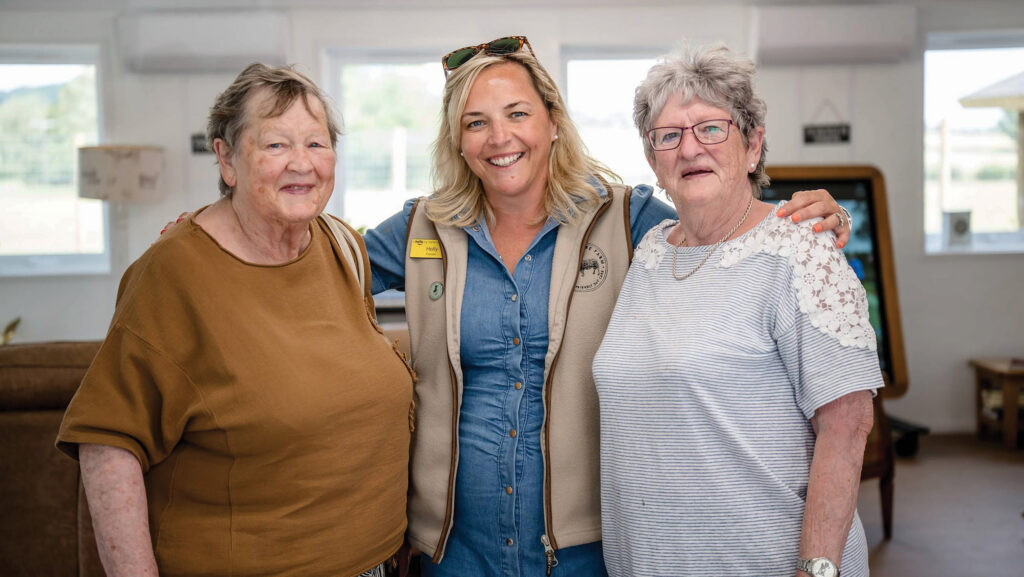
Val Dyson, Holly Bainbridge and Ruth Young © Primrose Care Farm
For people who have spent a lifetime farming, Primrose Care Farm in North Yorkshire offers something that can become harder to retain as dementia progresses – familiarity.
The rural day-care service supports people with mild to moderate dementia in a farm environment where animals, machinery and conversations about farming remain part of everyday life.
Director Holly Bainbridge developed the idea after meeting families struggling to keep relatives safely at home.
“The farmer who’s farmed forever, he wants to go out in that rain, because he’s always gone to look after his cows in that rain,” she says.
Companions can spend time with livestock, grow vegetables or simply remain surrounded by familiar rural sights and conversations.
One former farmer regards Primrose as his workplace. “He’ll go home and he’ll say, ‘I’ve had such a good day at work today. This is what I’ve done,’” Mrs Bainbridge says.
The service also gives family carers time away from caring responsibilities and provides guidance on accessing other support.
Mrs Bainbridge said caring could otherwise gradually consume people’s identities and relationships.
“They just become a carer. Then they’re not Mrs Smith, you know, Mr Smith’s wife anymore.”
At its heart, Primrose aims to keep people connected to a life they recognise.
Level the Field
Our campaign, Level the Field, aims to make agriculture fairer, more equitable and more inviting for everyone.
By engaging people and organisations across our industry, Level the Field will champion inclusivity for the benefit of farm businesses and all who work in them.
This year, the campaign puts the spotlight on physical health in agriculture. Previous years have focused on women in farming, and neurodiversity.
See more on our Level the Field campaign hub.