Will’s World: Farming ties that bind us right where we belong
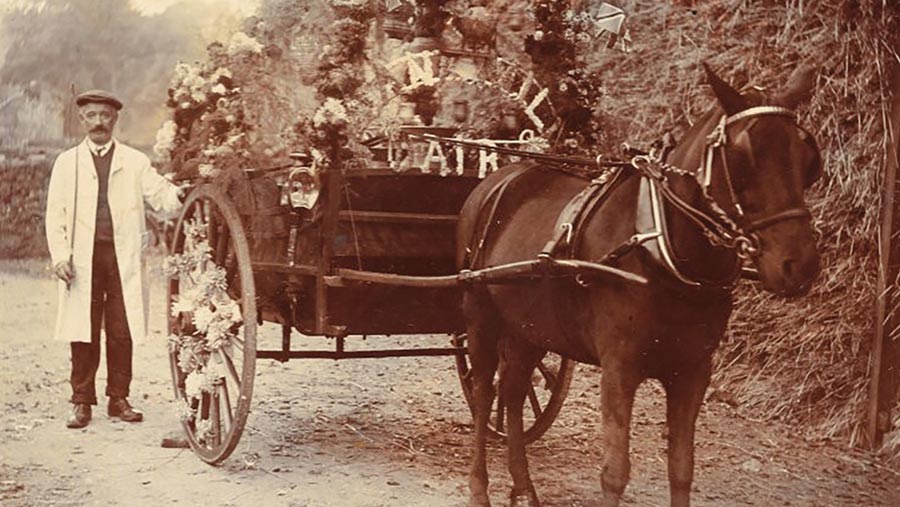 Great Grandfather Sam Nant Mill © The Evans Family
 Do you ever get the sudden urge to reconnect with your family’s past? To remind yourself of where you came from? It hits me sometimes when I’m least expecting it, and it’s happening more and more as I’m getting older.
I see a shrub or tree in flower that my grandmother planted, I use one of my grandfather’s well-worn tools, or fleetingly see an older family member in one of my young daughters’ facial expressions, and I’ll find myself sitting in the farm office that night looking through boxes and albums of old family photos, stretching back well over a century.
See also: How prenuptial agreements can help shape farming family futures
About the author

I see scenes of rural Edwardian Britain, where tired-looking men and women with weather-beaten faces and rough hands stare into the camera, solemn in their collarless shirts or flour-covered aprons.
I see my great-grandfather Evans, Sam Nant Mill, leading a horse and cart bedecked with flowers and garlands, ready to participate in the village carnival.
I see some of my great-uncles grinning while operating an early tractor and binder.
I see families dressed in their Sunday best, standing proudly beside their first-ever car – the inevitable black Ford Model T – and wonder how they must have felt on that life-changing day.
I see fresh-faced and handsome young men, in the Army uniforms of both First and Second World Wars, ready to march away to France, and know that many of them are still there, in the great military cemeteries of the Somme and Flanders. Their mothers never got over the loss.
Old and new
On the back of this slightly introspective mood, just before Christmas I called into our local church – where the present Mrs Evans and I got married, as did my parents, and where we baptised our daughters – to see my grandparents and put a sprig of holly on their grave.
I don’t visit as often as I should, but they wouldn’t mind. They were busy people all their lives and would fully understand the demands of farm and family.
Anyway, I never could do any wrong with my grandmother. I was her only son’s only son and the apple of her eye.
She was more like me than anyone else in my family. She passed on to me her sentimentality and love of literature and the arts, and I miss her every day.
It’s a simple headstone; it has their names, years of birth and death, and the name of our farm, in bold letters.
I stand awkwardly, with tears in my eyes (this, too, happens more as I’m getting older) for a few minutes, before walking slowly back to the truck.
Time to remember
As I walk along the path, I notice many other headstones with the names of farms on them. Family names, dates, farm names, and sometimes a brief verse.
Some of the farms I recognise, and some have the same families living and farming there today.
Some I’m not sure of, and some are long gone; the land sold off and the barns converted into expensive houses for commuters. But on the headstones, the farm names are forever linked to the families that once lived there.
I spend the rest of the day thinking about this, and the infinitely complex relationship that those of us born into multigenerational farming families have with our farms and those who came before us.
I wonder how I’d ever begin to describe this deep reverence and sense of connection to outsiders, when I can’t even adequately explain it to myself.