Will’s World: Modest but mighty – the Little Grey Fergie at 80
If I asked you to name the most iconic representation of 20th-century agriculture, what would you say?
Land girls, perhaps? The Smithfield Show? The Holstein Friesian cow? Farmers Weekly’s legendary yellow cover? All perfectly good answers.
But I’d argue the most quintessential of all sprang from the pioneering genius and drive of Irish-born mechanic and inventor Harry Ferguson – the TE20 (T = tractor, E = England, 20 = approximate engine power), affectionately known to all as the Little Grey Fergie.
See also: Ineos Grenadier combines Fieldmaster and Trialmaster specs
About the author

Eighty years ago, on 6 July 1946, in a Britain still economically, physically, and mentally recovering from six years of devastating war, the very first one rolled off the production line in a former munitions factory at Banner Lane, Coventry.
It was perhaps apt that a city which saw more than its fair share of wartime death and destruction was to play such a significant part in the rebuilding process.
Glimpse of the future
Designed to be user-friendly, fuel efficient, and affordable to the average farmer, this incredibly versatile, lightweight tractor, with its revolutionary three-point linkage and wide range of dedicated implements, had a transformational effect on global food production that is hard to overstate.
Replacing the unwieldy and erratic drawbar connections that had previously been the norm, the Ferguson System turned tractor and implement into a single mechanised unit.
Large public demonstrations were held throughout rural Britain towards the end of harvest season, with thousands turning out to see this vision of the farming future in action.
Ferguson became known for effective and stylish marketing campaigns, emphasising that the tractor wasn’t only a replacement for the horse but, via its linkage and shaft-drive power take-off, it could mechanise dozens of tasks previously only performed by separate machines.
Ferguson himself rigorously tested and assessed each new implement before approving its introduction to the range.
His vision was to provide equipment capable of tackling every major job on the farm, eliminating much of the traditional manual labour and drudgery associated with the agriculture of the time.
How modern and exciting it must have seemed to witness a TE20 ploughing more in an hour than a man and horse could previously have done in an entire day – especially in a post-war society still in the depths of crippling food shortages and strict rationing.
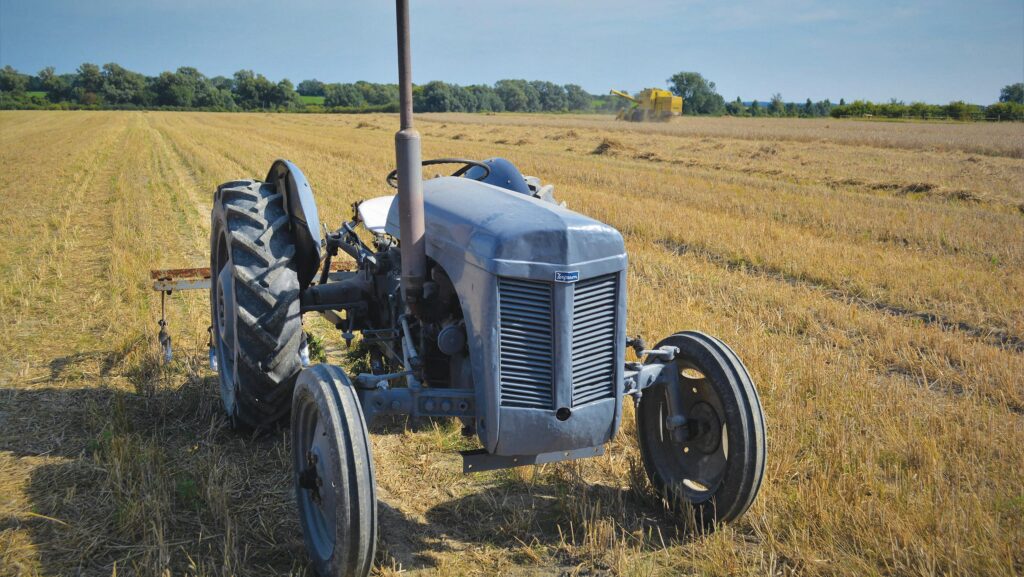
Little Grey Fergie © Paul Rolph/Alamy Stock Photo
Tractor training
Ferguson set up a state-of-the-art training centre at Stoneleigh Abbey. Here, salesmen, engineers and farmers – many of whom had spent their lives working only with draught horses – were schooled on the mechanics of this new way of farming.
A network of tractor dealerships rapidly sprang up round the country and, when farmers purchased a new TE20, the dealer would always come to the farm with it to make sure everyone knew what they were doing.
A fleet of service engineers working out of vans were also on standby to deal with any customers’ problems.
By the mid-1950s, the tractors were being used in more than 160 countries, with production up to an incredible 517,651 units by 1956.
Every farming family will doubtless have their own Little Grey Fergie story, and we’re no exception.
It was the first tractor that my grandfather bought in his own right; it went straight off the delivery truck and onto a Nicholson cultivator, before setting to work on a field we still farm, known as Eyton Hall Meadow.
That first one was a TVO model, but the second had a diesel engine and a loader. A strictly Massey Ferguson-only farm since then, I just wish we still had it.
If you have any TE20 stories, I’d love to hear them.