

Young farmer schemes help bring fresh approach to farming
 © iStockphoto
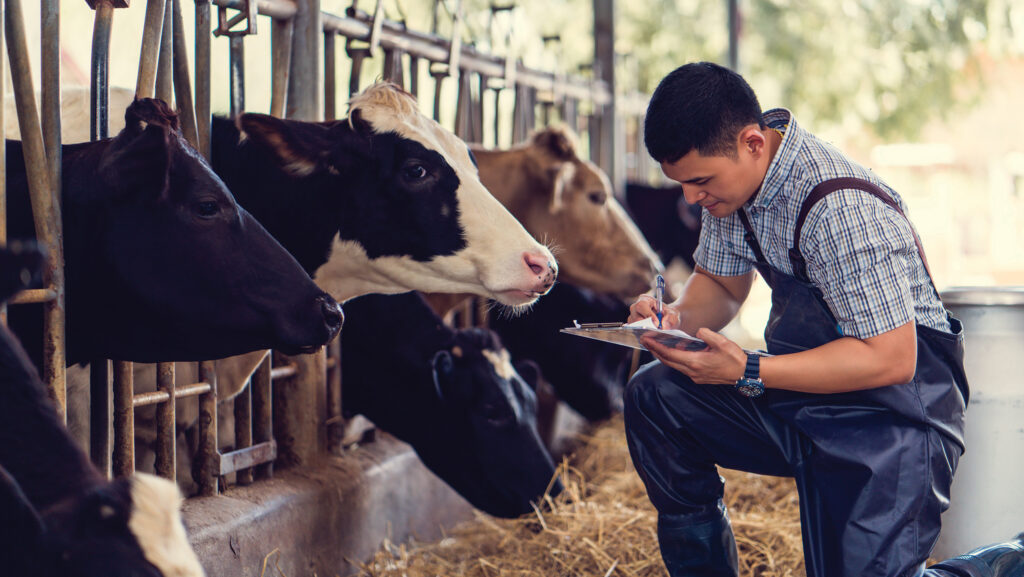
Pressure on farm incomes and diminishing financial support for agriculture from governments is not deterring young entrants from choosing to work in the industry. Many of them have no background in farming, but are individuals with forward-thinking ideas and an upbeat attitude.
Initiatives established to help the next generation get a foothold are helping with that pull factor; some schemes are funded by governments, others by business, and all deliver high-quality support.
These are drawing in a new breed of farmer and helping them to develop strategies for achieving long-term financial, practical and environmental sustainability in their businesses.
Holly Atkinson © Holly Atkinson
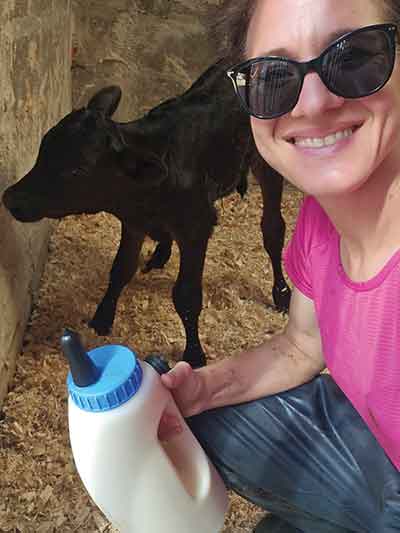
Holly Atkinson – Tesco/Harper Adams Future Farmers Programme
As an animal lover, Holly Atkinson wanted to farm or train as a vet, but with no family background in agriculture, careers advisers didn’t encourage her to pursue her farming dream.
Agriculture was considered by those advisers as a job for school leavers who weren’t destined for university or had a family farm to return to.
See also: Allerton Project left in limbo after SFI chaos
“I come from a family of artists. No one at my school sat me down and gave me advice on the ways I could get into farming – it felt completely inaccessible to me,” says Holly.
She instead took up a place at Bristol Veterinary School and qualified as a vet, but her love of farming was undiminished. That passion was ignited as a teenager, volunteering or working on local farms and reading Farmers Weekly as a medium to educate herself.
An important mentor was beef and sheep farmer Murray Garrett, a Farmers Weekly columnist for many years. As a 15-year-old, Holly worked on his farm on the Bedfordshire-Buckinghamshire border, where she got hands-on experience in lambing and calving.
“Murray was so passionate about farming, he really ignited that in me too,” says Holly. After graduating, she joined a veterinary practice in the south-west of England, drawn to the region by its high concentration of dairy farms.
“I loved being part of the team on the farms I visited; it was very satisfying to play a part in supporting the food supply chain,” she says. Adam, her future husband, was a manager at one of those farms, a 1,000-cow, year-round-calving system in Somerset.
After they were married, the couple relocated to Devon, where Adam managed another large-scale block-calving dairy farm, and after their two sons were born, Holly stepped back from her veterinary job to manage the calf rearing, later taking on the overall management of youngstock.
Career change
“I planned to go back to veterinary, to only work on the farm temporarily, but it dawned on me that what I really wanted to do was to farm, because I could use my knowledge as a vet but see it all the way through by implementing changes, directly influencing the outcome for those calves.”
With a formal vet education but a knowledge of agriculture acquired only through practical experience, Holly was keen to gain more through structured learning.
The Future Farmers Programme, sponsored by Tesco and delivered by the Harper Adams University School of Sustainable Food and Farming, offered that.
With visits to farms, processing plants and retailers, and a series of tutorials, she says the programme gave her a wide-ranging insight into the entire agricultural process.
“We had the privilege of getting access to places and people we would not otherwise have had; it was a great opportunity,” says Holly, who was part of the 2025-26 cohort.
“The unexpected part of it was that I also made some lovely friends in like-minded people.”
While she was participating in that programme, she and Adam received confirmation that their application to become tenants of a 51ha Devon County Council farm had been successful.
They are now milking 100 year-round-calving cows on a grass-based system on the farm near Newton Abbot, renting a further 11ha forage block also owned by the authority.
The couple had wanted to farm in their own right, but didn’t have the capital to buy land – the county council farm system provided a route to establishing that business.
“It took quite a few years to get that opportunity. It seemed fitting that the tenancy offer came when I was on the Future Farmers Programme,” says Holly.
The couple practice regenerative farming principles in their new business, supplying milk to the Naturally Better Dairy Group. They are in the process of converting their system to organic, and once that is completed their buyer will be Yeo Valley.
Holly says the Future Farmers Programme could not have come at a better time for her. “It has given me those extra bits of knowledge.
“It offered such a comprehensive understanding of the whole agricultural process, of milk contracts, for example, and I now have a fuller picture of what supermarkets and consumers want from us as farmers.”
Lucy Eyre © Richard-Stanton
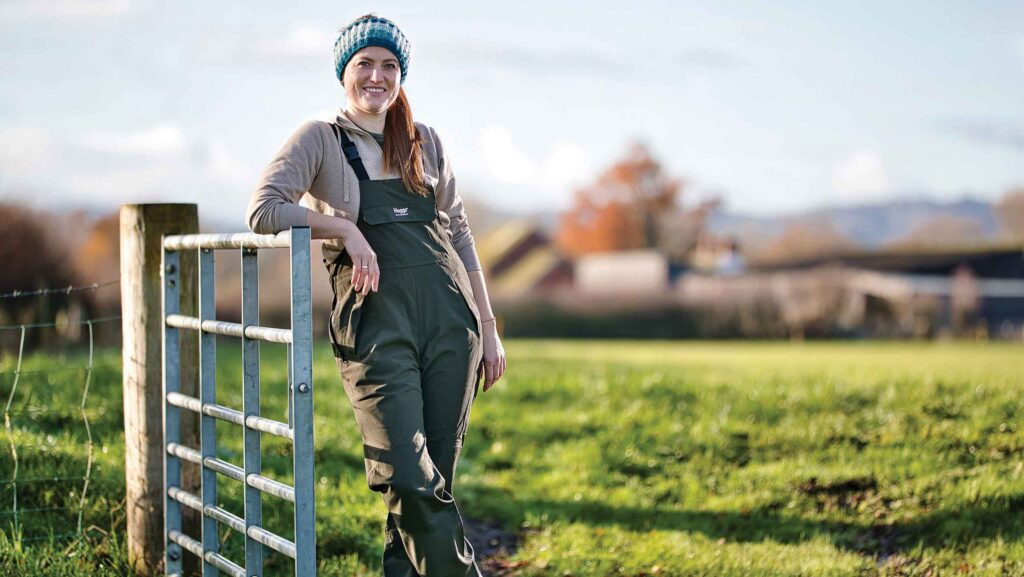
Lucy Eyre – Farming Connect Agri-Academy and county council farm tenancies
County council farms are a valuable route into agriculture for aspiring farmers without land of their own. Transition Farmer Lucy Eyre wanted to farm from early childhood, but with no family connections to agriculture, she instead studied veterinary medicine.
However, she couldn’t shake off the farming bug, so she rented small parcels of land to keep sheep in tandem with her job as a vet. Lucy took a bigger and bolder step when she applied for the tenancy of Wern Holding at Wern, near Welshpool, a 51ha Powys County Council farm, where she now farms beef and sheep.
Without the county council farms system, she doubts she would be farming at the scale she is now. Farming rented land can have its limitations, though – Lucy says the length of tenancies is a principal one, as agreements have progressively got shorter.
She has a 12-year agreement with break clauses and the potential to extend it by eight years, longer than many farm business tenancies (FBTs), but even with that duration she feels time is against her.
“I have been on this farm since the summer of 2020, so I am now six years into my tenancy and only after that number of years am I starting to get a handle on the land. It will take more time to get it performing as I think it should be, and by then my tenancy could be over.”
Conversations
Lucy believes it would be beneficial for tenants and landlords to have more conversations about their mutual aims.
“It might be about biodiversity or soil health, but whatever those aims are, there should be a reasonable plan going forward. Not one that restricts the tenant, but one that results in more of a legacy going into these farms to protect the land and to make that process easier for future tenants.
“Tenants can sometimes be left feeling that as long as they pay the rent, it doesn’t really matter how they farm it.” There can also be challenges with securing finance from lenders to invest in capital improvements on a rented holding.
“If I wanted to replace a crumbling old building with a new shed, I would probably struggle to get the money based on a tenancy like mine, because the break clauses wouldn’t offer a bank the security it needs.
“Also, even if I did get the money, if I had to leave the farm I would have a big debt but nothing to show for it. But I also understand why a landlord wouldn’t want to spend £100,000 on a new shed that wouldn’t give them any direct financial benefit.”
Her own landlord, Powys County Council, is being more proactive than some local authorities, though. It has just released a new strategy to work more closely with its farm tenants, and tenancy lengths could also increase if there are mutually agreed targets and investment is made. Lucy sees it as a very positive step.
“I have invested not far off £70,000 in fencing here, and still have lots to do.
“A lot of councils are taking the approach of selling – at least Powys County Council is trying to work out a way of making its farm tenancies work for both parties.”
Without opportunities to rent, she would not be farming the acreage she is now.
“I don’t even know if I would be farming in any meaningful way, because you need to try it out first, and buying land is a big financial commitment. If you haven’t established whether it is something you want to do and can do well, you might not want to buy.”
Various initiatives have helped Lucy develop as a farmer. She was a member of the 2025 Farming Connect Agri Academy.
“It was a brilliant programme; I saw some amazing things that really inspired me and I learned so much. Farming Connect is a valuable resource that we are lucky enough to have access to in Wales. It was nice to take a break from the farm to spend time with others farmers. We all forged a really good bond.”
Lucy has also taken advantage of the Farming Connect skills and training courses and is a member of its Farming with Trees Group, with monthly meet-ups on different farms. She has gained a great deal of knowledge too by engaging with the Natural Friendly Farming Network.
Josh and Harriet Millichap © Kepak
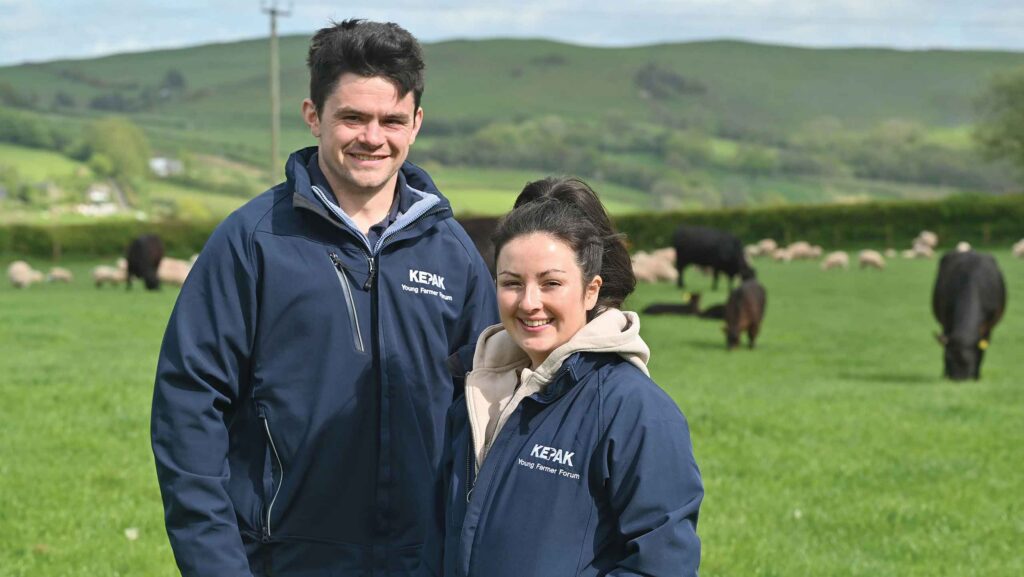
Josh and Harriet Millichap – Kepak Young Farmer Forum
As the next generation stepping into a Welsh family farming partnership, Josh and Harriet Millichap are grateful for the freedom they have to take that business forward. Josh’s parents, Colin and Amanda, have advanced the business in the years they have farmed across two holdings.
“My parents’ approach has always been to look at ways of improving things, and they have allowed us to come in and take things forward, giving us the freedom to have an input – for example, in breed selection,” says Josh.
He and Harriet are based at Yscirfawr and his parents at Llwynnoyadd – 500 acres in Powys, and all farmed as one business. “It’s a good working relationship, we discuss ideas and bounce those off each other,” says Josh.
Opportunity
The family farms 100 beef suckler cows, mostly Stabilisers, and 1,000 breeding ewes, mainly Welsh Mountains. Lamb and beef is supplied to Kepak, and through that relationship Josh and Harriet joined the Kepak Young Farmer Forum.
This has given them the opportunity to spend time at Kepak’s St Merryn processing plant in Merthyr Tydfil, and participate in a training day. Those opportunities have been extremely useful, says Harriet.
“We now understand exactly what Kepak is looking for in terms of specification, so when we are getting our lambs and cattle ready for sale, we know what our buyer expects. “As a farmer, when you see lambs or cattle in a field it can be difficult to visualise how they will grade on the hook, but the training has given us a good handle on that.”
It has helped the couple gain confidence, especially Harriet, who doesn’t have a family background in farming. As a member of the Young Farmer Forum, Josh was a speaker on the stand of Kepak buyer Tesco at the 2026 Royal Welsh Show, a “nerve-racking” experience.
“We are used to talking to other farmers, but the stand was full of members of the public. It was interesting to talk to our customers, they were a very engaged audience. There are enough negative stories about farming, but by talking to a few consumers for 10 minutes, I now feel more emboldened to promote what we do, as well as Welsh farming more generally.”
Josh has spent the past 18 months saying yes to new opportunities that present themselves. “Schemes come out and it can sometimes be easier to not make the effort to get involved, but by saying yes and being proactive, doors do open and other opportunities come along.”
Resources
Tesco/Harper Adams University Future Farmers Programme
A programme designed to help up-and-coming British farmers develop their skills in sustainable agriculture.
It runs for three years and each year 75 farmers under 40 receive face-to-face and live online training on how to implement sustainable agriculture practices and protect biodiversity over nine months. There are also events and mentoring sessions on business operations and personal development
Kepak Young Farmer Forum
This group is made up of farmers from Brecknockshire, local to the Kepak hub in Merthyr Tydfil. The hands-on programme is open to farmers under 40, giving them the chance to see what happens beyond the farm gate and gain a clear understanding of the entire beef and lamb supply chain.
It includes farm walks, technical sessions and visits to the Merthyr site to see grading, efficiency and sustainability in practice.
Scottish Land Matching Service (SLMS)
A free service funded by the Scottish government offering independent advice and facilitation to people who are considering joint ventures in farming and crofting in Scotland.
Farming Connect Start To Farm
Farming Connect matches landowners who want to step back from the industry with new entrants who are looking for a route into farming.
The service guides each party through the key steps they need to find a potential business partner. It offers a package of support, including mentoring, business planning and legal advice, and guidance at each of the stages of establishing a joint venture.

Explore more / Transition
Follow the experiences of our 16 Transition Farmers and access in-depth supplements, expert webinars, live events and practical content covering the challenges and opportunities facing farm businesses.
Transition is an independent editorial initiative supported by our UK-wide network of partners.
Explore the Transition hub for the latest insights, resources and events.
