

Advice on keeping track of dairy heifer rearing costs
 © Tim Scrivener
 Keeping calf and heifer rearing costs on a separate spreadsheet can highlight areas to cut waste and improve efficiency, while also monitoring to see if growth targets are being met.
The trick is to make sure that costs and quantities are recorded regularly – and accurately, says consultant Andy Dodd of the Farm Consultancy Group.
See also: How a heifer rearing unit works successfully at scale
“If you don’t know your numbers, you can’t do anything about them. Whether you rear your own replacements, someone else does, or you are selling heifers, you need to know the cost from birth to calving,” he says.
“You might need to spend the first six or 12 months gathering information before you can get accuracy and be able to adjust figures accordingly.”
Potential savings and investments
Milk price volatility means that farmers have to understand their own costs and where they can make savings, as well as identify where it’s worth investing.
“Someone could be cutting corners [to save money or time] but find it’s not actually worth it,” Andy points out.
Some farms could improve performance just by replacing complicated systems that involve many changes between birth and calving (from feed types to housing), as such systems can compromise growth rates.
Andy says it’s simple enough to set up a spreadsheet, but as software packages differ, and every farm’s rearing approach varies, he suggests the simplest method is to break down records into three sections by age.
They are:
- Birth to weaning
- Weaning to service (about 14 months)
- 14 months to calving.
The more entries logged of quantities and costs, he says, the easier it is to build a picture of what’s happening, and to find wastage in the process.
Although a whiteboard is useful to record information in situ, Andy cautions that if there are too many of them on farm, no one keeps them up to date. He favours a youngstock WhatsApp group, which can hold the data and allows everyone to contribute information.
Reviewing the spreadsheet to track progress or identify a problem is best done every six months – usually about the time that milk powder and concentrate prices are reviewed.
Otherwise, it can become a forever job, updating a spreadsheet that “tells you nothing” he says.
Feed, forage and bedding
Feed cost is easy to add to a spreadsheet as most farms get a price for their milk powder and rearing nut.
Then it’s a case of working through how much is fed every day and calculating the total cost at the end of the period.
“To find wastage, record what comes [on the farm], then what’s wasted from split milk powder bags, calves getting out, or vermin. It makes you think when you are paying over £2,000 for a pallet of powder,” says Andy.
Another blind spot in cost control is when cow refusals are fed to heifers. These are often seen as “free” feed and reducing waste, but in fact it is wasted feed, so comes at a cost.
© Tim Scrivener
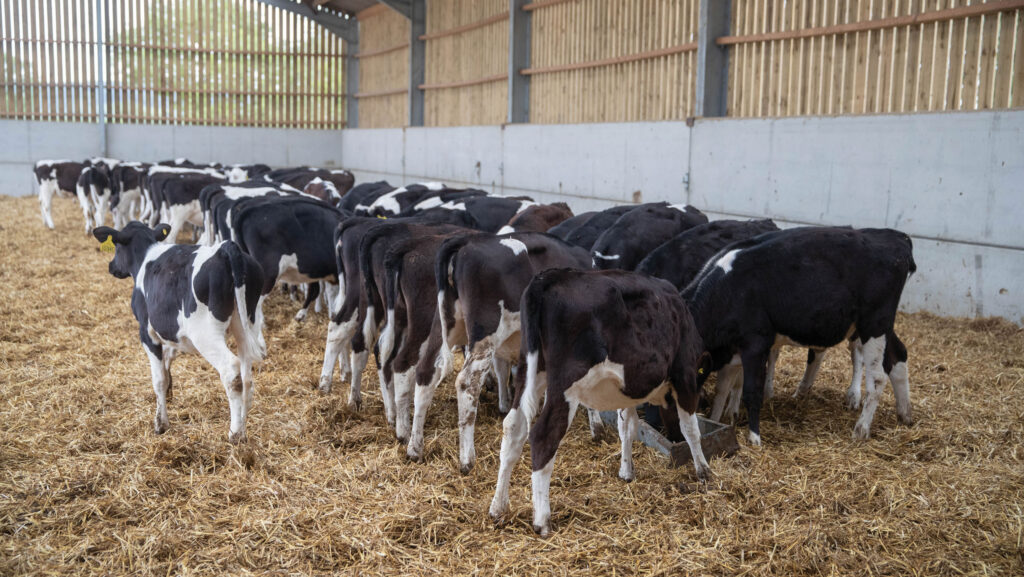
Andy says people overestimate the amount of starter feed a calf eats, compared with what has been dribbled on, making it unpalatable and thrown away. “This is seen as ‘not much’, but for every calf, every day, it adds up,” he says.
“To know where to trim costs, you also need to understand your growth rates [to put them in context]. But there is still a huge number of farms who don’t weight cattle [to set targets].”
Forage and bedding can be a grey area for splitting costs away from the herd. Farms using contractors can, however, work out the price for one bale (or even clamp silage), then use this with the tonnage fed.
Similarly, straw bedding and bales can be weighed on a feeder wagon.
Vet costs
The big vet costs tend to be for vaccinations, which is why Andy recommends reviewing protocols with the vet on a regular basis.
“It can be easy to vaccinate for everything, but this gets expensive. Make sure it’s needed,” he says.
He finds some farmers can be a bit blasé about treatment, either over treating or blanket treating when they haven’t found the root cause of a problem.
If an issue such as poor colostrum or bad ventilation is not rectified, the illness won’t go away.
Labour and machinery
© Tim Scrivener
One area that tends to be fudged is time and labour. To do it correctly, he advises logging the hours worked on the heifer enterprise and putting in an hourly labour cost.
Analysing the results could reveal ineffective work routines or a badly set-up system. Farmers often fail to attribute their own time to calves and heifers, reckoning “it doesn’t take long”.
“Even just a routine check is time consuming,” Andy points out.
“On farms with multiple groups or multi-sites, the hours soon add up, so you need to review what and where, whether you are paying someone or it’s your own time.”
With machinery use on the heifer unit, it’s easy to evade the real cost of a tractor plus implement, particularly when it’s shared with the herd.
Again, Andy suggests using an hourly rate for power and machinery (adding depreciation gets complicated).
Electricity
Expenditure on utilities can be lost among the whole farm costs. Yet electricity to heat water for mixing milk powder and cleaning has become very expensive, says Andy.
It’s therefore a good place to start looking to save money. Check thermostats and timer clocks are accurate, and consider heat recovery from the milk cooling systems to get water to 45-60C for the calf unit.
This is cheaper than starting with cold water, and morning milking in a parlour is not only well timed, it sends a large volume of milk through the unit from which heat can be recovered.
Andy stresses that taking the effort to record costs on a spreadsheet is wasted unless the information is used.
The aim isn’t to have a total rearing cost to first calving, he says, but to use the data to dig deeper and reveal what can be done more efficiently and where money can be saved.