

Benefits of using ‘lead’ measures to assess herd performance
 © GNP
Metrics, measures or KPIs are all good ways to assess and track herd performance, but because most are historic figures, they only show whether a job is done well or badly. Measures used in dairy farming don’t tend to warn of a problem or highlight a negative trend.
See also: How to identify outliers to raise herd performance
Yet making effective business decisions requires a combination of metrics that flag issues in the early stages, so they can be quickly sorted, with measures to confirm that the changes have worked.
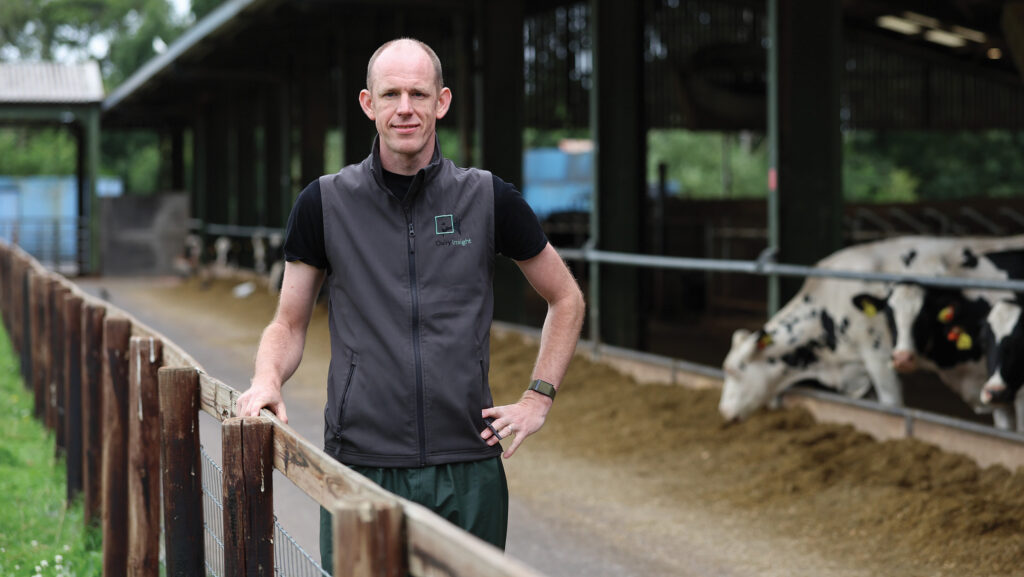
Vet Dan Humphries of Horizon Dairy Vets in Shropshire, who is also the 2026 Farmers Weekly Livestock Adviser of the Year, says in business this approach uses what are termed “lead” measures and “lag” measures.
Dan Humphries © Nathan Stirk
What are lead and lag measures?
A lead figure is forward looking, can be altered and is an early indicator, he explains. Lag measures give feedback or reflect what has happened and, because they are past outcomes, they can’t be changed.
“Lead tells you what is happening; lag, you’ll be wondering what happened,” says Dan. “Lead measures give us early clues that what we are doing is correct. Lag ones traditionally tell you how you have done and are used in benchmarking a lot to compare performance with target. But [if the outcome isn’t what you wanted] they don’t say what needs to change.”
Quite a few measures routinely used in dairy herds to assess performance are lag ones, says Dan. Examples include bulk milk somatic cell count (SCC), lactation yield, calving interval and pregnancy rate. While they may be “interesting”, these numbers are the end result of a long process, so can’t be influenced.
© GNP
Proactive management
For example, a producer might be monitoring a bulk SCC (lag) and realise it’s too high and a problem when it reaches 300,000 cells/ml, possibly affecting the milk cheque. However, Dan points out it is the result of issues that will have started a long time ago – it can take six months for a bulk SCC to increase.
The better option is to track new infection rates (lead) using SCC on monthly milk records. Monitoring between recordings the proportion of cows above 200,000 cells/ml (which denotes infection) and below that figure “is a detailed measure that you can influence before it gets to the bulk tank”.
Another useful lead measure to monitor trends is income over feed costs. This includes values for forages and links to dry matter intakes and milk production. Submission rate is another lead figure – the number of cows bulling can change in the short term, depending on herd management.
Timely action
There are some measures that can be both lead and lag, depending on when they are used. “If you weigh heifers at service [to see if they are heavy enough], this is a lag measure because you can’t change it. Weighing two to three months before you want to serve, however, turns it into a lead measure, as there is time to change weight to be on track at breeding,” he explains.
Body condition score is another metric that can be a lead if it is used in advance: “Having fat cows at drying-off is too late – scoring cows in mid- to late-lactation is better,” he adds.
In a climate of volatility, Dan says the relevance of lead and lag is that top-performing dairy farms must be able to identify negative trends quickly to be able to reduce the damage and/or financial effect on their business.
“If you wait for things to fail before taking action, that’s too slow. The ability to identify issues early is the determinant of your success, especially when [there are few] external factors you can control. The challenge is to find the key predictors in your business – and they will change over time.”
Step-by-step approach
He thinks a mindset of continuous improvement is looking for progress of 1% in a particular area (it’s rare to get 10% on good dairy farms). This calls for very precise measuring. His advice, therefore, is to identify the farm’s “own bottlenecks and remove them one by one”.
Problems and progress are multi-factorial in every herd and unique to a farm, says Dan. He sets specific lead and lag measures for clients, which may change according to season, what is trying to be achieved, what success looks like and, in turn, what needs to be measured.
One client, for instance, wanted to establish whether using a robot feed pusher would pay for itself. To validate this potential change in management, Dan says it was important to get data from measuring to provide evidence that it would work and the confidence to action change.
The farm already had good feed access and presentation, so the farmer was able to select a small group of cows and increase the number of daily push-ups from four to 10, says Dan.
The lead measure used was to track the change in dry matter intakes, knowing that an increase in milk yield (lag) would naturally follow.
Over two weeks, intakes rose by 20%, which, he says, was big enough to either expand the push-up frequency to the whole herd, or justify buying the robot.
Effective decision-making
Dan reckons farmers know their own business better than any adviser and believes it is better when they can analyse their own data to highlight issues. It saves a lot of time and brings focus to problem solving, he explains.
Furthermore, detecting issues in a lower-stress situation (rather than firefighting) helps effective decision-making.
This requires that data and information must be at the point of use – on farm (whether on a whiteboard or in the office), not in an adviser’s laptop.
