How easy calving underpins low-input suckler herd success
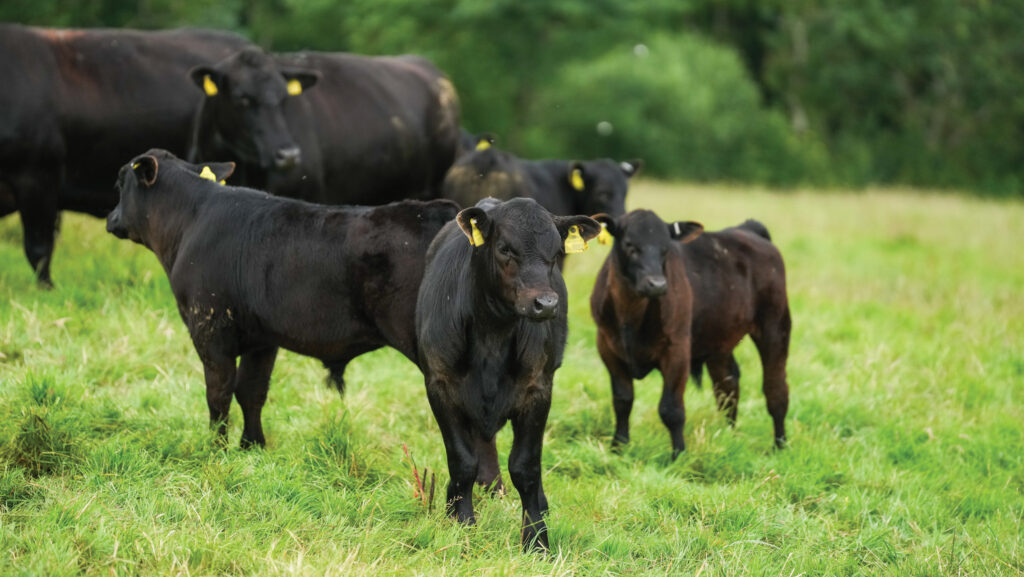 Jonathan Chapman's Aberdeen Angus herd © Emily Fleur
 Breeding a low-input cow that has good temperament and functionality, thrives on challenging pastures and produces a calf unaided has been the goal at Atlantic Angus for more than 20 years.
Running 210 pedigree, spring-calving Aberdeen Angus cows that calve over a short period make calving ease a prerequisite.
But for Jonathan Chapman, it was also borne out of his previous experience as a full-time practising vet.
“I spent enough time calving other people’s cows – the last thing I wanted to do was calve my own,” he says.
See also: Farmers Weekly Awards 2025: Beef Farmer of the Year
Farm facts
Atlantic Angus, Holsworthy, Cornwall
- Farming 350ha – 240ha owned and 110ha rented
- Running 210 Aberdeen Angus pedigree cows plus 450 followers
- Closed herd, spring calving
- Selling breeding bulls and females
- Steers and heifers sold through the farm shop and supplied to Kepak/Tesco
- Countryside Stewardship and Sustainable Farming Incentive agreements
Cows calve over seven weeks and heifers over five, meaning as many as 15-20 cows can calve on a single day at peak.
“If I touch a calf, it goes into a ‘B’ group. We live and breathe for easy-calving cows,” says Jonathan, who farms in partnership with his dad, Peter, at Holsworthy, Cornwall.
Breeding
Calving ease direct and maternal calving ease breeding values are carefully balanced.
“If you’re not careful, you can end up with cows with small pelvises if you select heavily for calving ease direct,” Jonathan points out.
Meticulous record-keeping underpins progress.
All calves are weighed at birth using a sheep weigher to ensure accurate data feeds into the herd’s breeding plan and estimated breeding values.
The best-performing “A” cows and heifers – those calving within the first three weeks that also meet other criteria – are artificially inseminated for 10 days.
This group typically numbers 100-120 animals. Last year, conception rates to first service hit 78%.
Later calvers or cull cows are put in the “B” group and are run with home-bred Angus bulls with terminal traits, with all progeny finished.
Mature cow weights have fallen below breed average (to 650kg), but growth rates from weaning to slaughter are punching higher than breed average.
All this is done off a diet of 95% forage with only a small amount of home-grown barley fed to steers for finishing by 18 months.
Grassland management
Two-thirds of the farm are now sown to herbal leys, which comprise grass, red and white clover, chicory and plantain.
These have improved soil structure and drought tolerance on the heavy clay soils, extending the grazing season by about a month.
They have also enabled fitter cows and in-calf heifers to be outwintered on free-draining coastal land, reducing housing costs.
In addition, Jonathan believes plantain has helped reduce bloat risk because of its tannin content.
Future
This year, he plans to undersow peas and barley into outwintering fields earmarked for spring reseeding to overcome dry conditions and fix nitrogen.
“I will direct-drill the peas and barley in one pass, followed by herbal leys in a second.
“It will be cut for silage after eight to 10 weeks because I don’t want to overshadow the herbal ley underneath,” he says.
He has also applied for a grant to install virtual fencing collars on 150 cows at the tenanted unit, which is 15 minutes from the homestead.
“It’s quite steep ground, and rented, so we don’t want to overspend on fencing,” he explains.
“With the collars, we can protect birds’ nests and change field sizes easily without travelling back and forth to move fences.”