

How meeting beef carcass specification reduced farm costs
 © Ian Willison
 A switch from terminal to maternal genetics and a focus on carbon efficiency have enabled a Nottinghamshire beef farmer to make significant strides in rearing to meet market specification.
And he has done this at a reduced cost.
See also: How maternal genetics helped double kg output/ha
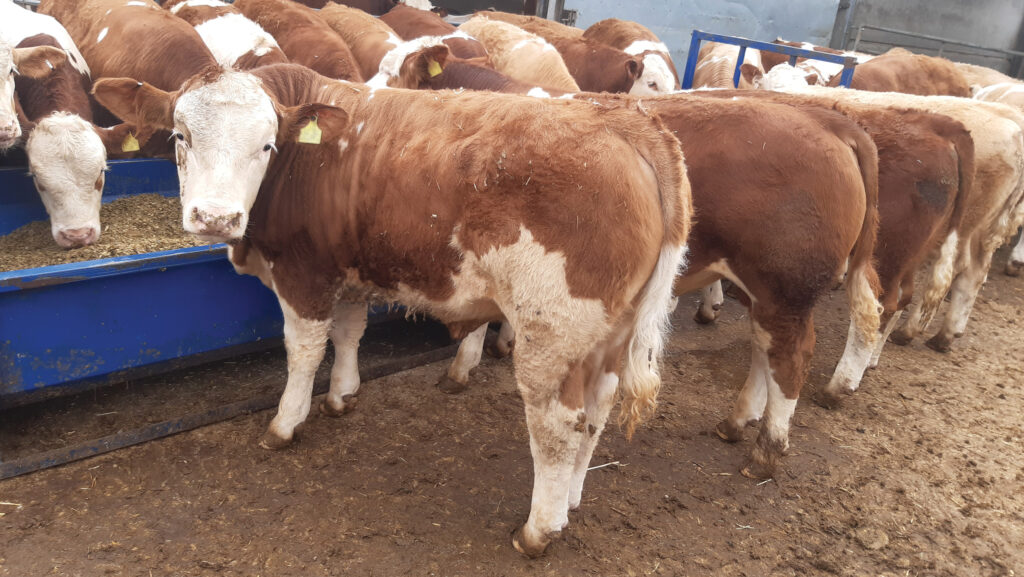
In 2019, Ian Willison of Williamswood Farm, Warsop Vale, changed his breeding system from a Simmental cross Blue to a Simmental (75%) cross native (25%), using either a South Devon or Simmental bull on cows, and a Simmental or Hereford bull on heifers.
His aim in changing breed was to get a smaller and cheaper animal to rear, with easier calving and lower calf mortality rates.
Although the change caused carcass classification to drop from a U grade to an R, Ian says this is outweighed by benefits including easier calving, lower mortality rates and reduced vet costs.
Farm facts: Williamswood Farm, Nottinghamshire
- 212ha, including 97ha grazing platform
- 12ha maize silage
- 120 suckler cows plus 25 followers
- Nine-week calving block starting August
- All artificial insemination
- Paddock grazing on a three-day rotation in two groups
- Supplying ABP
- 30-horse livery yard
In 2019, Ian produced 92 live calves for every 100 cows calved, with two caesarean sections and two prolapses.
In 2025, the figure was 98 live calves for each 100 cows calved, with no vet fees for calving.
He says he now has lower input costs from earlier finishing, while producing more kilograms of beef a hectare.
Ian calculates that a U grade bonus on the 60 bulls finished in 2025 would have earned him an additional £2,142.
However, the gross margin for the six extra born calves in 2025, based on this year’s gross margin, is expected to be £3,194.
Savings on vets’ fees, he explains, came to £1,800 (2019 costs), providing a net gain of £2,852 for 100 cows.
With a base price of £6.45/kg for an R grade in 2025 and a 10p bonus for a U grade (10% of the cattle), “chasing the higher grade is not financially viable”.
Ian sells finished bulls at 13 months, with carcass weights of 358kg and an average of 0.9kg/day deadweight gain, and 1.6kg daily liveweight gain (DLWG) from birth to slaughter.
Heifers, sold at 16 months, usually meet R grade classification and weigh 333-335kg deadweight, with a growth rate of 0.65kg deadweight (0.9kg DLWG).
Meeting market specification
Over the past decade, Ian has overhauled his approach to genetics and meeting market specifications.
Before switching breeds, he focused on growth rates and closely tracked estimated breeding values, which remain vital for predicting average growth rates.
However, he no longer sells solely on weight: instead, he focuses on specifications and condition.
“We used to get an animal that would grow and grow, but it was difficult and expensive to get a finish because all they wanted to do was grow frame,” he explains.
Today he aims to meet the R grade specification and avoid any deductions. “We must be in a certain weight and fat grade to meet spec, and we first consider fat grade.
Not enough fat cover means we will get deductions, and too much hits our pockets as it is an inefficient use of resources.
On top of that, the processor has more work to do in trimming at the slaughterhouse, which incurs a penalty on our end as well.”
Ian says it is also important to be in the right weight margins to avoid further penalties.
To keep a gauge on weight, cattle are weighed regularly – up to three times by the time they are finished. Fat cover, however, is determined by eye and condition scoring.
Introducing the native breeds makes it much easier to achieve fat cover, and he feeds more forage and less concentrate. “When we had the terminal genetics, we were feeding 50:50 in forage and concentrates.
Today, we’re using a diet that’s one-third concentrates and two-thirds forage,” he explains.
Rather than chasing frame in bulls, the focus is on quick finishing, and by keeping the heifers on grass outside, Ian says they achieve the frame he wants by 12 months of age.
“Because we have retained at least 50% continental, we didn’t need to manipulate the frame, which saves us time in the overall finishing process,” he explains.
He adds that the older an animal gets, the less efficient it is, and the more resources it needs to achieve the same growth rate on a daily basis.
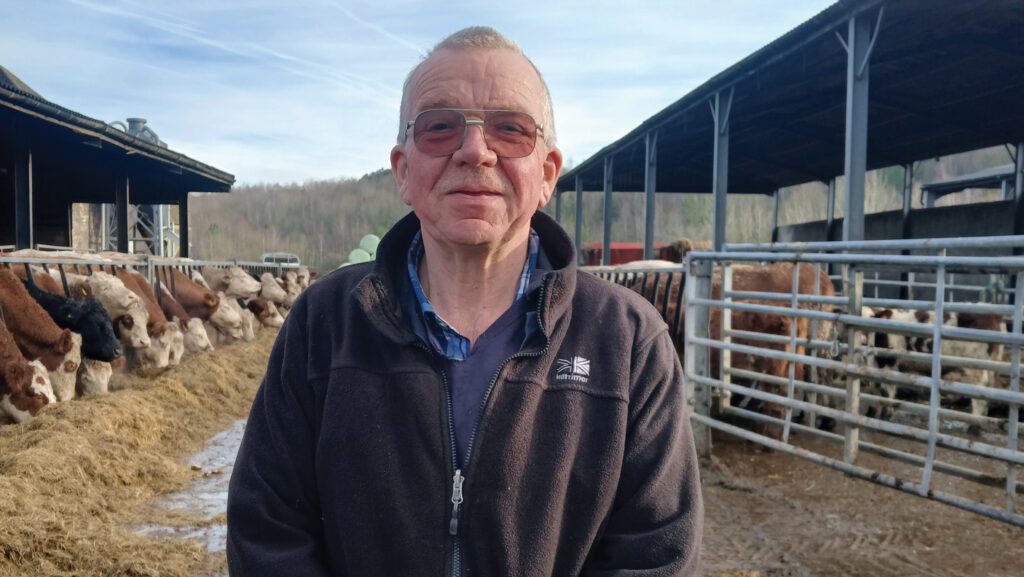
Ian Willison © Ian Willison
Feeding regime
To achieve an R grade, Ian has a strict feeding regime for the autumn-born bull calves.
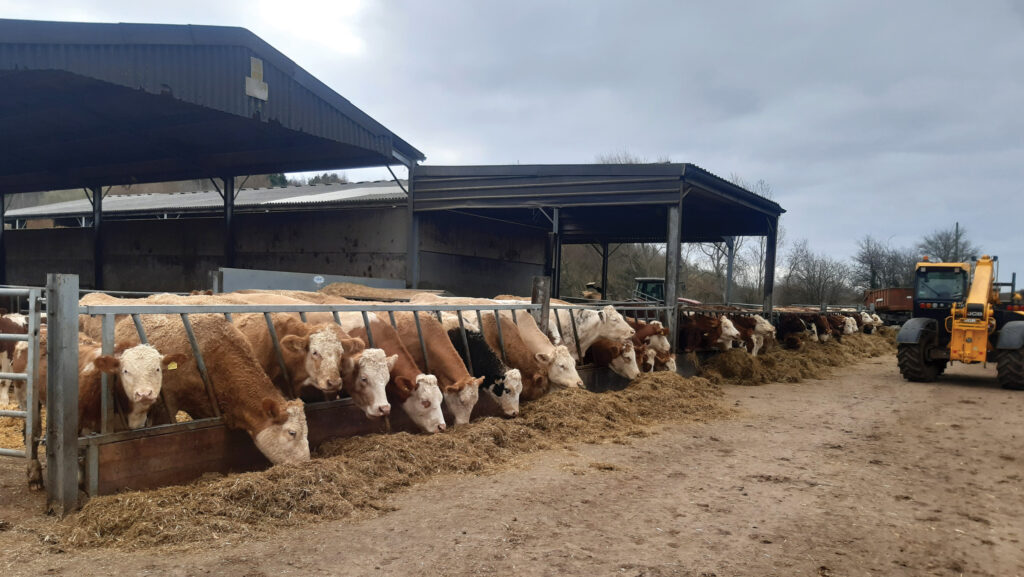
Those born in August go out to pasture with their dams until the end of October, when they are housed and offered ad-lib creep in the form of beef nuts.
They also have access to the cows’ total mixed ration (TMR), which comprises one-third maize silage and two-thirds grass silage, fed ad-lib and consumed at 40kg a cow a day.
Bulls are weaned in April, then fed a finishing ration of two-thirds maize silage and one-third beef nuts, with ad-lib straw.
The ration is adjusted as they grow, offering 13% crude protein and about 11MJ metabolisable energy (ME)/kg dry matter (DM).
Heifers graze with their dams from birth and are weaned in July, grazing until grass quality and quantity deteriorate in September.
They are then fed a finishing ration of equal parts grass silage, maize silage and beef nuts, providing 13% protein and 10MJ ME/kg DM.
By putting the heifers on a finishing ration earlier, Ian has reduced finishing time from 21 months to 16.
© Ian Willison
Carbon efficient
Producing cattle for slaughter more quickly also improves carbon efficiencies, he says.
“We’ve had three carbon audits, and found that the more intensively we finish, the lower the carbon footprint is for the bulls as we’re using fewer planet resources – even if we are buying in feed.”
With processor requirements changing from slower-grown livestock to more carbon-efficient production, Ian says it is worth keeping on top of the sustainability criteria.
“The consumer wants to see a lower carbon footprint and something that’s more sustainable, which means shortening that fattening period.”
A focus on efficiency and getting livestock ready for slaughter has always been key for Ian – with limited housing space, he adds.
He suggests that to achieve steady growth leading to an animal that fulfils processor standards and offers good eating quality, it is best to push animals daily to help them reach their full potential.
“Get at it while it’s young and keep at it. That’s the most efficient way of doing it,” he says.
Ian Willison’s top tips for meeting market specification
- Identify your market specification and tailor your production system accordingly
- Balance market demand with farm capabilities to ensure profitability
- Focus on producing healthy animals, providing the best care possible
- Adapt to market changes to meet consumer demand
- Attend live-to-dead events to understand how to best select animals